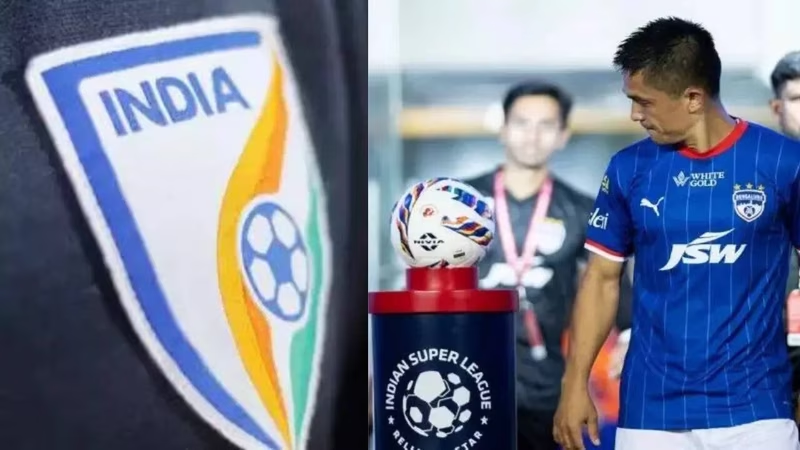
In a bitter pill for Indian football fans and stakeholders alike, the Asian Football Confederation (AFC) has delivered a double-edged verdict: while it has granted formal approval for a **shortened Indian Super League (ISL) season**, it has simultaneously stripped Indian clubs of their **direct entry into the AFC Champions League 2 (ACL 2)**. The reason? India failed to fulfill the AFC’s minimum requirement of 24 competitive matches—combining league and domestic cup fixtures—for its top-tier clubs.
This decision marks a significant blow to the country’s growing football ecosystem, which had been steadily gaining traction on the continental stage. With no automatic berth, Indian teams must now navigate a more arduous qualification path just to earn a spot in Asia’s second-tier club competition—let alone dream of the elite AFC Champions League Elite. For a sport striving for global relevance in a cricket-dominated nation, this setback couldn’t come at a worse time.
Table of Contents
- Why Indian Clubs Lose AFC Entry
- The 24-Match Rule and AFC Regulations
- Impact on Indian Football Development
- Historical Context: India’s AFC Journey
- What Next for AIFF and ISL?
- Conclusion: A Wake-Up Call for Indian Football
- Sources
Indian Clubs Lose AFC Entry: The Core Issue
The root cause lies in the chaotic scheduling of India’s domestic football calendar. Due to repeated delays—stemming from clashes with international tournaments, administrative indecision, and logistical bottlenecks—the 2025–26 ISL season was pushed into a compressed window. To salvage the season, the All India Football Federation (AIFF) proposed a truncated format, which the AFC reluctantly accepted to avoid complete cancellation.
However, even with the inclusion of the Super Cup (India’s premier domestic knockout tournament), the total number of official matches per club falls short of the **mandatory 24**. Without meeting this benchmark, the AFC cannot grant direct qualification rights—a rule designed to ensure clubs gain sufficient competitive experience before representing their nation in continental competitions.
The 24-Match Rule and AFC Regulations
The AFC’s Club Licensing Regulations are clear: for a member association to secure direct slots in ACL 2, its top division must guarantee each participating club a minimum of 24 official matches across league and national cup competitions. This isn’t arbitrary—it’s about quality control.
Clubs from nations like Japan, South Korea, Saudi Arabia, and even Vietnam regularly exceed 30+ matches annually. In contrast, many Indian ISL teams often play fewer than 20 games in a full season. The AFC views consistent high-volume competition as essential for tactical maturity, squad depth development, and financial sustainability—all critical for surviving the rigors of continental football.
Impact on Indian Football Development
Losing direct AFC entry has far-reaching consequences:
- Reduced Exposure: Fewer Indian clubs in ACL 2 means less international experience for players and coaches.
- Financial Loss: Participation guarantees prize money, broadcasting revenue, and sponsorship opportunities—now at risk.
- Recruitment Challenges: Top foreign players may shy away from leagues that offer no continental pathway.
- Youth Development Setback: Aspiring talents lose motivation when the dream of playing in Asia feels distant.
For context, Bengaluru FC’s historic run to the 2016 AFC Cup final not only brought glory but also inspired a generation of young footballers across Karnataka and beyond. Without regular continental access, such moments may become rare.
Historical Context: India’s AFC Journey
India’s relationship with AFC competitions has always been turbulent. While East Bengal and Mohun Bagan dominated regional tournaments in the 2000s, systemic issues—lack of professionalism, poor infrastructure, and inconsistent calendars—prevented sustained success. The launch of the ISL in 2014 was meant to change that narrative.
For a brief period, it worked. ATK, Chennaiyin FC, and Hyderabad FC all featured in AFC competitions. But without a unified league structure (the I-League vs. ISL divide) and chronic scheduling issues, progress stalled. Now, with Indian clubs lose AFC entry becoming a recurring headline, the dream of competing with Asia’s best feels further away than ever.
What Next for AIFF and ISL?
The AIFF faces an urgent reckoning. To regain AFC trust, it must:
- Unify the domestic calendar under a single-window system, eliminating overlaps with national team duties.
- Mandate a minimum 22-game ISL season plus a robust Super Cup format to hit the 24-match threshold.
- Invest in grassroots and reserve leagues to build squad depth capable of handling fixture congestion.
- Engage proactively with the AFC rather than seeking last-minute exemptions.
Failure to act could see India relegated to the third-tier AFC Challenge League—a scenario no serious footballing nation wants.
Conclusion: A Wake-Up Call for Indian Football
The news that Indian clubs lose AFC entry is more than an administrative footnote—it’s a stark warning. Approval for a shortened ISL might save the 2026 season, but it doesn’t fix the structural rot beneath. If Indian football is to truly rise, it needs long-term vision, not quick fixes. The ball is now in the AIFF’s court—and millions of fans are watching. For a deeper dive into India’s football governance challenges, see our analysis on [INTERNAL_LINK:future-of-indian-football].
Hæ, ég vildi vita verð þitt.