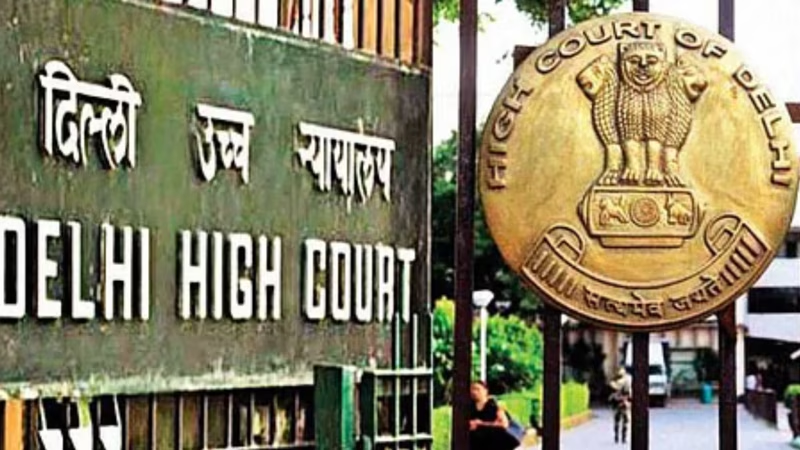
For millions of Indian cancer patients, hope just got more affordable. In a precedent-setting ruling, the Delhi High Court has dismissed a patent injunction sought by global pharma giant Roche, paving the way for Zydus Lifesciences to launch its biosimilar version of trastuzumab—a critical drug used to treat HER2-positive breast cancer .
This decision isn’t just a legal win for an Indian company; it’s a lifeline for countless families burdened by the exorbitant cost of cancer therapy. While the original drug, sold under the brand name Herceptin, can cost upwards of ₹1.5–2 lakh per cycle, Zydus’s biosimilar is expected to be priced at less than one-third of that—potentially saving patients over ₹10 lakh per full course of treatment .
Table of Contents
- What Is the Zydus Biosimilar—and Why It Matters
- The Legal Battle: Roche vs. Zydus Over Patent Rights
- Delhi HC Ruling: A Win for Public Health
- How Biosimilars Work—and Why They’re Safe
- Impact on Indian Cancer Patients: Cost and Access
- Global Context: India as a Hub for Affordable Medicines
- Conclusion: A Step Toward Health Equity
- Sources
What Is the Zydus Biosimilar—and Why It Matters
The Zydus biosimilar replicates trastuzumab, a monoclonal antibody that targets HER2 proteins in aggressive forms of breast and gastric cancers. For patients with HER2-positive tumors—which account for about 20% of all breast cancer cases—this drug can be the difference between remission and rapid progression .
Biosimilars are not generic copies (like those for small-molecule drugs) but highly similar versions of complex biologic medicines. They undergo rigorous testing to ensure they match the original in safety, purity, and potency—but at a fraction of the cost.
The Legal Battle: Roche vs. Zydus Over Patent Rights
Roche, the Swiss originator of Herceptin, filed a lawsuit claiming that Zydus’s biosimilar infringed on its secondary patents related to manufacturing processes and formulations. The company sought an injunction to block the launch, arguing that such patents were still valid in India .
However, the Delhi High Court ruled that these secondary patents did not meet the threshold of “inventive step” required under Section 3(d) of the Indian Patents Act—a provision famously used to deny Novartis a patent on Glivec in 2013, thereby enabling affordable generics for leukemia patients .
The court emphasized that public health must prevail over evergreening tactics—where companies extend monopolies through minor modifications rather than true innovation.
Delhi HC Ruling: A Win for Public Health
This judgment reaffirms India’s commitment to balancing intellectual property rights with the right to health. By allowing the Zydus biosimilar to enter the market, the court has:
- Expanded access to essential cancer medicine for middle- and low-income patients.
- Encouraged domestic innovation in biopharmaceuticals.
- Set a strong precedent for future biosimilar approvals in oncology and autoimmune diseases.
As Dr. Rajesh Dikshit, Chief of Oncology at Tata Memorial Hospital, noted: “Affordability is the biggest barrier to cancer care in India. This ruling could change that overnight.”
How Biosimilars Work—and Why They’re Safe
Unlike chemical generics, biosimilars are made from living cells, making them inherently more complex. But regulatory bodies like India’s Central Drugs Standard Control Organisation (CDSCO) and the European Medicines Agency (EMA) require extensive analytical, non-clinical, and clinical studies before approval .
Key safety assurances include:
- Structural similarity: Near-identical protein structure to the reference product.
- Clinical equivalence: Demonstrated comparable efficacy and safety in trials.
- Pharmacovigilance: Ongoing monitoring post-launch for adverse effects.
For more on how biosimilars are regulated, see our guide on [INTERNAL_LINK:biosimilars-safety-and-regulation-in-india].
Impact on Indian Cancer Patients: Cost and Access
Breast cancer is the most common cancer among Indian women, with over 160,000 new cases diagnosed annually. Yet, fewer than 30% receive optimal targeted therapy due to cost constraints .
With Zydus’s biosimilar, a full year-long regimen could drop from ₹18–24 lakh to under ₹6 lakh—making it feasible for government schemes like Ayushman Bharat to include it in coverage. State cancer centers may also bulk-procure the drug, further driving down prices.
Global Context: India as a Hub for Affordable Medicines
India has long been the “pharmacy of the developing world,” supplying 60% of global vaccines and 20% of generic medicines. This ruling strengthens its role in biologics—a $400 billion global market dominated by Western firms .
Companies like Biocon, Dr. Reddy’s, and now Zydus are proving that high-quality, affordable biosimilars can be produced domestically. The World Health Organization (WHO) has repeatedly endorsed such efforts as critical to achieving universal health coverage .
Conclusion: A Step Toward Health Equity
The Delhi High Court’s green light for the Zydus biosimilar is more than a corporate victory—it’s a moral one. In a country where cancer treatment often means selling land or taking crippling loans, this decision restores dignity and choice to patients. It sends a clear message: in the battle between profit and people, India will always lean toward the latter.
Sources
- “Delhi HC clears Zydus biosimilar, boosting access to affordable cancer care.” Times of India, January 12, 2026.
- Indian Council of Medical Research (ICMR). “Cost of Cancer Therapy in India – 2025 Report.”
- American Cancer Society. “HER2-Positive Breast Cancer.” cancer.org.
- Supreme Court of India. Novartis AG v. Union of India, (2013) 6 SCC 1.
- Central Drugs Standard Control Organisation (CDSCO). “Guidelines on Similar Biologics.” Ministry of Health, Govt. of India.
- National Cancer Registry Programme. “Estimated Incidence of Breast Cancer in India – 2025.” ICMR.
- World Health Organization. “Access to Biological Medicines.” who.int.