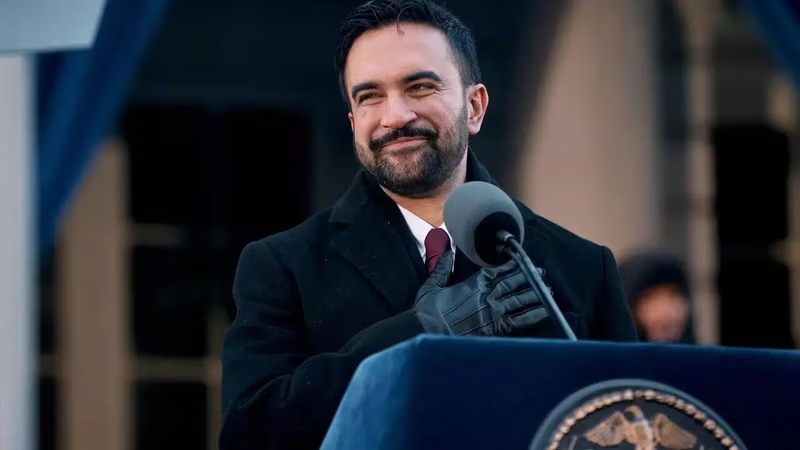
In a moment that blended personal heritage with public service, Zohran Mamdani was sworn in as New York City’s mayor on Wednesday, January 1, 2026—ushering in a new era for America’s largest metropolis. But it wasn’t just his policy platform that captivated millions. It was his simple, powerful phrase during his oath: “To my family, from Kampala to Dilli”—a line that instantly went viral and crystallized a generation’s transnational identity.
Table of Contents
- A Historic Milestone for New York
- Zohran Mamdani New York Mayor: Who Is He?
- The Viral Oath-Taking Moment Explained
- Family Roots and Diasporic Identity
- Policy Vision: Affordability and Inclusion
- Why This Matters for the Global Diaspora
- Reactions from Around the World
- Conclusion: A New Chapter for American Politics
- Sources
A Historic Milestone for New York
Zohran Mamdani’s inauguration isn’t just another mayoral transition—it’s a watershed moment in U.S. political history. At 34, he becomes the youngest person ever elected mayor of New York City, and more significantly, the first South Asian and first Muslim to hold the office. His landslide victory in November 2025 signaled a dramatic shift in the city’s political landscape, driven by a coalition of young voters, working-class communities, and the ever-growing diaspora.
But what truly set his swearing-in apart was its emotional resonance. While most political speeches focus on budgets or infrastructure, Mamdani opened his heart—and his family story.
Zohran Mamdani New York Mayor: Who Is He?
Born in Kampala, Uganda, in 1991, Zohran Mamdani is the son of two globally renowned intellectuals: Mahmood Mamdani, a Ugandan-Indian political scientist and professor at Columbia University, and Mira Nair, the Oscar-nominated Indian filmmaker behind classics like Monsoon Wedding and Salaam Bombay!.
The family moved to the United States when Zohran was a child. He grew up between New York and Delhi, attending elite schools but remaining deeply attuned to issues of inequality and housing justice. He became a U.S. citizen in 2018 and quickly rose through local politics, first as a community organizer in Queens and later as a New York State Assembly member representing Astoria.
His campaign for mayor centered on a bold slogan: “Housing for All.” He promised to build 200,000 units of truly affordable housing, cap subway fares, and challenge corporate landlords—a platform that resonated powerfully in a city where median rent exceeds $4,000.
The Viral Oath-Taking Moment Explained
During his inaugural address at City Hall, Mamdani paused and said: “I stand here today not just as your mayor, but as a son. To my family—from Kampala to Dilli—I thank you.”
The phrase “Kampala to Dilli” struck a chord far beyond New York. For millions in the South Asian and African diasporas, it encapsulated a lived reality: being rooted in multiple continents, languages, and cultures. Social media exploded with tributes, memes, and personal stories. #KampalaToDilli trended globally on X (formerly Twitter), with users from Nairobi to Toronto sharing their own family migration maps.
Family Roots and Diasporic Identity
Mamdani’s lineage reflects the complex tapestry of post-colonial migration:
- Kampala: His paternal grandfather was part of the Indian diaspora in East Africa, a community expelled by Idi Amin in 1972.
- Delhi: His mother, Mira Nair, was born in Rourkela, Odisha, and raised in Delhi—a city that remains a cultural touchstone for the family.
- New York: The city where Zohran came of age and launched his political career.
This tri-continental identity isn’t just symbolic—it shapes his worldview. In interviews, he’s spoken about how watching his mother film in Mumbai slums and his father analyze post-colonial states gave him a unique lens on urban inequality.
Policy Vision: Affordability and Inclusion
Beyond symbolism, Mamdani’s administration promises concrete change. His first 100-day plan includes:
- A citywide rent freeze for units under $3,000/month.
- Expansion of the “Housing Our Neighbors” program to convert vacant offices into affordable units.
- Creation of a Diaspora Engagement Office to connect NYC with global migrant communities.
- Free public transit for all students and seniors.
For more on urban policy innovations, see our deep dive on [INTERNAL_LINK:affordable-housing-models-in-global-cities].
Why This Matters for the Global Diaspora
Mamdani’s rise is a beacon for diaspora communities who’ve long felt politically invisible. According to the Migration Policy Institute, over 5 million Americans claim South Asian heritage—and that number is growing fast [[MPI]]. Yet representation in executive office has lagged.
His victory signals that identity and policy aren’t mutually exclusive. You can honor your roots while fighting for universal housing. You can say “Dilli” and “NYC” in the same breath—and mean both.
Reactions from Around the World
Indian Prime Minister Narendra Modi tweeted his congratulations, calling it a “proud moment for the Indian diaspora.” Ugandan President Yoweri Museveni praised Mamdani’s “African-Asian synthesis.” Even Hollywood stars like Mindy Kaling and Hasan Minhaj shared celebratory posts.
Back in Queens, where Mamdani once organized tenant unions, residents held street parties. “He’s one of us,” said Maria Gutierrez, a Bronx schoolteacher. “He understands what it’s like to choose between rent and groceries.”
Conclusion: A New Chapter for American Politics
Zohran Mamdani’s journey—from Kampala to Dilli to City Hall—is more than a personal triumph. It’s a cultural milestone that redefines what leadership looks like in 21st-century America. As Zohran Mamdani New York mayor, he carries not just a mandate for policy change, but a powerful message: that your heritage is not a barrier to power—it’s your compass.
Sources
- Times of India. “‘Kampala to Dilli’: New York Mayor Zohran Mamdani’s oath-taking moment; speech goes viral.” https://timesofindia.indiatimes.com/world/us/kampala-to-dilli-new-york-mayor-zohran-mamdanis-oath-taking-moment-speech-goes-viral/articleshow/126299536.cms
- Migration Policy Institute. “Indian Immigrants in the United States.” https://www.migrationpolicy.org/article/indian-immigrants-united-states