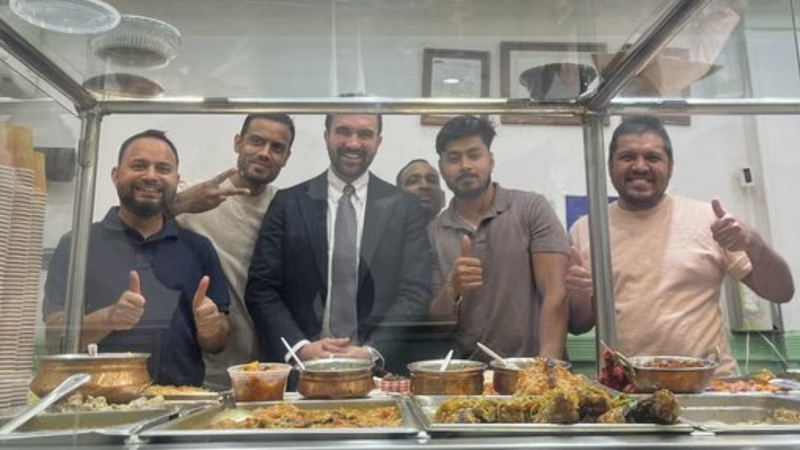
On the first day of the new year, as the clock ticked past midnight and New York City officially welcomed its 112th mayor, the air in City Hall wasn’t filled with the usual staid formalities. Instead, it pulsed with the infectious energy of Punjabi Bhangra beats, a soundtrack that would perfectly set the stage for a historic, and deeply symbolic, first meal for the city’s new leader, Zohran Mamdani .
Mamdani, who was sworn in as New York City’s first South Asian and Muslim mayor, didn’t just take an oath; he celebrated a homecoming. His choice to groove to Punjabi music and then savor a plate of comforting Bengali Aloor Dum wasn’t just a personal preference—it was a powerful declaration of his identity and a tribute to the communities that have shaped his journey and the very fabric of New York City .
Table of Contents
- A Night of Firsts: A Historic Inauguration
- The Symbolism of Zohran Mamdani’s First Meal
- Why Bengali Food Matters in Queens and Beyond
- The Enduring Power of Punjabi Beats in NYC
- A Mayor Who Reflects the Soul of the City
- Summary: The Future is Flavorful
- Sources
A Night of Firsts: A Historic Inauguration
January 1st, 2026, wasn’t just a new year; it was a new era for New York. The inauguration of Zohran Mamdani was a watershed moment, marking him as the city’s first mayor of South Asian descent and its first Muslim mayor . Born in Kampala, Uganda, and raised in the heart of one of the world’s most diverse boroughs, Queens, Mamdani’s path to City Hall is a story of the city’s immigrant spirit .
The ceremony itself was a vibrant reflection of his journey and his city. A Toronto-based Punjabi artist, Babbulicious, closed the event with a high-energy performance that had the new mayor himself singing along, a moment that quickly went viral [[7], [8]]. This wasn’t just entertainment; it was a statement that New York’s official story now includes the rhythms of its vast Punjabi community, particularly strong in neighborhoods like Richmond Hill and Bellerose .
The Symbolism of Zohran Mamdani’s First Meal
If the music was the city’s pulse, the food was its soul. Following the energetic Punjabi finale, Mamdani sat down for his first official meal as mayor. He didn’t choose a power lunch of steak and potatoes. He chose a plate that told his own story: Bengali Aloor Dum—a rich, spiced potato curry—paired with Nepali Tingmo, a soft, steamed bread .
This choice was profound. It wove together two of the largest and most influential South Asian communities in New York. While Mamdani’s personal connection to Bengali culture is a key part of his identity, his embrace of Punjabi culture speaks to his broader vision. It’s a vision of a city where every thread of its diverse tapestry is not just visible, but celebrated at the highest levels of power.
Why Bengali Food Matters in Queens and Beyond
The choice of Bengali food is more than a personal nod. The Bangladeshi-born immigrant population has been one of the fastest-growing demographics in New York City for decades, with a massive community centered in places like Jackson Heights and the Bronx .
From the bustling streets of what’s known as the “100 Languages” stretch on Roosevelt Avenue in Queens, Bengali businesses, from sweet shops to textile stores, have become a cornerstone of the local economy and culture [[14], [18]]. The mayor’s choice of Aloor Dum was a powerful signal to this community—a recognition of their strength, their spirit of solidarity, and their immense contribution to the city’s life .
The Enduring Power of Punjabi Beats in NYC
Similarly, the Punjabi Bhangra beats that closed the inauguration are the heartbeat of another massive New York community. The Punjabi-speaking population has been a vibrant part of the city since the 1960s, contributing immensely to its social, cultural, and economic vitality .
Their presence is marked by grand Gurdwaras (Sikh temples) and the energetic music that filled City Hall. By choosing this music for his historic night, Zohran Mamdani was acknowledging a community that has long been a pillar of New York’s South Asian identity. He was saying, “Your joy, your culture, is now the city’s official joy.”
A Mayor Who Reflects the Soul of the City
Mamdani’s background is a microcosm of New York itself. From his Ugandan birth to his upbringing in Cape Town and then in the hyper-diverse landscape of Queens, his life is a story of movement, adaptation, and the creation of a new, layered identity . His political awakening happened on the streets of a city that, as the saying goes, has a flavor for every tongue and a rhythm for every heart .
His first act as mayor—a fusion of Punjabi music and Bengali cuisine—wasn’t just a personal celebration. It was a masterclass in symbolic politics. It was a way to instantly connect with two of the city’s most dynamic communities and send a message of inclusion to all. He is a mayor who doesn’t just govern a diverse city; he is of that city. For more on the politics of identity in public office, see our deep dive on [INTERNAL_LINK:representation-in-government].
Summary: The Future is Flavorful
Zohran Mamdani‘s first day as mayor will be remembered not for a policy announcement, but for a plate of food and a song. This simple yet profound act has set a new tone for his administration—one that is rooted in the lived experiences and vibrant cultures of New York’s people. By honoring both Bengali and Punjabi traditions on his very first night, he has promised a future where the city’s incredible diversity isn’t just tolerated, but is its guiding principle and its greatest source of pride. The future of New York, it seems, is not just bright—it’s delicious and full of rhythm.