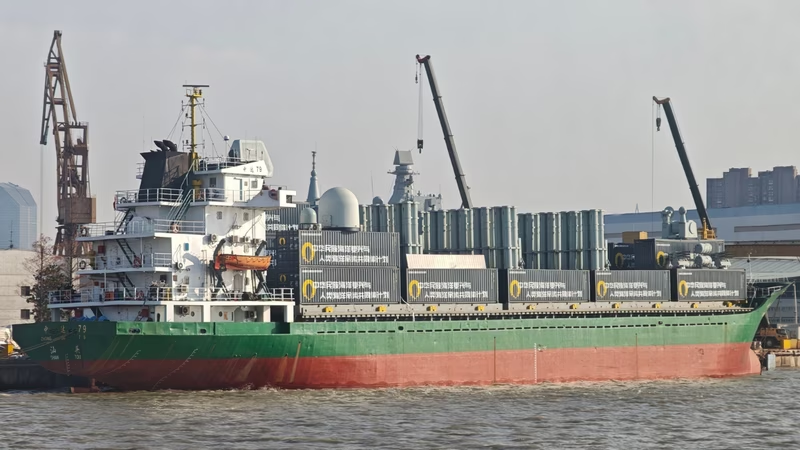
Imagine a standard cargo ship docked in a busy commercial port. Now picture it bristling with 60 missile launchers, advanced radar arrays, and close-in weapon systems (CIWS). This isn’t a scene from a dystopian thriller—it’s the new reality of China’s maritime strategy, embodied by the Zhongda 79 cargo ship missiles configuration [[1], [5]].
China’s conversion of the 97-meter feeder vessel into a formidable arsenal ship is more than a technical feat; it’s a strategic masterstroke with chilling implications for regional stability, especially concerning Taiwan. This article unpacks the technical details, strategic rationale, and global ramifications of this unprecedented move.
Table of Contents
- The Zhongda 79 Revealed: From Cargo to Cruiser
- Zhongda 79 Cargo Ship Missiles: A Technical Breakdown
- The Strategic Genius (and Risk) of Civilian Vessel Weaponization
- Hypersonic Threat: Assessing the Missile Arsenal
- The US Navy Comparison and the VLS Gap
- Conclusion: A New Era of Asymmetric Naval Warfare
- Sources
The Zhongda 79 Revealed: From Cargo to Cruiser
The Zhongda 79 was once an unremarkable commercial container ship, sailing under China’s flag with a standard 97-meter length and 16-meter width . That all changed when it was spotted at a Shanghai shipyard undergoing a radical transformation between April and August 2025 .
Published images show the vessel now outfitted with containerized launchers, advanced radars, and defensive CIWS systems . This conversion effectively blurs the line between civilian and military assets, a tactic that offers Beijing significant strategic ambiguity .
Zhongda 79 Cargo Ship Missiles: A Technical Breakdown
The ship’s new armament is its most striking feature. It has been fitted with containerized vertical launch systems (VLS) arranged in a 5-by-3 grid, with each unit housing four large launch tubes. This configuration yields a total of 60 missile cells .
These aren’t just any missiles. The launchers are believed to be capable of deploying a range of China’s most advanced weaponry, including hypersonic anti-ship ballistic missiles like the DF-21D, which are notoriously known as “carrier killers” due to their ability to target and destroy large naval vessels like US aircraft carriers .
The Strategic Genius (and Risk) of Civilian Vessel Weaponization
Why would China choose to arm a civilian cargo ship? The reasons are multifaceted and point to a doctrine of asymmetric warfare.
- Force Multiplication: By converting hundreds of its vast civilian merchant fleet into potential combat platforms, China can rapidly scale its naval firepower without the cost and time of building dedicated warships.
- Strategic Deception: In the fog of war, an armed cargo ship can operate in commercial shipping lanes, making it difficult for adversaries to identify and target military assets until it’s too late. This creates a significant intelligence and targeting challenge .
- Rapid Deployment: The containerized nature of these weapon systems means they can be installed or removed quickly, allowing for flexible and deniable military posturing .
Hypersonic Threat: Assessing the Missile Arsenal
The true danger of the Zhongda 79 lies in its potential payload. China’s hypersonic arsenal includes systems like the YJ-21 and DF-21D, which can travel at speeds exceeding Mach 5 and perform evasive maneuvers that make them nearly impossible for current missile defense systems to intercept [[11], [12]].
The DF-21D, for instance, has a range of up to 2,150 kilometers and can carry either a conventional or nuclear warhead [[19], [20]]. Deploying such a weapon from a disguised civilian vessel in the South China Sea or near Taiwan would compress decision-making timelines for any defending force, creating a highly volatile scenario.
The US Navy Comparison and the VLS Gap
This move is also a direct response to the US Navy’s overwhelming advantage in vertical launch system capacity. As of recent analyses, the US Navy possesses around 8,400 VLS cells across its fleet, compared to China’s 4,300 .
While China is actively closing this gap with new destroyers and cruisers, the Zhongda 79 represents a novel and cost-effective way to add significant missile capacity almost overnight . It’s a clear signal that Beijing is not just building a blue-water navy; it’s redefining the very concept of a naval fleet by integrating its massive commercial maritime infrastructure into its defense strategy.
For deeper insights into naval modernization, see our related coverage on [INTERNAL_LINK:china-navy-modernization] and [INTERNAL_LINK:us-navy-vls-capacity].
Conclusion: A New Era of Asymmetric Naval Warfare
The Zhongda 79 cargo ship missiles project is a watershed moment in 21st-century naval warfare. It demonstrates China’s willingness to innovate beyond traditional military boundaries, leveraging its dual-use civilian infrastructure for strategic military advantage. For Taiwan and its allies, this development is a stark reminder of the evolving and increasingly sophisticated nature of the threat from Beijing. The era of the armed merchantman is back, and it’s more dangerous than ever.
Sources
- Times of India: China’s maritime escalation: Zhongda 79 cargo ship armed with 60 missiles
- MarineTraffic: ZHONGDA79 (MMSI 412469140) Cargo Ship Details
- Center for Strategic and International Studies (CSIS): DF-21 (CSS-5) Missile Threat Profile
- U.S. Naval Institute: China’s Arsenal Ship Experiment: Implications for Naval Strategy
- Defense News: China closes VLS gap with US Navy through innovative platforms