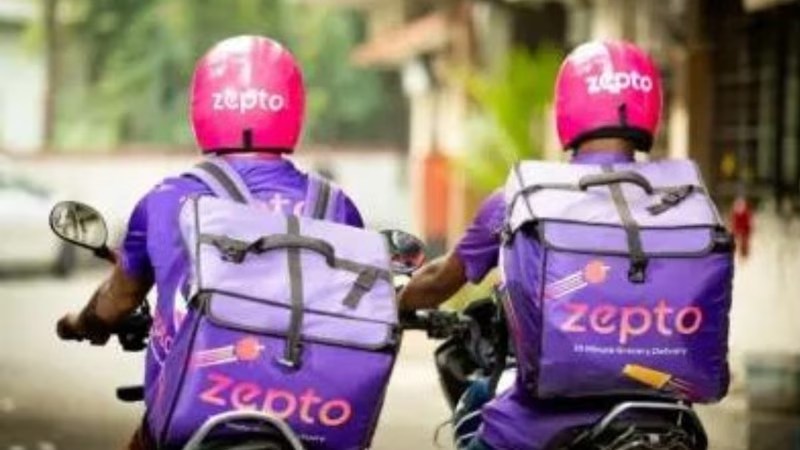
In a move that’s set to electrify India’s startup and investment ecosystem, Zepto—the lightning-fast e-commerce disruptor—has officially filed its draft red herring prospectus (DRHP) with the Securities and Exchange Board of India (SEBI) . The company is aiming for a blockbuster initial public offering (IPO) in 2026, targeting a massive fundraising goal of **Rs 11,000 crore**.
This landmark filing isn’t just another startup going public; it’s a pivotal moment for the entire ‘quick commerce’ sector. Founded by teenage Stanford dropouts Aadit Palicha and Kaivalya Vohra, Zepto has grown from a scrappy Mumbai experiment into a formidable player valued at over $5 billion . Now, by stepping onto the public stage, Zepto is inviting every retail investor in India to become a part-owner of its ambitious 10-minute delivery dream.
Table of Contents
- What the Zepto IPO Filing Tells Us
- The Zepto Story: From Stanford to Quick Commerce King
- How Zepto Stands Against Zomato and Swiggy
- The State of India’s Quick Commerce Market
- What Investors Should Watch Before the Listing
What the Zepto IPO Filing Tells Us
The filing of the draft papers with SEBI is the first formal step in a long and rigorous IPO process. Zepto has opted for the confidential route, which allows it to keep its financial details under wraps until closer to the actual market launch—a common strategy among high-growth tech firms .
Key takeaways from the announcement so far:
- Issue Size: A substantial **Rs 11,000 crore**, which would make it one of the largest tech IPOs in India in recent years.
- Timing: Planned for 2026, giving the company ample time to refine its business model, improve unit economics, and meet all regulatory requirements.
- Structure: The issue will likely comprise a fresh issue of shares to raise capital for growth and an Offer for Sale (OFS) component, allowing early investors and founders to partially exit.
The proceeds from the **Zepto IPO** are expected to fuel its aggressive expansion plans, including entering new cities, enhancing its technology platform, and strengthening its dark store network—the backbone of its 10-minute delivery promise.
The Zepto Story: From Stanford to Quick Commerce King
Zepto’s origin story reads like a Silicon Valley fairy tale, but it’s firmly rooted in Mumbai’s local markets. In 2021, 19-year-old Aadit Palicha and 20-year-old Kaivalya Vohra made the bold decision to leave their studies at Stanford University to tackle a simple, yet universal, problem: grocery shopping is a hassle.
They started by rebranding their initial venture from ‘KiranaKart’ to ‘Zepto’ and pioneered the ‘dark store’ model in India. Instead of relying on large, centralized warehouses, Zepto set up hundreds of small, neighborhood-based micro-fulfillment centers. This hyperlocal strategy is what enables them to promise and often deliver everyday essentials in under 10 minutes.
Backed by marquee investors like Glade Brook Capital, Y Combinator, and Nexus Venture Partners, Zepto has raised over $750 million in private funding, rapidly scaling to over 25 Indian cities .
How Zepto Stands Against Zomato and Swiggy
Zepto isn’t entering a vacuum. Its path to an IPO is paved with the precedents set by its food-tech rivals, Zomato and Swiggy, who have already tasted the public markets.
Here’s a quick comparison of the three giants:
| Company | Core Business | IPO Year | Market Cap (Approx.) |
|---|---|---|---|
| Zomato | Food Delivery + Quick Commerce (Blinkit) | 2021 | ~$9 Billion |
| Swiggy | Food Delivery + Quick Commerce (Instamart) | 2024 | ~$8 Billion |
| Zepto | Pure-Play Quick Commerce | 2026 (Planned) | ~$5 Billion (Private) |
While Zomato and Swiggy have diversified into quick commerce as a secondary vertical, Zepto’s entire identity and technology stack are built from the ground up for speed and convenience. This pure-play focus is both its biggest strength and its biggest risk. Investors will be keenly watching its ability to achieve profitability faster than its diversified rivals.
The State of India’s Quick Commerce Market
The market Zepto is betting its future on is booming. The Indian quick commerce sector is projected to grow from a $3 billion market in 2023 to a staggering **$45 billion by 2030**, according to a report by Bain & Company .
This explosive growth is fueled by rising urbanization, increasing smartphone penetration, and a consumer base that increasingly values time over everything else. However, the path to profitability is steep. The model requires massive capital expenditure to build and maintain the dark store network, and customer acquisition costs remain high.
For a deep dive into this high-stakes game, check out our analysis on [INTERNAL_LINK:is-quick-commerce-profitable-in-india].
What Investors Should Watch Before the Listing
While the Rs 11,000 crore target is ambitious, retail investors should keep a close eye on several key metrics before deciding to jump in:
- Unit Economics: Is Zepto making money on each order after accounting for delivery, packaging, and overheads?
- Customer Retention & Frequency: Are users returning for repeat purchases, or is the business reliant on constant discounts?
- Path to Profitability: What is Zepto’s concrete plan to move from heavy losses to a sustainable profit, as demanded by public market investors?
- Regulatory Landscape: How might future regulations around e-commerce or dark stores impact the business model?
The BSE and NSE websites, along with SEBI’s official portal, will be the primary sources for the final, detailed DRHP once it’s made public.
Summary
The **Zepto IPO** filing with SEBI is a watershed moment for India’s startup ecosystem and the quick commerce sector. With a planned Rs 11,000 crore public issue in 2026, the company founded by two Stanford dropouts is now on a direct path to join the league of publicly traded giants like Zomato and Swiggy. Its pure-play, hyperlocal model offers a sharp contrast to its rivals’ diversified strategies. While the market potential is enormous, the journey to profitability remains a significant challenge. For investors, the Zepto listing will be a high-stakes bet on the future of instant gratification in Indian retail.
Sources
- Times of India: Zepto files draft IPO papers with Sebi: Rs 11,000 cr issue planned for next year
- Tracxn: Zepto Company Profile
- Bain & Company: Quick Commerce in India: A $45 Billion Opportunity
- SEBI Official Website: https://www.sebi.gov.in/