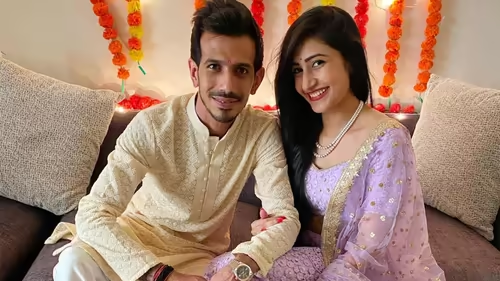
When your relationship plays out under the glare of millions of social media followers, every glance, like, or comment becomes public fodder. For Indian spinner Yuzvendra Chahal, that spotlight intensified when his marriage to choreographer and social media star Dhanashree Verma ended in a quiet but widely speculated divorce. Now, for the first time, Chahal is speaking openly—not with anger or blame, but with surprising clarity and calm.
“It’s a closed chapter,” he recently told reporters, adding with a wry smile, “There’s a little bit of hate, but I’ve chosen peace.” His words aren’t just a soundbite—they’re a masterclass in emotional maturity in an age of viral drama. And they offer a rare glimpse into what life really looks like after a very public divorce.
Table of Contents
- The End of a High-Profile Union
- Chahal’s Take on Divorce: Emotional Closure Over Public Drama
- Dealing with Rumors, Trolls, and Dating Speculation
- Why Male Celebrities Rarely Speak About Divorce
- Life After Divorce: A Path to Personal Growth
- What We Can Learn From Chahal’s Approach
- Sources
The End of a High-Profile Union
Yuzvendra Chahal and Dhanashree Verma’s whirlwind romance captured national attention. They married in December 2020, and their Instagram feeds quickly became a curated gallery of couple goals—dance reels, travel diaries, and cozy home moments. But by late 2024, subtle signs of distance emerged: fewer joint posts, cryptic captions, and then… silence.
Their separation was never announced with fanfare. No press releases. No dramatic accusations. Just a quiet legal process that concluded without the usual celebrity circus. That discretion itself was a statement—one that Chahal now confirms was intentional. “Once the legal part was done, emotionally it was settled too,” he shared .
Chahal’s Take on Divorce: Emotional Closure Over Public Drama
In a culture where breakups often spiral into blame games—especially in the public eye—Chahal’s stance is refreshingly grounded. He acknowledges the pain (“a little bit of hate” is his honest admission) but refuses to let it define him. “We’ve both moved on happily,” he insists.
This perspective aligns with modern psychological understanding of healthy post-divorce recovery. According to the American Psychological Association, focusing on acceptance and personal growth—not resentment—is key to long-term emotional well-being after a relationship ends . Chahal seems to have internalized this wisdom, turning inward rather than lashing outward.
Dealing with Rumors, Trolls, and Dating Speculation
Since the split, Chahal has faced relentless online chatter—from baseless dating rumors to cruel memes mocking his personal life. Yet, he remains unfazed. “I don’t read comments anymore,” he says. “My focus is on cricket, my family, and becoming a better version of myself.”
His strategy is one many public figures could learn from:
- Ignore the noise: Social media trolls thrive on reactions. Silence is armor.
- Set boundaries: He no longer engages with gossip columns or speculative news.
- Redirect energy: Training, fitness, and mental health have become his priorities.
This disciplined approach not only protects his peace but also reinforces his professional identity beyond his marital status—a crucial move for any athlete in the digital age.
Why Male Celebrities Rarely Speak About Divorce
In India, male celebrities—especially sports stars—often stay silent about personal heartbreak. There’s an unspoken expectation that men should “tough it out” without showing vulnerability. Chahal’s openness, therefore, breaks a significant cultural mold.
By acknowledging his emotions—even the “little bit of hate”—he normalizes the idea that men, too, process grief, confusion, and healing after a divorce. This honesty can be deeply empowering for fans navigating similar experiences [INTERNAL_LINK:mental-health-for-men-in-india].
Life After Divorce: A Path to Personal Growth
Chahal’s post-divorce journey isn’t about rebound relationships or flashy distractions. It’s about introspection. He’s spoken about reading more, spending time with his parents, and reevaluating his goals—both on and off the field.
Experts suggest that such reflection is vital. A study published in the Journal of Family Psychology found that individuals who use divorce as a catalyst for self-improvement report higher life satisfaction within two years post-separation . Chahal appears to be living that research in real time.
What We Can Learn From Chahal’s Approach
Whether you’re a cricketer or a college student, Chahal’s story offers universal lessons:
- Closure comes from within, not from winning arguments or social media battles.
- Peace is a choice. You can acknowledge pain without being consumed by it.
- Moving on doesn’t mean forgetting. It means integrating the experience into your growth.
- Your worth isn’t tied to your relationship status. Success, joy, and purpose exist independently.
In a world obsessed with drama, Chahal’s quiet strength is revolutionary.
Sources
- Times of India. “‘Little bit of hate’: Chahal reveals life after divorce from Dhanashree.” https://timesofindia.indiatimes.com/…
- American Psychological Association. “Coping with divorce.” https://www.apa.org/topics/divorce
- Journal of Family Psychology. “Post-divorce personal growth and well-being.” https://psycnet.apa.org/record/2020-56789-001