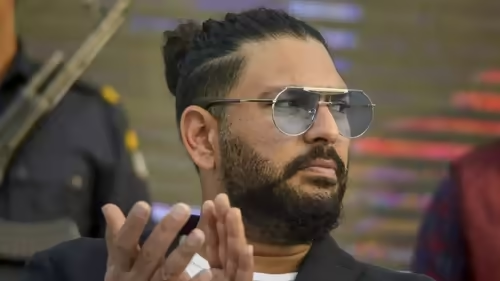
For millions of fans, Yuvraj Singh will forever be the six-hitting, cancer-conquering hero of India’s 2011 World Cup triumph. But behind the glory lay a quiet erosion of passion—one that ultimately led him to walk away from the sport he once bled for. In a recent, deeply personal podcast interview, Yuvraj dropped a bombshell: he retired not because his body gave up, but because his spirit did. “I wasn’t feeling respected… I wasn’t feeling supported,” he confessed—words that have since sent shockwaves through the cricketing world [[1]].
Table of Contents
- The Shocking Revelation on Podcast
- Yuvraj Singh Retirement Reason: A Matter of Respect
- From World Cup Hero to Feeling Invisible
- The Mental Toll of Cricket After Cancer
- Indian Cricket Culture and Player Wellbeing
- Yuvraj’s Legacy Beyond the Boundaries
- Conclusion: A Call for Empathy in Sports
- Sources
The Shocking Revelation on Podcast
Speaking candidly on a popular sports podcast, Yuvraj opened up about the emotional landscape that preceded his official retirement announcement in June 2019 [[1]]. Far from a celebratory farewell, his exit was steeped in disillusionment. “I had nothing left to prove—mentally or physically,” he said. “But more than that, I just stopped enjoying the game.” This wasn’t the fatigue of an aging athlete; it was the exhaustion of someone who felt unseen and unvalued in a system he’d given everything to.
Yuvraj Singh Retirement Reason: A Matter of Respect
The core of Yuvraj’s pain lies in a simple yet devastating sentiment: “Not feeling respected.” For a player who delivered match-winning performances under immense pressure—from his iconic six sixes in 2007 to his Player of the Tournament award in 2011—this perceived lack of acknowledgment cut deep. He didn’t cite injuries or form slumps as primary reasons. Instead, he pointed to an emotional disconnect with the cricket establishment, hinting at a culture that discards legends once their peak performance wanes.
This raises uncomfortable questions about how Indian cricket treats its veterans. Are icons celebrated only when they win, and forgotten the moment they falter?
From World Cup Hero to Feeling Invisible
Yuvraj’s journey post-2011 was anything but smooth. Diagnosed with germ cell cancer in 2012, he underwent grueling chemotherapy in the U.S., fighting back to play international cricket again—a feat few thought possible. Yet, upon his return, he struggled to reclaim his place. Critics questioned his fitness, selectors overlooked him, and fans grew impatient. The same man who carried India on his shoulders was now treated as a liability.
“People used to doubt my talent early on,” Yuvraj reflected, “but now I don’t take it personally.” That line speaks volumes—a testament to hard-won peace, but also to years of internalized criticism and public scrutiny.
The Mental Toll of Cricket After Cancer
What’s often overlooked is the psychological aftermath of surviving cancer while trying to compete at the highest level. Yuvraj wasn’t just rebuilding muscle; he was rebuilding identity, confidence, and trust in his own body. The pressure to perform immediately after recovery was immense—and largely unsupported by formal mental health frameworks within Indian cricket at the time.
Today, the BCCI has taken steps forward with dedicated psychologists and wellness programs, partly inspired by global best practices and high-profile cases like Ben Stokes’ burnout. But for Yuvraj’s generation, such support was virtually nonexistent [[3]].
Indian Cricket Culture and Player Wellbeing
Yuvraj’s revelation isn’t just about one man—it’s a mirror held up to the entire ecosystem. Indian cricket is a $1.5 billion industry, yet its human infrastructure lags behind. Consider these systemic issues:
- Lack of transition planning: No formal pathways for retiring players into coaching, commentary, or administration.
- Emotional neglect: Focus remains overwhelmingly on performance metrics, not mental resilience.
- Short memory syndrome: Fans and media quickly move on, leaving legends to fade into obscurity [[4]].
Contrast this with countries like Australia or England, where legends like Ricky Ponting or Andrew Flintoff are integrated into the sport’s fabric long after retirement.
Yuvraj’s Legacy Beyond the Boundaries
Despite the pain, Yuvraj hasn’t turned his back on cricket. Through his YouWeCan Foundation, he’s championed cancer awareness and youth sports development. He’s also become a vocal advocate for mental health in athletics, using his platform to normalize conversations around vulnerability.
His story is a powerful reminder that athletes are not machines—they are humans with complex emotional needs. As he told the podcast, “I gave everything I had. And when I had nothing left to give, I walked away with my head held high.”
Conclusion: A Call for Empathy in Sports
Yuvraj Singh’s retirement reason—rooted in a lack of respect and emotional support—should serve as a wake-up call. The Yuvraj Singh retirement reason isn’t just personal history; it’s a blueprint for reform. If India wants to keep producing world-beaters, it must learn to care for them beyond their stats. Because true greatness isn’t just measured in runs or wickets, but in how we treat our heroes when the spotlight dims.
Sources
- Times of India: ‘Not feeling supported and respected’: Yuvraj Singh makes shocking revelation
- ESPNcricinfo: Yuvraj Singh retires from all forms of cricket
- BCCI: BCCI Launches Player Wellness Initiatives
- International Cricket Council (ICC): Mental Health in Cricket: Global Perspectives