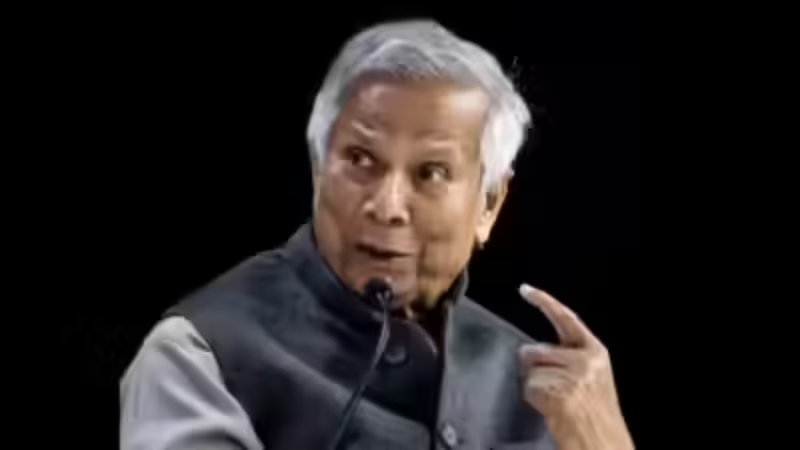
In a striking statement that has ignited fierce debate across South Asia, Bangladesh’s interim government—led by Nobel Peace Prize winner Muhammad Yunus—has categorically denied allegations of recent attacks on religious minorities, calling them “baseless propaganda” designed to destabilize the nation. The denial comes amid mounting reports from local activists, diaspora groups, and international observers detailing incidents of vandalism, intimidation, and violence targeting Hindu, Christian, and Buddhist communities in several districts.
But here’s the troubling part: while the Yunus government minority attacks narrative is being officially rejected, on-the-ground evidence suggests a more complex—and concerning—reality. This isn’t just about political messaging; it’s about the safety of millions of citizens who fear speaking out. So, what’s really going on in Bangladesh?
Table of Contents
- The Official Stance: Yunus Govt Calls It ‘Propaganda’
- What Reports Actually Say: Alleged Incidents Detailed
- Why the Denial? Political Context and Timing
- Voices from the Ground: Minority Communities Speak Out
- International Reaction and Human Rights Concerns
- Conclusion: Truth Amidst the Noise
- Sources
The Official Stance: Yunus Govt Calls It ‘Propaganda’
Speaking at a press briefing in Dhaka, a spokesperson for the interim administration—installed following weeks of civil unrest and the resignation of former Prime Minister Sheikh Hasina—stated: “There is no organized or state-sanctioned violence against minorities. These reports are fabricated by vested interests to tarnish Bangladesh’s image and create chaos during this transitional period.”
The government emphasized its commitment to secularism—a founding principle of Bangladesh—and pointed to increased police patrols in minority neighborhoods as proof of its protective stance. Officials also accused “certain foreign media outlets and opposition-linked NGOs” of exaggerating isolated incidents into a false narrative of systemic persecution.
What Reports Actually Say: Alleged Incidents Detailed
Contrary to the government’s claims, multiple credible sources have documented disturbing events over the past six weeks:
- January 3, 2026 (Rangpur): A Hindu temple vandalized; idols smashed, property looted. Local police filed a report but made no arrests.
- December 28, 2025 (Chittagong): A Christian family forced to flee their home after threats from local extremist groups.
- January 7, 2026 (Khulna): A Buddhist monastery received threatening letters demanding conversion or departure.
These aren’t isolated anomalies. The Human Rights Watch recently noted a “worrying uptick in hate speech and targeted harassment” since the political transition began, particularly in rural areas where law enforcement is weak .
Pattern or Coincidence?
While the Yunus government insists these are random crimes with no communal motive, community leaders argue otherwise. “When three temples are attacked in one week across three districts, and all perpetrators vanish without trace—that’s not coincidence. That’s complicity,” said Rina Das, a Hindu rights activist from Jessore.
Why the Denial? Political Context and Timing
The interim government, led by Muhammad Yunus in an advisory role (though not holding formal executive power), is walking a tightrope. Its primary mandate is to oversee free and fair elections by mid-2026. Admitting to widespread minority insecurity could:
- Trigger international sanctions or travel advisories.
- Alienate key voter blocs ahead of elections.
- Empower hardline Islamist factions that oppose secular governance.
Thus, labeling such reports as “propaganda” serves as a convenient shield—but at the cost of credibility. Critics argue that dismissing legitimate concerns only emboldens aggressors and silences victims.
Voices from the Ground: Minority Communities Speak Out
Despite fear of reprisal, many minority families are breaking their silence. In interviews with regional journalists, dozens described a climate of fear:
“We don’t go out after sunset. Our children are scared to wear religious symbols. The police say they’ll help—but nothing changes,” said Arjun Sen, a shopkeeper in Barisal.
Community leaders have also criticized the lack of proactive protection. [INTERNAL_LINK:religious-freedom-in-south-asia] They point out that while the constitution guarantees equal rights, implementation remains patchy—especially when local officials share ideological sympathies with extremist elements.
International Reaction and Human Rights Concerns
The U.S. Commission on International Religious Freedom (USCIRF) has placed Bangladesh on its “Watch List” for three consecutive years due to deteriorating conditions for non-Muslims. The European Union has also urged the interim government to “ensure the physical security of all citizens, regardless of faith.”
Meanwhile, diaspora groups in the UK, Canada, and the U.S. have organized protests, demanding independent investigations. “Calling truth ‘propaganda’ is the oldest trick in the authoritarian playbook,” said Dr. Farah Khan, a Bangladeshi-Canadian academic specializing in minority rights.
Conclusion: Truth Amidst the Noise
The Yunus government minority attacks controversy reveals a dangerous gap between official rhetoric and lived reality. While the interim administration may be trying to project stability, ignoring or denying violence against vulnerable communities only deepens the crisis. True leadership in this fragile moment requires transparency, not deflection. For Bangladesh’s minorities, justice isn’t propaganda—it’s survival.
Sources
- Original Report: Times of India – Yunus government says reports on attack on minorities is ‘propaganda’
- Human Rights Watch – Bangladesh: https://www.hrw.org/asia/bangladesh
- USCIRF Annual Report 2025: https://www.uscirf.gov/
- Constitution of Bangladesh (Article 28 – Equality of Citizens): https://bdlaws.minlaw.gov.bd/