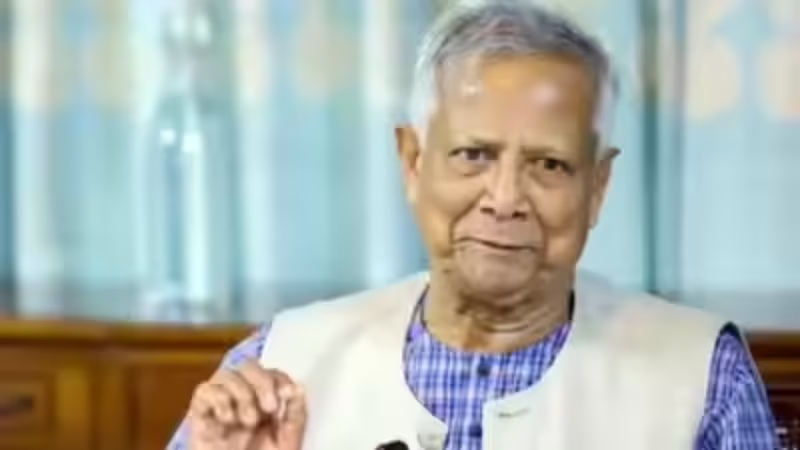
In the wake of a political earthquake that reshaped Bangladesh, a new and deeply troubling crisis has emerged from the shadows: a wave of violence targeting the nation’s religious minorities. At the center of this storm is the Muhammad Yunus-led interim government, which is now facing a barrage of criticism for what many are calling a passive, ineffective, and dangerously slow response to these escalating attacks. The question on everyone’s lips is stark: is the Yunus government failing its most vulnerable citizens?
Table of Contents
- The Crisis Unfolding: A Surge in Violence
- The Yunus Government‘s Response: Too Little, Too Late?
- International Community Sounds the Alarm
- A Historical Pattern or a New Low?
- Conclusion: A Test of Leadership and Justice
- Sources
The Crisis Unfolding: A Surge in Violence
The data paints a grim picture. According to the Bangladesh Hindu Buddhist Christian Unity Council, a staggering 2,442 incidents of attacks on minorities were recorded between August 2024 and June 2025 alone . This isn’t just a series of isolated events; it’s a systemic pattern of intimidation, property destruction, and physical violence. Just in December 2025, ahead of crucial elections, the council reported 51 fresh cases of communal violence [[15], [23]].
The victims are primarily from the Hindu, Buddhist, and Christian communities, who have long been integral parts of Bangladesh’s social fabric. The violence ranges from the desecration of temples and homes to brutal assaults and even murder. In a chilling example, a Hindu journalist was shot dead in Jashore district, a stark reminder of the lethal danger faced by minority members .
The Yunus Government‘s Response: Too Little, Too Late?
The interim administration, led by Nobel laureate Muhammad Yunus, has publicly reaffirmed its commitment to protecting all communities . However, its actions on the ground tell a different story. Human rights organizations and local advocacy groups have slammed the government for its poor investigation and trial processes in these cases . The gap between official statements and the reality experienced by minorities is vast and growing.
Critics argue that the government’s inaction is not just a failure of policy but a tacit signal of permissiveness. The lack of swift arrests, transparent investigations, and successful prosecutions has created an environment of impunity for the perpetrators. This perceived weakness has emboldened extremist elements, leading to a vicious cycle of violence and fear. Former Prime Minister Sheikh Hasina has directly blamed the interim Yunus government for the deteriorating situation and the resulting strain on India-Bangladesh relations .
Why the Probe and Trial Process is Failing
Several key factors appear to be crippling the justice system’s ability to respond effectively:
- Lack of Political Will: The interim nature of the government may have led to a focus on short-term stability over the long, hard work of prosecuting complex communal crimes.
- Institutional Weakness: Law enforcement agencies may be under-resourced, under-trained, or even compromised by local biases, making them ineffective in handling sensitive minority cases.
- Slow Judicial System: Bangladesh’s courts are notoriously backlogged, meaning that even when cases are filed, justice is delayed for years, if it comes at all.
International Community Sounds the Alarm
The international community is watching with deep concern. A UK MP has publicly termed the situation in Bangladesh as ‘concerning’ and called for immediate action to protect minority communities [[3], [22]]. India has also urged its neighbor to take concrete steps to safeguard its religious minorities, highlighting the issue as a matter of bilateral importance .
Human Rights Watch and other major NGOs have issued warnings, stating that the interim government must act decisively to avoid a return to the widespread human rights abuses seen in previous administrations . The world is demanding accountability, and the Yunus government‘s legacy may well be defined by how it handles this critical human rights challenge.
A Historical Pattern or a New Low?
While Bangladesh has a history of sporadic communal violence, the current scale and frequency under the interim government appear to mark a significant escalation . The organized nature of many recent attacks, often occurring in the immediate aftermath of political rallies or during religious festivals, suggests a coordinated effort to destabilize the minority communities.
This is not merely a law-and-order issue; it strikes at the heart of Bangladesh’s constitutional promise of secularism and equal protection for all its citizens. The failure to protect these communities undermines the very foundation of the state and threatens its social cohesion. For many, this moment is a crucial test of whether Bangladesh can live up to its democratic ideals.
Conclusion: A Test of Leadership and Justice
The Muhammad Yunus-led interim government stands at a crossroads. On one path is the continuation of a weak, reactive stance that allows violence against minorities to fester, eroding its credibility both domestically and internationally. On the other is a path of decisive, proactive leadership—launching thorough investigations, ensuring swift and fair trials, and providing tangible security for vulnerable communities.
The choice is clear. To restore trust and uphold its constitutional duties, the Yunus government must move beyond mere rhetoric and demonstrate a genuine, unwavering commitment to justice for all its citizens, regardless of their faith. The world, and more importantly, the people of Bangladesh, are waiting to see which path it will choose. For more on the political landscape of South Asia, see our coverage on [INTERNAL_LINK:bangladesh-politics] and [INTERNAL_LINK:south-asia-human-rights].
Sources
- Times of India: Violence against minorities: Yunus government slammed for poor probe, trial
- Bangladesh Hindu Buddhist Christian Unity Council Reports (as cited in various news sources)
- Human Rights Watch: Bangladesh: Events of 2025
- Ministry of External Affairs, India: Statements on Bangladesh Minority Rights