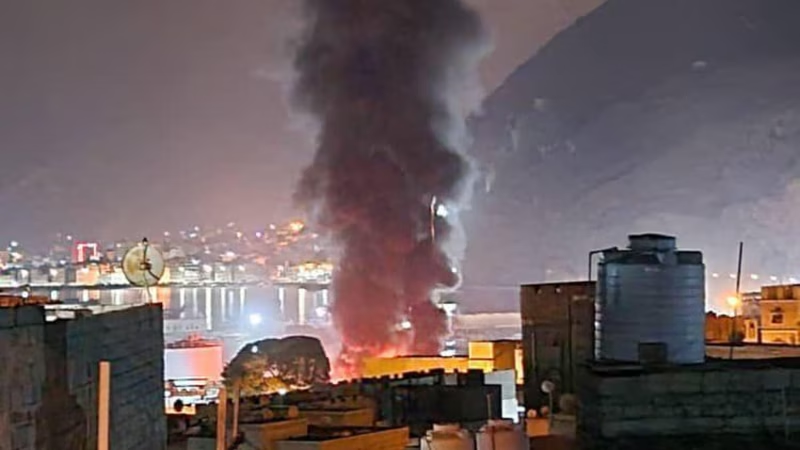
Yemen Declares Emergency After Saudi Arabia Bombs Mukalla Port
In a dramatic and alarming escalation, Yemen has declared a nationwide state of emergency after Saudi Arabian forces launched a devastating airstrike on the port city of Mukalla. The bombing, which targeted critical infrastructure at one of Yemen’s key maritime gateways, has been followed by a strict 72-hour blockade on the city—cutting off essential supplies and deepening a humanitarian crisis that has plagued the country for over a decade.
This sudden surge in hostilities has stunned regional observers and raised urgent questions: What triggered this attack? Who is really behind the crossfire? And could this spark a broader conflagration in the Red Sea corridor—a vital global shipping lane already under strain from Houthi activities? The phrase Yemen emergency Saudi bombing is now at the center of a rapidly unfolding geopolitical storm.
Table of Contents
- What Happened in Mukalla?
- Why Did Saudi Arabia Bomb the Port?
- The 72-Hour Blockade and Humanitarian Impact
- Broader Geopolitical Context
- International Reactions and Diplomatic Fallout
- What Happens Next?
- Conclusion
- Sources
What Happened in Mukalla?
On Monday, multiple airstrikes—attributed to the Saudi-led coalition—hit the port facilities in Mukalla, a major city in Yemen’s Hadhramaut Governorate and a crucial hub for imports, including food, fuel, and medical supplies. According to Yemeni officials, the bombing caused significant damage to warehouses, cranes, and docking infrastructure .
Hours later, Yemen’s government announced a 72-hour emergency blockade on the city, restricting the movement of people and goods in and out of the area. While the official reason cited “security threats,” analysts believe the blockade is also a response to internal political maneuvering and fears of infiltration.
Why Did Saudi Arabia Bomb the Port?
Saudi Arabia has not officially claimed responsibility, but regional sources and military analysts point to intelligence suggesting the port was being used to smuggle weapons—possibly to Houthi rebels in the north or to Iran-aligned militias in the south .
However, this explanation is contested. The internationally recognized Yemeni government, which is backed by Saudi Arabia, actually controls Mukalla. This raises a perplexing question: Why would Riyadh attack its own ally’s territory?
Some experts suggest the strike may have been a message—a show of force aimed at pressuring Yemeni factions to halt alleged backchannel dealings with Tehran. Others believe it could be a case of faulty intelligence or an overreach by coalition forces operating with limited coordination .
The 72-Hour Blockade and Humanitarian Impact
The immediate consequence of the bombing and subsequent blockade is a deepening humanitarian emergency. Mukalla serves as a lifeline for millions in eastern Yemen. Disrupting its operations—even for 72 hours—can have cascading effects:
- Food shortages: Over 60% of Yemen’s wheat imports arrive via southern ports like Mukalla .
- Medical supply delays: Hospitals are already running low on critical medicines.
- Fuel scarcity: Power outages could worsen, affecting water pumps and refrigeration.
- Displacement risk: Civilians may flee the area amid fears of further strikes.
Organizations like the World Food Programme (WFP) have repeatedly warned that any disruption to Yemen’s ports could trigger widespread famine . [INTERNAL_LINK:yemen-humanitarian-crisis-explained]
Broader Geopolitical Context
This incident doesn’t occur in a vacuum. It’s part of a tangled web of regional rivalries:
- Saudi-Iran Proxy Conflict: Yemen has long been a battleground for influence between Riyadh and Tehran.
- Houthi Red Sea Attacks: Since late 2023, Houthi missile and drone strikes on commercial ships have drawn international military responses, including US and UK operations.
- Fragmented Yemeni Governance: The country is effectively split between Houthi-controlled north, the Saudi-backed government in the south, and local separatist movements.
The Mukalla strike may signal Saudi Arabia’s growing frustration with the lack of unified control in southern Yemen and its determination to assert dominance—even at the cost of collateral damage.
International Reactions and Diplomatic Fallout
The international community has responded with cautious concern. The United Nations called for “immediate de-escalation” and urged all parties to protect civilian infrastructure. The US State Department expressed “deep concern” but stopped short of condemning Saudi Arabia, its key Gulf ally .
Meanwhile, Iran has seized the moment to criticize Saudi “aggression,” framing the bombing as evidence of Riyadh’s destabilizing role in the region—a narrative it will likely amplify through its media channels.
What Happens Next?
Three scenarios are possible in the coming days:
- De-escalation: If the blockade lifts after 72 hours without further strikes, this may remain an isolated event.
- Retaliation: Southern Yemeni factions or Iran-aligned groups could respond with attacks on Saudi interests.
- Wider Conflict: If the port remains damaged long-term, supply chain disruptions could fuel unrest, potentially drawing in external powers more directly.
All eyes are now on diplomatic backchannels in Riyadh, Sanaa, and Muscat, where quiet talks may determine whether this flare-up becomes a spark or just a smolder.
Conclusion
The Yemen emergency Saudi bombing of Mukalla port is more than a military strike—it’s a symptom of a region teetering on the edge of broader chaos. With humanitarian needs at a breaking point and geopolitical tensions at an all-time high, this incident serves as a stark reminder that peace in Yemen remains fragile, and the Red Sea remains a powder keg. The world cannot afford to look away.
Sources
- Times of India: Escalation in Mukalla – Yemen declares emergency after Saudi Arabia bombs port
- Reuters: Saudi coalition strikes Yemen port city of Mukalla
- International Crisis Group: Yemen Reports
- UN OCHA: Yemen Port Assessment
- World Food Programme: Yemen Emergency
- U.S. Department of State: Press Briefing