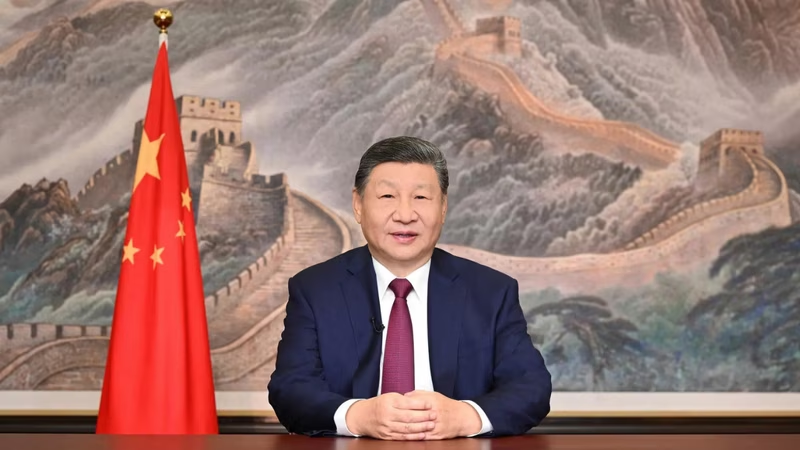
The geopolitical chessboard in the Asia-Pacific has just been shaken. In his 2026 New Year message, Chinese President Xi Jinping delivered a stark and unambiguous declaration: “The reunification of our motherland, a trend of the times, is unstoppable” . This statement wasn’t made in a vacuum. It came on the heels of a massive, two-day military exercise dubbed “Justice Mission 2025,” which saw China’s army, navy, air force, and rocket force mobilize in seven distinct zones encircling Taiwan . The timing is deliberate, the message clear, and the world is watching with bated breath.
Table of Contents
- Xi Jinping’s ‘Unstoppable’ Declaration
- Decoding the ‘Justice Mission 2025’ Drills
- Why the Taiwan Reunification Timeline is Accelerating
- The U.S. Response and Global Ramifications
- What Does This Mean for Taiwan’s Future?
- Conclusion: A Region on the Brink
- Sources
Xi Jinping’s ‘Unstoppable’ Declaration
Xi’s annual New Year address is a highly choreographed event, and his 2026 speech was no exception. The focus on Taiwan reunification was front and center, framed not as a threat but as an inevitable historical force. “The Chinese people on both sides of the Taiwan Strait share a bond of blood and kinship,” he stated, a common narrative from Beijing that emphasizes a shared cultural and ethnic identity .
This move is widely interpreted as a direct signal to both Taipei and its international allies, particularly the United States. The message is that China’s long-stated goal of bringing Taiwan under its control is non-negotiable and its timeline is its own to dictate.
Decoding the ‘Justice Mission 2025’ Drills
The military exercises that preceded Xi’s speech were the largest in recent months. The “Justice Mission 2025” drills were a show of force designed to demonstrate Beijing’s capability and resolve . By deploying its most advanced air, naval, and rocket units in a coordinated, multi-theater operation around the island, China effectively simulated a blockade and potential invasion scenario.
These aren’t mere training exercises; they are political statements conducted with live ammunition. The seven operational zones established around Taiwan are a clear demonstration of the PLA’s (People’s Liberation Army) ability to project power and restrict the island’s access to vital sea and air lanes .
Why the Taiwan Reunification Timeline is Accelerating
Several factors are converging to push this issue to the forefront.
- Domestic Politics in China: For the Chinese Communist Party, the return of Taiwan is a core pillar of its nationalist narrative and a key metric of its historical legitimacy.
- Perceived Shifts in U.S. Policy: Beijing is acutely sensitive to any moves by Washington that it sees as supporting Taiwan’s independence, such as the recent defense policy acts allocating funds for a “Taiwan Security Cooperation Initiative” .
- 2026 as a Pivotal Year: Analysts have long predicted that 2026 could be a critical juncture in the US-China strategic competition, with the Taiwan issue at its core . The region is bracing for a “precarious year” of deepening tensions .
The U.S. Response and Global Ramifications
The United States, bound by its own laws to provide Taiwan with the means to defend itself, finds itself in a delicate balancing act. While it officially adheres to the “One China” policy, its actions—including significant arms sales and diplomatic support for Taiwan’s participation in international forums—rattle Beijing .
The current pause in US-China trade tensions is fragile, and dozens of U.S. lawmakers foresee a potential surge in conflict over the Taiwan issue that could shatter this truce in 2026 . The situation has escalated to a point where serious military planning scenarios for a potential conflict are being openly discussed in U.S. defense circles .
What Does This Mean for Taiwan’s Future?
For the 23 million people in Taiwan, the message from Beijing is a stark reminder of the precariousness of their de facto independence. While the majority of Taiwanese citizens identify as distinct from mainland China and desire to maintain their democratic way of life, they now operate under the shadow of an increasingly assertive neighbor.
Taiwan’s government will likely double down on its own defense modernization efforts and seek to strengthen its informal alliances with the U.S., Japan, and other regional partners, a move that itself could provoke further escalation from Beijing.
Conclusion: A Region on the Brink
The combination of Xi Jinping’s resolute declaration on Taiwan reunification and the massive “Justice Mission 2025” military drills has created a perfect storm of tension in East Asia. This is not just a regional dispute; it is a flashpoint with the potential to draw in global superpowers and reshape the world order. As we move deeper into 2026, all eyes will remain fixed on the Taiwan Strait, a narrow body of water that now carries the weight of global peace and security. For more on the evolving dynamics of global superpowers, check out our deep dive on [INTERNAL_LINK:US-China-Relations].
Sources
- Times of India: ‘Reunification of our motherland unstoppable’: Xi’s message as Taiwan drills end
- Reuters: China says live-fire drills around Taiwan ‘completed’
- Xinhua News Agency: Xi says China’s reunification is unstoppable
- South China Morning Post: Xi Jinping vows to reunify China and Taiwan in New Year’s Eve speech
- NBC News: Xi told Biden reunification is ‘unstoppable’
- The Diplomat: China conducts massive drills around Taiwan in wake of…
- Foreign Policy: 4 ways China-US relations could fracture in 2026