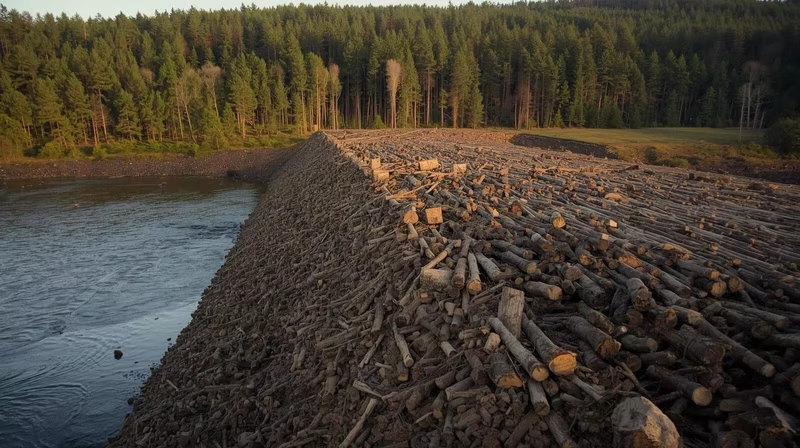
Imagine a structure so vast that astronauts on the International Space Station can spot it from over 250 miles above Earth. Now, imagine that this marvel of engineering wasn’t built by humans, but by a group of industrious rodents with an insatiable appetite for trees. Welcome to the astonishing reality of the world’s largest beaver dam.
Table of Contents
- A Hidden Giant in the Canadian Wilderness
- How Big Is the World’s Largest Beaver Dam, Really?
- Why Can’t Anyone Visit It?
- The Unsung Ecological Heroes: Beavers and Their Dams
- From Nuisance to Ally: Changing Our View of Beavers
- Conclusion: A Testament to Nature’s Power
- Sources
A Hidden Giant in the Canadian Wilderness
For decades, this natural wonder remained a secret, hidden within the dense boreal forests of northern Alberta. It wasn’t until the early 2000s that scientists, poring over satellite images from NASA’s Landsat program, stumbled upon an anomaly—an impossibly long, straight line cutting through the remote wetlands of Wood Buffalo National Park . This park, which straddles the border between Alberta and the Northwest Territories, is a UNESCO World Heritage site and the second-largest national park on the planet—larger than Switzerland itself .
The discovery was a stark reminder of how much of our planet remains unexplored, even in the age of Google Earth. The dam’s location, deep in a roadless, inaccessible part of the park, meant it had likely been under construction for generations of beavers, completely unnoticed by human eyes .
How Big Is the World’s Largest Beaver Dam, Really?
To call it a “dam” almost feels like an understatement. This isn’t just a pile of sticks across a stream; it’s a sprawling, complex megastructure. While initial estimates varied, the most accurate measurements place its length at a staggering 850 meters (2,788 feet) . To put that into perspective, that’s longer than eight American football fields placed end-to-end, or nearly as long as the Burj Khalifa is tall .
Its sheer scale is what makes it visible from space. Satellite imagery clearly shows its dark, sinuous form snaking through the landscape, holding back a significant reservoir of water from the surrounding watershed . This feat of natural engineering dwarfs the typical beaver dam, which usually measures a modest 10 to 100 meters in length.
Why Can’t Anyone Visit It?
Despite its fame, this iconic landmark is virtually off-limits to tourists. Its location is deliberately kept vague by Parks Canada to protect the fragile ecosystem and the beavers themselves from human disturbance . Reaching it would require a grueling multi-day trek through mosquito-infested marshes or an expensive helicopter charter, making it one of the world’s most famous yet least-visited natural wonders. This seclusion has allowed the beavers to continue their work undisturbed, a testament to the power of protected wilderness areas like [INTERNAL_LINK:conservation-parks].
The Unsung Ecological Heroes: Beavers and Their Dams
Far from being simple nuisances that flood backyards, beavers are now recognized by ecologists as “keystone species”—creatures whose impact on their environment is disproportionately large. Their dams are powerful ecological engines that create entire wetland ecosystems.
Water Management Masters
Beaver dams act as natural sponges. They slow down the flow of water during spring runoff and heavy rains, which helps mitigate downstream flooding . During dry summer months, they release this stored water slowly, maintaining stream flows and recharging groundwater aquifers . This increased water retention creates vital oases in otherwise dry landscapes .
Biodiversity Boosters
The ponds created behind these dams become nurseries for fish, amphibians, and insects. The flooded areas attract a wide variety of birds, mammals, and reptiles, significantly boosting local biodiversity . The complex habitat structure provides food and shelter for countless species, turning a simple stream into a thriving ecological hub .
Natural Water Filters
As water pools behind a dam, sediment and pollutants settle to the bottom. This natural filtration process dramatically improves water quality for everything living downstream . In an era of increasing water pollution, this free, natural service is invaluable.
From Nuisance to Ally: Changing Our View of Beavers
Historically, beavers were hunted to near extinction for their fur. Today, we are beginning to see them in a new light—not as pests, but as essential partners in environmental restoration. In many parts of North America and Europe, conservationists are actively reintroducing beavers or installing artificial “beaver dam analogs” to replicate their ecosystem benefits . These efforts aim to restore degraded streams, combat the effects of drought, and even help contain wildfires by creating firebreaks of wet, green vegetation . As one study concluded, beavers “probably don’t have overwhelmingly negative effects on the ecosystem,” a significant understatement given their profound positive impact .
Conclusion: A Testament to Nature’s Power
The world’s largest beaver dam is more than just a curiosity; it’s a powerful symbol. It’s a reminder that nature, left to its own devices, is capable of engineering feats that rival our own. It showcases the incredible, often overlooked, power of a single species to shape an entire landscape for the better. In a world facing climate change and biodiversity loss, the humble beaver and its monumental dam offer a compelling lesson in resilience, sustainability, and the quiet, persistent power of the natural world.
Sources
- Times of India: The world’s largest beaver dam is so big that you can see it from space
- Parks Canada: World’s Largest Beaver Dam – Wood Buffalo National Park [[1], [26]]
- Guinness World Records: Longest beaver dam [[3], [19]]
- EcoInformatics International: The World’s Longest Beaver dam
- One Earth: The benefits of beavers
- Smithsonian Magazine: How reintroducing beavers can enhance ecological health