Women First Election Strategy India: Empowerment or Electoral Opportunism?
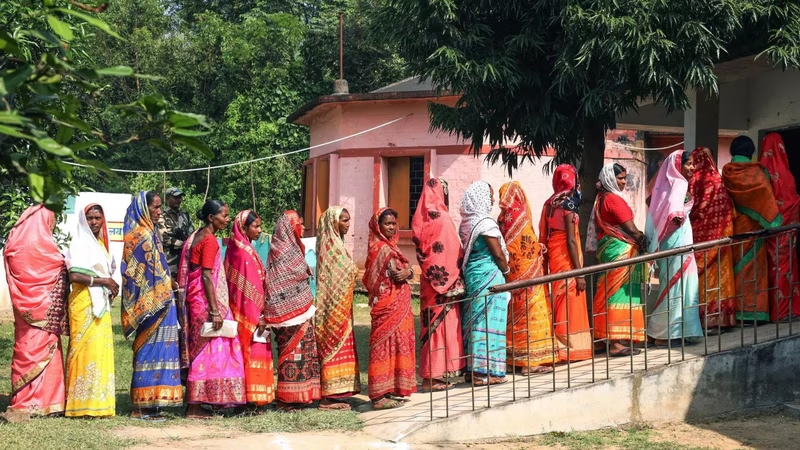
In the high-stakes game of Indian democracy, a new playbook is emerging—and it has women’s names written all over it. Ahead of crucial civic and state elections, both the ruling BJP-led alliance in Maharashtra and the DMK government in Tamil Nadu have rolled out or accelerated women-centric welfare schemes, timed suspiciously close to voting day. Critics cry “vote-buying,” while supporters hail it as long-overdue recognition of women as the true kingmakers of Indian elections. So, is the women first election strategy India deploying a genuine shift toward gender equity—or just another tactical maneuver in the electoral chess match?
Table of Contents
- The Maharashtra Move: Cash Before Ballots
- Tamil Nadu’s Tactic: Expanding the ‘Kalaignar Magalir Urimai’ Scheme
- Why Women Voters Are Now Political Gold
- The Ethical Debate: Welfare or Bribery?
- Historical Context: From Symbolic Gestures to Substantive Shifts
- Conclusion: A Double-Edged Sword for Democracy
- Sources
The Maharashtra Move: Cash Before Ballots
Just days before the February 2026 civic polls in Maharashtra, the state government announced the disbursement of welfare payments directly into the bank accounts of millions of women beneficiaries under various schemes. The Congress party immediately slammed the move as “blatant electioneering,” arguing that these funds—meant for regular social security—were deliberately withheld until the last possible moment to maximize political impact . The optics were undeniable: women across Mumbai, Pune, and Nagpur received SMS alerts about credited amounts mere hours before heading to the polls.
Tamil Nadu’s Tactic: Expanding the ‘Kalaignar Magalir Urimai’ Scheme
Meanwhile, in Tamil Nadu, Chief Minister M.K. Stalin’s DMK government took it a step further. Already running the flagship Kalaignar Magalir Urimai Thogai (Women’s Rights Scheme)—which provides ₹1,000 monthly to women heads of households—the administration recently announced an additional one-time payment of ₹2,000 per beneficiary ahead of upcoming local body elections . Opposition parties, including the AIADMK, accused the DMK of “using public exchequer to buy votes,” noting the uncanny timing just weeks before campaigning began. Yet, the scheme enjoys massive popularity, with over 1 crore women enrolled—a potent electoral base no party can afford to ignore.
Why Women Voters Are Now Political Gold
This strategic pivot isn’t random. Data from the Election Commission of India shows that women’s voter turnout has not only matched but often surpassed men’s in recent state and national elections—particularly in states like West Bengal, Kerala, and Tamil Nadu . More importantly, studies suggest women are more likely to influence household voting decisions and prioritize issues like healthcare, education, and financial security. Recognizing this, parties have shifted from tokenistic “women’s wings” to direct economic outreach:
- Direct Benefit Transfers (DBTs) ensure funds reach women without male intermediaries.
- Conditional cash transfers linked to children’s school attendance or immunization boost social outcomes.
- Asset ownership schemes (like free scooters or gas connections) enhance mobility and dignity.
In essence, empowering women financially has become synonymous with securing votes.
The Ethical Debate: Welfare or Bribery?
The core controversy lies in intent and timing. Is releasing scheduled welfare payments a legitimate government function—or an unethical pre-poll stunt? The Supreme Court of India has previously frowned upon announcements of new schemes within 48 hours of polling, but enforcement remains patchy. Experts argue that if the schemes are part of an approved budget and policy framework, their implementation shouldn’t be delayed for fear of appearing opportunistic. However, deliberately backloading disbursements to coincide with elections crosses an ethical line [[INTERNAL_LINK:india-election-code-of-conduct]]. As one political analyst put it, “Helping women is noble. Weaponizing help for votes is cynical.”
Historical Context: From Symbolic Gestures to Substantive Shifts
India’s journey toward recognizing women as pivotal voters has been gradual. In the 1950s, women’s turnout lagged by over 15 percentage points. By 2019, that gap had vanished—and reversed in many constituencies. Landmark schemes like the UPA’s Nirbhaya Fund or the NDA’s Beti Bachao, Beti Padhao laid groundwork, but they were often criticized as performative. Today’s cash-transfer models are harder to dismiss—they put real money in women’s hands, altering intra-household power dynamics. Whether driven by empathy or expediency, the outcome may still be transformative.
Conclusion: A Double-Edged Sword for Democracy
The women first election strategy India is witnessing reflects a complex reality: political opportunism can sometimes catalyze genuine social progress. While the timing of welfare payouts in Maharashtra and Tamil Nadu reeks of electoral calculation, the underlying message is clear—women’s votes matter, and their economic agency is non-negotiable. The challenge for voters, civil society, and institutions is to demand transparency: ensure these schemes continue post-elections, are evaluated for impact, and aren’t abandoned once ballots are counted. Because when women win, democracy wins too.
Sources
- Times of India: “From Maharashtra to TN, has ‘women first’ become best poll bet for parties?” (January 12, 2026)
- Election Commission of India – Voter Turnout Statistics (2014–2024)
- Centre for Policy Research – Reports on Gender and Electoral Politics in India