Why a ‘Successful India’ is the EU’s New Global Stability Play
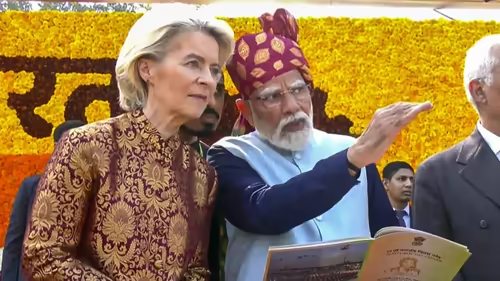
In a world increasingly defined by geopolitical fractures and economic uncertainty, one message from New Delhi on January 26, 2026, carried a profound weight: “A successful India makes the world more stable.” These weren’t just ceremonial words from a visiting dignitary. They were a strategic declaration from European Commission President Ursula von der Leyen, uttered after she and European Council President António Costa made history as the first-ever joint EU leaders to grace India’s Republic Day parade as chief guests .
This historic moment is far more than a symbolic photo-op. It’s the prelude to a pivotal India-EU summit scheduled for January 27, 2026, in New Delhi, where both sides are expected to unveil a new, comprehensive strategic agenda . So, what does the EU truly mean by a ‘successful India‘, and why has it become so central to their vision for a stable world order?
Table of Contents
- A Historic First for Republic Day
- What Does a ‘Successful India’ Mean to the EU?
- The Upcoming India-EU Summit: What’s on the Table?
- Beyond Trade: A Strategic Partnership for a Multipolar World
- Conclusion: The Future of the India-EU Alliance
- Sources
A Historic First for Republic Day
India’s choice of chief guest for its Republic Day parade has always been a carefully calibrated diplomatic signal. From heads of state of friendly nations to leaders of strategic allies, the guest list tells a story of India’s foreign policy priorities for the year ahead.
The decision to invite not one, but both top EU leaders—von der Leyen and Costa—breaks all precedent . This joint invitation is a clear and unambiguous message: the European Union is now viewed by India as a single, critical strategic partner, on par with any major nation. For the EU, accepting this dual role signifies a unified front and a commitment to elevating its relationship with India to a whole new level .
This move comes at a time when traditional alliances are being tested, and the world is searching for reliable poles of stability. By standing shoulder-to-shoulder on Rajpath, the EU and India are signaling their intent to co-author a new chapter in global governance.
What Does a ‘Successful India’ Mean to the EU?
Von der Leyen’s phrase, “a successful India makes the world more stable,” is deceptively simple but incredibly rich in meaning. To the EU, a successful India likely encompasses several key pillars:
- Economic Powerhouse: A thriving Indian economy offers a massive market for European goods and services, a source of innovation, and a crucial counterbalance to other dominant economic blocs.
- Democratic Anchor: In an era of democratic backsliding, a strong, vibrant democracy like India serves as a vital anchor for the rules-based international order that the EU champions.
- Strategic Counterweight: A confident and capable India can help maintain a balance of power in the Indo-Pacific region, promoting security and preventing any single nation from dominating—a core interest for the EU .
- Technological Partner: Collaboration with India on critical technologies, from green energy to digital infrastructure, is essential for the EU’s own strategic autonomy and future prosperity .
In essence, the EU sees India not just as a partner, but as a necessary pillar for a multipolar, stable, and prosperous world. [INTERNAL_LINK:india-eu-trade-deal-explained] provides a deeper dive into the economic underpinnings of this view.
The Upcoming India-EU Summit: What’s on the Table?
The Republic Day parade was the ceremonial kickoff; the real work begins at the India-EU summit on January 27, 2026. This meeting is expected to be transformative, moving beyond years of negotiation to concrete action. According to official sources, the summit will focus on three main pillars [[6], [7]]:
- Prosperity: Finalizing a long-pending Free Trade Agreement (FTA), often dubbed the “mother of all deals,” to unlock unprecedented economic potential between the two partners.
- Security: Deepening cooperation on maritime security, counter-terrorism, and cyber security, recognizing their shared interests in a stable global environment.
- Strategic Cooperation: Launching a new, comprehensive strategic agenda that will guide their partnership for the next decade, covering everything from climate change to critical raw materials and technology partnerships .
This summit represents a shift from a transactional relationship to a truly strategic one, built on mutual trust and a shared vision for the future.
Beyond Trade: A Strategic Partnership for a Multipolar World
While trade is a significant driver, the India-EU partnership is evolving into something much deeper. Both entities are navigating a complex global landscape marked by great power competition and systemic challenges like climate change. Their convergence is based on a shared belief in multilateralism, a rules-based order, and the need for a multipolar world where no single power dictates the terms.
The presence of the EU’s top leadership at the Republic Day parade is a powerful visual representation of this alignment. It’s a public affirmation that the EU and India are ready to move from being mere economic partners to becoming co-architects of a more stable and secure international system. This partnership is not aimed against anyone, but rather for a more balanced and predictable world—a world where a successful India is a key ingredient for success.
Conclusion: The Future of the India-EU Alliance
Ursula von der Leyen’s post-parade message is a clear-eyed assessment of 21st-century geopolitics. The EU’s bet on India is a bet on a stable, democratic, and prosperous future. The historic joint attendance at the Republic Day parade and the ambitious agenda of the upcoming summit mark a definitive turning point. The world is watching as these two giants forge a partnership that could well become one of the most defining alliances of our era, proving that a successful India is indeed a gift to global stability.
Sources
- India Today: Republic Day 2026: EU Leaders Antonio Costa and Ursula von der Leyen attend as chief guests
- EU-India.org: Republic Day 2026: EU leaders Ursula von Der Leyen and Antonio Costa to be key guests in FTA push
- The Economic Times: India, EU likely set to unveil new strategic agenda at January 27 summit
- Council of the European Union: EU-India summit, 27 January 2026
- European Times: India–EU Relations at the Dawn of 2026