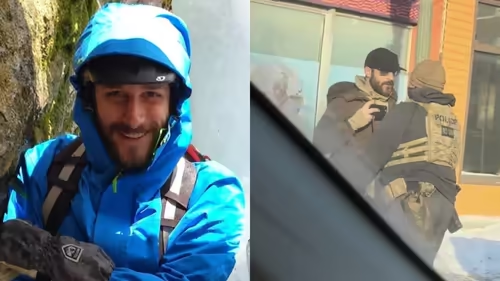
The name Alex Pretti has become a flashpoint in a national conversation that feels all too familiar. On a cold Saturday in Minneapolis, a routine immigration enforcement operation ended in tragedy when 37-year-old Alex Jeffrey Pretti was shot and killed by a U.S. Border Patrol agent . But who was he, and how did this happen? The details are murky, the official narrative is being fiercely contested, and the public is demanding answers.
Table of Contents
- The Fatal Encounter in Minneapolis
- Who Was Alex Pretti? Unraveling His Life
- The Official Story and Public Skepticism
- Broader Implications of the Alex Pretti Case
- Conclusion: A Search for Truth
- Sources
The Fatal Encounter in Minneapolis
According to federal authorities, the incident occurred on January 24, 2026, during a large-scale immigration enforcement operation in Minneapolis . Agents from U.S. Immigration and Customs Enforcement (ICE) and the U.S. Border Patrol were reportedly conducting arrests in the area. The official account states that Alex Pretti, who was a U.S. citizen, brandished a weapon and resisted arrest, leading a Border Patrol agent to open fire in self-defense .
Witnesses and early reports paint a more chaotic scene. Some accounts suggest Pretti was among a group of people gathered in the area, possibly in connection with ongoing protests against aggressive federal immigration policies that have been escalating in Minnesota throughout January 2026 . The exact sequence of events leading up to the shooting remains under investigation by local and federal authorities.
Who Was Alex Pretti? Unraveling His Life
In the immediate aftermath of the shooting, conflicting information about Pretti’s background began to circulate online. This has only added to the public’s confusion and distrust. However, multiple credible sources, including his family and official court records, have clarified his identity.
Alex Pretti was a 37-year-old intensive care nurse at the Veterans Administration . He was described by loved ones as an avid outdoorsman who deeply cared for his country but was troubled by its current political direction . His father, a Wisconsin resident, confirmed his son’s profession and passion for the outdoors .
Critically, and in stark contrast to some early, unverified rumors, official court records show that Alex Pretti had no serious criminal history. Searches of his background turned up only minor traffic violations . This fact—that a U.S. citizen with no violent past was killed during an immigration raid—has become a central point of outrage for many citizens and civil rights advocates. It raises profound questions about the scope and execution of such federal operations in American communities.
The Official Story and Public Skepticism
The government’s claim that Pretti “brandished a weapon” has been met with significant skepticism. In an era where body camera footage is often the key to transparency, the public is left waiting for concrete evidence to support the agent’s claim of self-defense.
Key points of contention include:
- The nature of the “weapon”: Was it a firearm, a tool, or something else entirely?
- Pretti’s intent: Was he acting in self-defense himself, or was he simply present in a volatile situation?
- The necessity of lethal force: Given that multiple agents were reportedly on the scene, were other, non-lethal options exhausted?
This incident is not happening in a vacuum. It follows a period of heightened federal immigration activity, with DHS Secretary Kristi Noem having recently participated in similar enforcement operations . The context fuels fears that these raids are becoming increasingly militarized and pose a danger to all citizens, not just undocumented immigrants.
Broader Implications of the Alex Pretti Case
The killing of Alex Pretti transcends a single tragic event. It has become a symbol of several deep-seated issues in American society:
1. The Militarization of Domestic Law Enforcement: The use of federal tactical units for immigration enforcement blurs the line between border security and domestic policing, creating an environment where encounters can escalate quickly and fatally.
2. Civil Rights and Citizen Safety: If a U.S. citizen with no criminal record can be killed during an immigration operation, it forces every American to ask: Could this happen to me or someone I love? This erodes the fundamental trust between the public and its government institutions.
3. The Need for Transparency and Accountability: Without an independent, thorough, and transparent investigation, public trust will continue to deteriorate. The release of all available evidence, including any video footage and radio communications, is crucial for a just outcome. For more on your rights during such encounters, see our guide on [INTERNAL_LINK:civil_rights_during_police_encounters].
Conclusion: A Search for Truth
The story of Alex Pretti is a heartbreaking reminder of how quickly a life can be lost and how complex the search for truth can be. While we await the findings of the official investigation, one thing is clear: the circumstances surrounding his death demand a full accounting. His life as a dedicated nurse and an American citizen deserves nothing less than a transparent and just process. The nation is watching.
Sources
- MPR News: “Federal agent fatally shoots man Saturday in Minneapolis”
- Associated Press: Reports on Alex Pretti’s profession as an ICU nurse
- Local news reports on the lack of a criminal record for Alex Pretti [[14], [15], [16]]
- Reports on the context of federal immigration operations in January 2026 [[6], [7], [9]]
- U.S. Department of Justice: Guidelines on the Use of Force by Federal Law Enforcement Officers [https://www.justice.gov/]