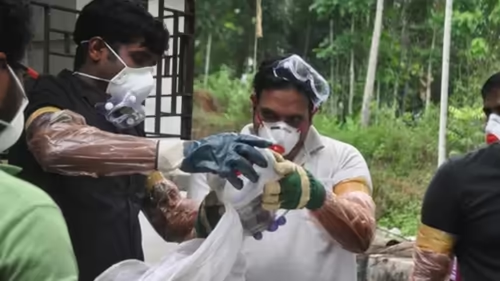
Headlines about a new Nipah virus India outbreak sent ripples of anxiety across social media this week. After all, Nipah isn’t just any virus—it’s a rare but deadly pathogen with a fatality rate that can soar as high as 75% [[1]]. So when news broke that two nurses in West Bengal had tested positive, many feared the worst: another pandemic brewing on the subcontinent.
But here’s the twist: the World Health Organization (WHO) has stepped in with a clear, calming message. In its latest risk assessment released on January 30, 2026, the global health body stated that the current outbreak poses a **low risk** at the national, regional, and global levels—and crucially, **no travel or trade restrictions are recommended** [[5]].
Table of Contents
- What Happened? The West Bengal Cases Explained
- Why WHO Says the Nipah Virus India Outbreak Is Low Risk
- Understanding the Real Dangers of Nipah Virus
- Symptoms, Transmission, and How to Protect Yourself
- Past Outbreaks and India’s Response
- Conclusion: Staying Informed, Not Alarmed
- Sources
What Happened? The West Bengal Cases Explained
The current situation centers on two female nurses at a private hospital in Asansol, West Bengal, who tested positive for the Nipah virus in late January 2026 [[5]]. Both had been caring for a patient who later died—though it remains unclear whether that patient was the source of infection. Immediately after confirmation, Indian health authorities sprang into action.
Over 100 close contacts—including family members, fellow healthcare workers, and other patients—were identified and placed under strict surveillance. As of January 30, **no secondary cases have been detected**, a strong indicator that the outbreak is contained [[5]]. This rapid response is a testament to India’s improved disease surveillance systems since previous outbreaks in Kerala.
Why WHO Says the Nipah Virus India Outbreak Is Low Risk
The WHO’s risk assessment isn’t based on guesswork—it’s grounded in epidemiological data and containment metrics. Here’s why they’re confident:
- Limited human-to-human transmission: Nipah doesn’t spread easily like influenza or SARS-CoV-2. It typically requires close, prolonged contact with infected bodily fluids [[10]].
- No community spread: All known cases are linked to a single healthcare setting. There’s no evidence of the virus circulating in the wider community.
- Effective contact tracing: Indian authorities have successfully isolated and monitored all potential contacts without new infections emerging.
- Geographic containment: The outbreak is confined to one district in West Bengal, with no spillover to neighboring states or countries.
That said, the WHO did classify the **sub-national risk within West Bengal as “moderate”**—a prudent acknowledgment that local vigilance must remain high [[5]].
Understanding the Real Dangers of Nipah Virus
First identified in Malaysia in 1998 during an outbreak among pig farmers, Nipah virus is a zoonotic pathogen—meaning it jumps from animals to humans. Fruit bats (flying foxes) are the natural reservoir. Humans can get infected through:
- Direct contact with infected bats or their secretions (e.g., urine, saliva)
- Consuming raw date palm sap contaminated by bat excretions—a known route in Bangladesh and India
- Close contact with infected people, especially in healthcare settings without proper PPE
There is **no approved vaccine or specific antiviral treatment** for Nipah virus infection. Care is supportive—managing fever, respiratory distress, and neurological complications [[10]]. This lack of medical countermeasures is why early detection and isolation are so critical.
Is Nipah Virus Contagious?
Yes—but not in the way most people fear. It is **not airborne**. You won’t catch it by walking past someone on the street. Transmission requires direct exposure to saliva, urine, blood, or other bodily fluids from an infected person or animal. This is why healthcare workers and family caregivers are at highest risk—and why proper infection control protocols are non-negotiable.
Symptoms, Transmission, and How to Protect Yourself
Early symptoms of Nipah virus infection mimic the flu: fever, headache, muscle pain, vomiting, and sore throat. But within 24–48 hours, it can escalate to drowsiness, disorientation, seizures, and acute encephalitis (brain inflammation). Some patients develop severe respiratory illness, including pneumonia [[10]].
Protective measures include:
- Avoiding consumption of raw date palm sap or toddy in endemic areas
- Washing fruits thoroughly and peeling them before eating
- Using gloves and masks when handling sick animals or patients
- Practicing rigorous hand hygiene
For travelers to West Bengal, the WHO explicitly states: **no special precautions beyond routine hygiene are needed**, and **travel bans are unnecessary** [[5]].
Past Outbreaks and India’s Response
India has faced Nipah outbreaks before—most notably in Kerala in 2018, 2019, 2021, and 2023. Each time, the state’s health department, supported by the National Centre for Disease Control (NCDC), mounted a swift and effective containment effort. The 2018 outbreak, which claimed 17 lives, led to major upgrades in India’s epidemic intelligence and lab testing capacity [[15]].
This experience is now paying off. The current West Bengal response mirrors Kerala’s successful model: rapid case identification, aggressive contact tracing, quarantine enforcement, and transparent public communication. Such preparedness is exactly what gives the WHO confidence in labeling the current event as low risk.
Conclusion: Staying Informed, Not Alarmed
While the words “Nipah virus India” naturally trigger concern, the reality today is one of control, not crisis. Thanks to vigilant local health authorities and a robust global monitoring system, this outbreak appears to be contained. The WHO’s reassurance should be welcomed—but not as a reason for complacency. Continued surveillance, public awareness, and investment in zoonotic disease research remain essential. For now, there’s no need to cancel travel plans or panic. Just stay informed, practice good hygiene, and trust the science. To learn more about how viruses jump from animals to humans, explore our guide on [INTERNAL_LINK:zoonotic-diseases-prevention].
Sources
- [[1]] World Health Organization (WHO). “Nipah virus.” Accessed January 30, 2026. https://www.who.int/news-room/fact-sheets/detail/nipah-virus
- [[5]] Times of India. “‘Low risk, travel curbs not needed’: WHO assesses Nipah virus cases in India.” January 30, 2026.
- [[10]] Centers for Disease Control and Prevention (CDC). “Nipah Virus (NiV).” Accessed January 30, 2026. https://www.cdc.gov/vhf/nipah/index.html
- [[15]] The Lancet Global Health. “Lessons from the 2018 Nipah outbreak in Kerala, India.” 2019.