For years, we’ve been told to trust WhatsApp. Its little green chat bubbles came with a powerful promise: end-to-end encryption. A digital vault where only you and the person you’re chatting with could see your messages. But what if that promise was just a facade?
A bombshell lawsuit and a chorus of criticism from some of the world’s most respected tech minds—including Zoho founder Sridhar Vembu, Elon Musk, and Telegram CEO Pavel Durov—are now forcing us to ask a terrifying question: Is WhatsApp security a lie?
Table of Contents
- The WhatsApp Security Lawsuit: What Are the Allegations?
- Sridhar Vembu: Zoho’s Founder’s Scathing Critique
- Tech Titans Join the Chorus: Musk and Durov Speak Out
- The Core Conflict: Meta vs. Privacy
- So, Is WhatsApp Really Secure? A Practical Guide
- Conclusion: Rethinking Your Messaging App of Choice
- Sources
The WhatsApp Security Lawsuit: What Are the Allegations?
The foundation of this controversy is a major lawsuit filed in a US federal court in January 2026 [[20]]. The plaintiff? None other than Attaullah Baig, WhatsApp’s former head of security [[4]]. His explosive claim: WhatsApp’s much-touted end-to-end encryption is, in his words, a “facade” [[22]].
According to the suit, Meta allegedly granted over 1,500 of its engineers “unrestricted access” to user data, effectively allowing them to bypass the encryption and read private messages [[6]]. The complaint further alleges that WhatsApp failed to implement basic cybersecurity measures befitting its massive scale, including not maintaining a proper 24/7 security operations center [[2]].
Meta has dismissed these allegations as “frivolous,” standing by its decade-long use of the Signal protocol for encryption [[28]]. But the damage to public trust is already being done.
Sridhar Vembu: Zoho’s Founder’s Scathing Critique
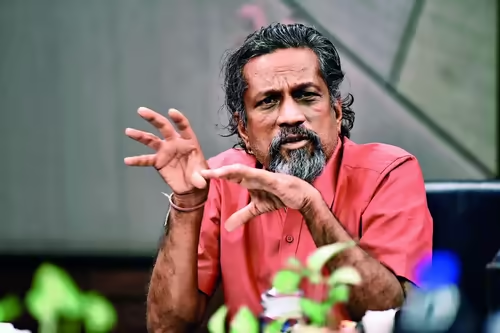
Adding immense weight to these allegations is the voice of Sridhar Vembu, the founder and CEO of India’s homegrown tech giant, Zoho. Vembu didn’t mince words, calling out the fundamental conflict at the heart of WhatsApp’s business model [[1]].
“As a general principle, when you have an ad-driven model, you cannot have privacy,” Vembu stated bluntly [[1]]. His point is simple and powerful: Meta’s entire revenue engine is built on collecting and monetizing user data through advertising. How can a company whose lifeblood is data harvesting be trusted to protect your most private conversations? This inherent conflict of interest, Vembu argues, makes WhatsApp’s privacy claims deeply suspect.
Vembu’s own company, Zoho, has launched its alternative messaging app, Arattai, which is set to roll out its own end-to-end encryption, positioning itself as a privacy-first option [[7]].
Tech Titans Join the Chorus: Musk and Durov Speak Out
Vembu isn’t alone in his skepticism. Elon Musk, the world’s richest man and a vocal tech commentator, took to his platform X (formerly Twitter) to declare, “WhatsApp is not safe” [[10]]. He even went so far as to question the reliability of Signal, another popular encrypted messenger, leaving many users wondering where to turn [[11]].
Meanwhile, Pavel Durov, the founder of Telegram—a direct competitor to WhatsApp—was even more direct. In a now-infamous post, he called anyone who believes WhatsApp is secure “braindead” [[12]]. Durov cited Telegram’s internal analysis that revealed unspecified “attack vectors” in WhatsApp’s encryption implementation, further fueling the fire [[14]].
The Core Conflict: Meta vs. Privacy
This controversy cuts to the core of the modern internet. On one side, you have a utility used by billions for their most personal communications. On the other, you have a corporation whose primary goal is to maximize shareholder value through an advertising model that thrives on data.
The lawsuit and the criticisms from Vembu, Musk, and Durov all point to the same uncomfortable truth: a company’s business model is the ultimate determinant of its commitment to privacy. When profit depends on knowing everything about you, promises of absolute secrecy become hard to believe. This is the central paradox of WhatsApp security in the Meta era.
So, Is WhatsApp Really Secure? A Practical Guide
For the average user, this news is alarming. So, what should you do? Here’s a practical breakdown:
- Understand the Threat Model: For most casual chats, WhatsApp’s encryption is likely still a strong barrier against external hackers and mass surveillance. The alleged vulnerability is primarily an internal one, related to potential employee access.
- Be Wary of Sensitive Data: Never send highly sensitive information—like financial details, passwords, or confidential business plans—over any mainstream messaging app, including WhatsApp.
- Explore Alternatives: If privacy is your top concern, research alternatives like Signal (which is non-profit and open-source) or even Telegram (though its default chats are not end-to-end encrypted). For a deeper dive into secure communication, check out our guide on [INTERNAL_LINK:best-encrypted-messaging-apps].
Conclusion: Rethinking Your Messaging App of Choice
The criticisms from Sridhar Vembu and other tech leaders, coupled with the serious allegations in the whistleblower lawsuit, have cast a long shadow over WhatsApp’s security claims. While the legal battle will play out in court, the broader message is clear: blind trust in any big tech platform is a risky proposition. In an age where data is the new oil, it’s more important than ever to understand who owns the platform you’re on and how they make their money. Your privacy might just depend on it.
Sources
- [[1]] Times of India: Zoho founder Sridhar Vembu on ‘big problem’ with WhatsApp’s security
- [[2]] CNBC: Ex-Meta employee whistleblower suit alleged security flaws in WhatsApp
- [[4]] Thompson Coburn: WhatsApp Lawsuit vs. Meta: Access Governance, Culture & The Enforcement Horizon
- [[6]] Outlook Business: Ex-WhatsApp Security Chief Sues Meta, Alleges “Systemic Data Security Failures”
- [[7]] LinkedIn: Sridhar Vembu on Arattai’s upcoming end-to-end encryption
- [[10]] Business Today: Elon Musk says WhatsApp is ‘not secure’ as lawsuit alleges the app has no end-to-end encryption
- [[11]] Times of India: Tech leaders express skepticism on WhatsApp’s security
- [[12]] Moneycontrol: Telegram CEO Pavel Durov calls people ‘Braindead’ for believing WhatsApp is secure
- [[14]] Times of India: Telegram CEO says that one has to be braindead to believe WhatsApp is secure
- [[20]] ABZ Global: WhatsApp “Encryption Lawsuit” Explained
- [[22]] Cybersecurity Insiders: WhatsApp End to End Data Encryption Claims in Lawsuit
- [[28]] Yahoo Finance: Lawsuit Claims Meta Can See WhatsApp Chats in Breach of Privacy