In a digital world where our private conversations are our most valuable asset, trust in messaging apps is paramount. But that trust is being violently shaken in January 2026. A bombshell class-action lawsuit against Meta has been joined by a blistering public attack from Telegram’s founder, Pavel Durov, who declared it “braindead” to believe in WhatsApp security. And if that wasn’t enough, tech titan Elon Musk has thrown his weight behind the critics, publicly warning users to steer clear.
Table of Contents
- The WhatsApp Security Lawsuit Explained
- Pavel Durov’s “Braindead” Comment on WhatsApp Security
- Elon Musk’s Stunning WhatsApp Warning
- WhatsApp vs. Telegram: A Security Comparison
- What This Means For You, The User
- Conclusion: Is WhatsApp Security a Farce?
- Sources
The WhatsApp Security Lawsuit Explained
On January 23, 2026, a massive international class-action lawsuit was filed against Meta Platforms, the parent company of WhatsApp [[19]]. The core allegation is explosive: despite its long-standing public promises of end-to-end encryption, Meta can allegedly access and read user messages [[12]].
The plaintiffs argue that WhatsApp’s implementation of encryption is flawed or contains deliberate backdoors, allowing the company to bypass the very security it touts as its main selling point. This directly contradicts WhatsApp’s official stance, which relies on the Signal Protocol for its encryption [[17]].
In response, Meta has issued a firm denial, calling the lawsuit’s claims “frivolous,” “absurd,” and “categorically false” [[17]]. They maintain that every personal message, photo, and video sent on the platform is indeed protected by end-to-end encryption, meaning only the sender and recipient can see them.
Pavel Durov’s “Braindead” Comment on WhatsApp Security
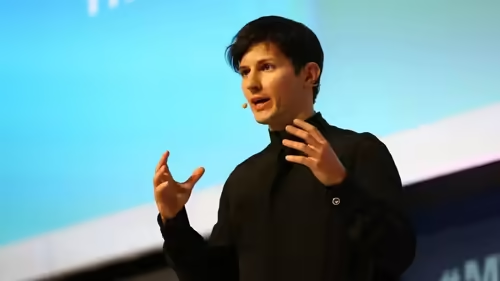
Never one to shy away from controversy, Telegram CEO Pavel Durov seized the moment to launch a direct assault on his biggest competitor. In a post on his social network, he stated, “You’d have to be braindead to believe WhatsApp is secure in 2026” [[1]].
Durov didn’t stop at the insult. He claimed that internal analyses by his team revealed “multiple attack vectors” in WhatsApp’s encryption implementation [[6]]. His comments are clearly designed to position Telegram as the more trustworthy and secure alternative, capitalizing on the growing public skepticism fueled by the lawsuit. This is a classic move in the ongoing battle for the privacy-conscious user, a market segment that has become increasingly valuable. For more on the history of this rivalry, see [INTERNAL_LINK:telegram-vs-whatsapp-privacy-battle].
Elon Musk’s Stunning WhatsApp Warning
The controversy escalated dramatically when Elon Musk, the world’s most influential tech CEO, weighed in on X (formerly Twitter). In a post that sent shockwaves through the tech community, Musk declared, “WhatsApp is not secure. Even Signal is questionable. Use X Chat” [[22]].
Musk’s intervention is significant. His endorsement carries immense weight with millions of followers. By questioning not just WhatsApp but also Signal—a long-time favorite of privacy advocates—he has thrown the entire landscape of mainstream encrypted messaging into turmoil. His comment appears to be a strategic push for his own nascent messaging platform, X Chat, which he claims will offer superior security [[21]]. This high-profile backing of Durov’s sentiment has amplified the crisis for WhatsApp far beyond a legal dispute, turning it into a major public relations nightmare.
WhatsApp vs. Telegram: A Security Comparison
So, where does the truth lie? Let’s break down the key differences between the two platforms:
| Feature | Telegram | |
|---|---|---|
| Default Encryption | End-to-end encrypted for all chats. | Cloud chats are NOT end-to-end encrypted by default. Only “Secret Chats” are. |
| Open Source | Client-side code is open source, but server-side is not. | Client-side code is fully open source. |
| Data Collection | Collects metadata (who you talk to, when, etc.) and links to your Facebook profile. | Collects minimal data; phone number is primary identifier. |
| Backups | iCloud/Google Drive backups are NOT encrypted by WhatsApp, creating a potential vulnerability. | Cloud storage is a core feature, but non-Secret Chats are stored on Telegram’s servers. |
As you can see, both platforms have their trade-offs. WhatsApp’s strength is its universal end-to-end encryption, but its ties to Meta and its handling of backups are major concerns. Telegram offers more flexibility and transparency but requires users to actively choose its most secure mode (“Secret Chats”).
What This Means For You, The User
This situation is a stark reminder that you should never take a company’s security claims at face value. Here’s what you can do:
- Understand the Fine Print: Know that “end-to-end encryption” often doesn’t cover your backups or your metadata (data about your data).
- Review Your Settings: On WhatsApp, consider disabling cloud backups if you’re highly sensitive. On Telegram, make sure to use “Secret Chats” for your most private conversations.
- Stay Informed: Follow reputable tech news sources for updates on the lawsuit and any security vulnerabilities that may be discovered. For a deeper dive into digital safety, check out our guide on [INTERNAL_LINK:best-practices-for-secure-messaging].
- Diversify: Don’t put all your eggs in one basket. It might be wise to use different apps for different types of communication.
Conclusion: Is WhatsApp Security a Farce?
While the lawsuit’s allegations are still just that—allegations—the combined force of a legal challenge and public condemnation from figures like Durov and Musk has severely damaged WhatsApp’s reputation for security. Whether the app is truly “insecure” or simply a victim of its corporate parent’s data-hungry business model is a complex question. However, one thing is clear: the era of blindly trusting Big Tech with our private lives is over. Users are demanding more transparency and genuine privacy, and the outcome of this 2026 showdown will likely shape the future of secure messaging for years to come.
Sources
- Moneycontrol. “Telegram CEO Pavel Durov calls people ‘Braindead’ for believing WhatsApp is secure.” https://www.moneycontrol.com/technology/… [[2]]
- PCMag. “Lawsuit Alleges That WhatsApp Has No End-to-End Encryption.” https://www.pcmag.com/news/lawsuit-alleges-that-whatsapp-has-no-end-to-end-encryption [[4]]
- Bloomberg Law. “Lawsuit Claims Meta Can See WhatsApp Chats in Breach of Privacy.” https://news.bloomberglaw.com/us-law-week/… [[13]]
- Times of India. “Meta can access all WhatsApp chats, lawsuit claims; Company replies.” https://timesofindia.indiatimes.com/… [[17]]
- Mashable. “Elon Musk Says WhatsApp Isn’t Safe Amid Lawsuit Over Encryption.” https://in.mashable.com/tech/105089/… [[27]]