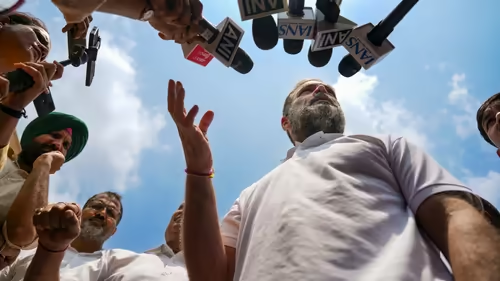
It started with a simple question about election ink—and exploded into a national conversation about truth, trust, and psychological manipulation. During a recent press conference, Congress leader Rahul Gandhi dropped a bombshell phrase: he accused the Election Commission of India (ECI) of “gaslighting” voters in the ongoing controversy over indelible ink used during elections. Overnight, Google searches for “what is gaslighting?” surged across India.
But what exactly does gaslighting mean? And why would a senior politician use a clinical psychology term to describe an electoral body’s actions? The answer reveals far more than semantics—it exposes growing public anxiety about transparency, institutional credibility, and the very nature of democratic dialogue in modern India.
Table of Contents
- The Indelible Ink Controversy: What Happened?
- What Is Gaslighting? A Psychological Term Enters Politics
- Why Rahul Gandhi’s Use of ‘Gaslighting’ Resonates With Voters
- How Gaslighting Works in Public Discourse
- The Election Commission’s Response and Fact-Check
- Is It Fair to Call It Gaslighting? Expert Perspectives
- Conclusion: When Language Becomes a Tool of Accountability
- Sources
The Indelible Ink Controversy: What Happened?
The row began when reports surfaced that the indelible ink—traditionally applied to voters’ fingers to prevent double voting—was washing off unusually quickly in some states. Social media videos showed people removing the mark with soap or sanitizer within hours, sparking fears of potential electoral fraud.
Rahul Gandhi seized on the issue, demanding answers from the ECI. When the Commission dismissed concerns, calling the ink “scientifically tested and foolproof,” Gandhi fired back: “They are gaslighting the people of India. They’re making voters doubt their own eyes.”
What Is Gaslighting? A Psychological Term Enters Politics
Originally coined from the 1944 film *Gaslight*, where a husband manipulates his wife into believing she’s going insane, gaslighting is a form of psychological abuse in which a person or institution makes someone question their reality, memory, or perception .
According to the American Psychological Association, classic signs of gaslighting include:
- Denying facts that the victim knows to be true.
- Dismissing concerns as “overreactions” or “delusions.”
- Insisting the victim is confused or mistaken—even when evidence says otherwise.
In political contexts, the term has evolved to describe tactics where authorities dismiss credible public concerns with blanket denials, thereby eroding trust and sowing self-doubt among citizens .
Why Rahul Gandhi’s Use of ‘Gaslighting’ Resonates With Voters
Gandhi’s choice of words struck a chord because many voters *felt* unheard. When they saw videos of ink vanishing, their instinct was alarm. But instead of a transparent investigation, they got reassurances without proof. That gap between lived experience and official narrative is fertile ground for accusations of gaslighting.
For a generation increasingly fluent in mental health and emotional intelligence, the term gives language to a deep-seated frustration: “Am I crazy for noticing this, or are they just not listening?”
How Gaslighting Works in Public Discourse
Institutional gaslighting doesn’t require malicious intent—it can emerge from defensiveness, bureaucratic inertia, or a desire to maintain control. Common patterns include:
- Over-reliance on authority: “Trust us, we’re the experts”—without sharing data.
- Victim-blaming: “You’re being misled by fake news” instead of addressing the core concern.
- Changing the subject: Diverting to past achievements rather than current failures.
When repeated, these tactics can make the public feel irrational for questioning power—a dangerous dynamic in any democracy.
The Election Commission’s Response and Fact-Check
The ECI maintains that the ink supplied by Mysore Paints & Varnish Ltd.—a government-owned company—is compliant with international standards. Officials claim that while surface marks may fade, a chemical reaction ensures the stain remains under UV light for days .
However, independent tests by media outlets have shown inconsistent results. Some samples vanished completely within 24 hours, raising legitimate questions about quality control—not necessarily fraud, but certainly oversight. The EC’s refusal to acknowledge even this nuance is what fuels the gaslighting accusation.
Is It Fair to Call It Gaslighting? Expert Perspectives
Not all psychologists agree with the political use of the term. Dr. Anjali Chhabria, a Mumbai-based clinical psychologist, cautions: “While institutions can be dismissive, true gaslighting implies sustained, intentional manipulation. We must be careful not to dilute the term’s clinical weight.”
Yet, political communication experts argue that in the public sphere, the *effect* matters more than the *intent*. “If people feel their reality is being denied, the psychological impact is real—regardless of motive,” says Prof. Rajesh Kumar of JNU’s Centre for Media Studies [INTERNAL_LINK:political-rhetoric-in-india].
Conclusion: When Language Becomes a Tool of Accountability
Rahul Gandhi’s use of “gaslighting” may be politically charged, but it has done something vital: it’s forced a national conversation about trust, transparency, and how institutions respond to citizen concerns. Whether or not the ECI’s actions meet the clinical definition, the public’s perception of being dismissed is a crisis in itself.
In a healthy democracy, voters shouldn’t have to wonder if they’re imagining things. Institutions must not just be trustworthy—they must *show* they are. Because when people stop believing their own eyes, democracy itself begins to blur.
Sources
- Times of India. “Indelible ink row: Rahul Gandhi accuses EC of ‘gaslighting’ voters – What does it mean?” https://timesofindia.indiatimes.com/…
- American Psychological Association. “What is gaslighting?” https://dictionary.apa.org/gaslighting
- Election Commission of India. “Frequently Asked Questions on Indelible Ink.” https://eci.gov.in/faq-on-indelible-ink/