Introduction
Thousands of West Bengal voters are now racing against time to save their right to vote. In a significant intervention just weeks before crucial local body elections, the Supreme Court of India has directed the Election Commission (EC) to publicly display the names of voters flagged for “logical discrepancy” in panchayat and block offices across the state. Even more critically, these individuals have been granted an **additional 10 days** to submit documentary proof of their identity and residence. The order, aimed at ensuring electoral integrity, has ignited a political storm—raising urgent questions about transparency, bureaucratic errors, and the risk of mass disenfranchisement in one of India’s most politically charged states.
Table of Contents
- What Is a ‘Logical Discrepancy’ in Voter Rolls?
- Why the Supreme Court Stepped In
- Key Directives from the SC Order
- How Voters Can Respond and Protect Their Franchise
- Political Reactions and Concerns Over Mass Exclusion
- Broader Implications for Indian Democracy
- Conclusion: A Delicate Balance Between Purity and Inclusion
- Sources
What Is a ‘Logical Discrepancy’ in Voter Rolls?
A “logical discrepancy” refers to inconsistencies detected by the Election Commission’s automated data-matching systems when verifying voter information. These are not necessarily cases of fraud—but often result from clerical errors, outdated records, or mismatched details across government databases. Common examples include:
- A birth year that makes the applicant younger than 18 (e.g., DOB listed as 2010 for a 2025 voter).
- Family members listed with impossible age gaps (e.g., a “mother” born after her “child”).
- Same photograph or biometric data linked to multiple voter IDs.
- Address mismatches between Aadhaar, ration card, and voter application.
While the EC uses these flags to clean up rolls, critics argue that automated systems often penalize marginalized communities—migrant laborers, women, and the elderly—who may lack consistent documentation.
Why the Supreme Court Stepped In
The Court’s intervention came in response to petitions alleging that over **4.3 million voters** in West Bengal had been excluded from draft electoral rolls due to such discrepancies—without adequate notice or opportunity to respond . Petitioners argued this violated Article 326 of the Constitution, which guarantees adult suffrage as a fundamental democratic right.
The bench, led by Chief Justice of India, emphasized that while electoral purity is important, it must not come at the cost of disenfranchising genuine citizens. The Court noted that many exclusions appeared to stem from “technical glitches” rather than intentional fraud—a concern echoed by civil society groups monitoring the process.
Key Directives from the SC Order
The Supreme Court issued a clear, multi-part directive to ensure fairness:
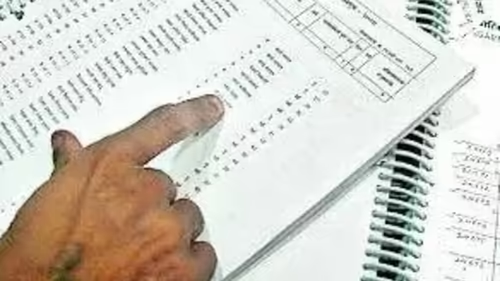
- Public Display: The EC must physically display lists of voters marked with “logical discrepancy” notices at all panchayat and block development offices across West Bengal.
- Extended Deadline: Affected individuals get **10 additional days** beyond the original deadline to submit valid proof (e.g., Aadhaar, passport, utility bills, or school certificates).
- State Support: The West Bengal government must provide necessary manpower and logistical support for this “special intensive revision drive.”
- Law and Order: The state must ensure peaceful conditions so citizens can access offices without fear or intimidation.
This hands-on approach aims to bridge the gap between digital governance and ground-level reality.
How Voters Can Respond and Protect Their Franchise
If you or someone you know is in West Bengal, here’s what to do immediately:
- Check your name on the draft electoral roll via the National Voter Service Portal or visit your local booth level officer (BLO).
- Visit your panchayat/block office to see if your name appears on the “logical discrepancy” list.
- Gather acceptable documents: Proof of age (birth certificate, school record), address (ration card, electricity bill), and identity (Aadhaar, PAN).
- Submit documents in person before the new deadline—keep a stamped copy for your records.
For step-by-step guidance, see our resource on [INTERNAL_LINK:how-to-correct-voter-id-details].
Political Reactions and Concerns Over Mass Exclusion
Opposition parties in West Bengal have accused the EC of bias, claiming the discrepancies disproportionately affect rural and minority communities—traditional strongholds of certain parties. The ruling Trinamool Congress has demanded a full audit of the exclusion process, while the BJP insists the cleanup is necessary to prevent “duplicate voting.”
Election experts warn that without proper outreach, millions may miss the window to appeal—not out of fraud, but because they never knew they were flagged. This underscores a systemic issue: the gap between algorithmic governance and citizen awareness.
Broader Implications for Indian Democracy
West Bengal is not alone. Similar “logical discrepancy” drives have occurred in Assam, Telangana, and Delhi. The Supreme Court’s order sets a vital precedent: **automated exclusions must be transparent, reversible, and accompanied by robust remedial mechanisms**. As India moves toward fully digitized electoral rolls, this case highlights the need for human oversight in algorithmic decision-making.
Conclusion: A Delicate Balance Between Purity and Inclusion
The Supreme Court’s intervention in the West Bengal voter list controversy is a timely reminder that democracy thrives not just on clean data, but on inclusive participation. The term “logical discrepancy” may sound technical, but its consequences are deeply human. By mandating public display and extra time for appeals, the Court has reaffirmed a core principle: no citizen should lose their vote due to a bureaucratic error. Now, it’s up to the Election Commission and the state government to implement this order with speed, fairness, and empathy.
Sources
- Times of India: List WB voters with ‘logical discrepancy’: SC to poll panel
- Election Commission of India – Electoral Roll Guidelines: Official Procedures for Voter List Revision
- Constitution of India, Article 326: Right to Vote
- National Voter Service Portal (NVSP): Check Voter Status & Submit Claims