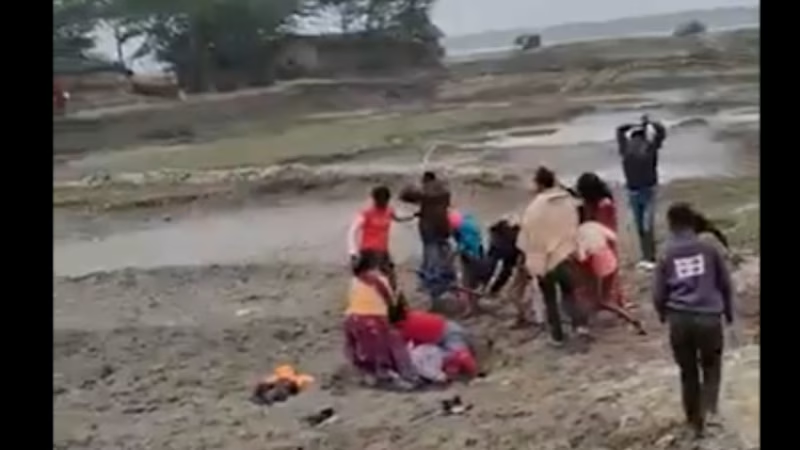
A chilling video has thrust West Bengal into the national spotlight—and reignited a fierce political battle over women’s safety and governance. The footage, now widely shared by the BJP, shows a woman and her family being viciously assaulted with bamboo sticks in broad daylight in Uttar Bhangnamari village, Basanti block of South 24 Parganas. Bloodied and screaming, the victims are seen trying to shield themselves as attackers—allegedly led by Jalil Laskar, Munna Laskar, and Arif Laskar—show no mercy.
The incident, which reportedly occurred over a land dispute, has become more than just a local crime. It’s now a symbol in a larger narrative: is West Bengal becoming increasingly unsafe for women? And is Chief Minister Mamata Banerjee’s government failing in its most basic duty—maintaining law and order?
Table of Contents
- The West Bengal Assault Video: What Happened?
- BJP’s Political Backlash: ‘Anti-Women State’ Claim
- Mamata Govt’s Response and Police Action
- Broader Pattern: Violence Against Women in Bengal?
- National Implications: The Law and Order Debate
- What Happens Next? Legal and Political Fallout
- Conclusion: Beyond the Viral Video
- Sources
The West Bengal Assault Video: What Happened?
According to police reports and local eyewitnesses, the attack took place on December 29, 2025, in Uttar Bhangnamari, a remote village in South 24 Parganas—one of West Bengal’s most politically sensitive districts.
The victims, a woman and her male relatives, were allegedly targeted over a longstanding land ownership feud. The assailants, identified as members of the Laskar family, descended upon them armed with thick bamboo sticks, raining blows without warning.
What makes the video particularly disturbing is the brazenness of the attack—conducted in public, with no intervention from bystanders or local authorities. The woman’s cries for help echo hauntingly as the camera captures every brutal second.
BJP’s Political Backlash: ‘Anti-Women State’ Claim
The BJP wasted no time in weaponizing the footage. Within hours, party leaders began sharing the West Bengal assault video across social media, framing it as evidence of systemic collapse under Trinamool Congress (TMC) rule.
BJP national spokesperson Amit Malviya tweeted: “This is not an isolated incident. This is the reality of an anti-women state. Where is Mamata Banerjee? Why is she silent as women are beaten into submission?”
Other BJP leaders echoed the sentiment, calling West Bengal a “failed state” where political patronage shields criminals and ordinary citizens—especially women—live in fear. The party has demanded a National Commission for Women (NCW) probe and the arrest of all accused without delay.
Mamata Govt’s Response and Police Action
The TMC government, initially silent, later issued a statement assuring “swift action.” By December 31, South 24 Parganas police confirmed the arrest of Munna Laskar and Arif Laskar. Jalil Laskar remains at large but is being actively pursued.
Local TMC leaders, however, downplayed the incident as a “private dispute” and denied any political angle. This response has drawn sharp criticism from women’s rights groups, who argue that labeling gendered violence as “personal” is part of the problem.
For context on similar incidents, see our coverage on [INTERNAL_LINK:violence-against-women-in-eastern-india].
Broader Pattern: Violence Against Women in Bengal?
Is this attack an anomaly—or part of a trend?
Data from the National Crime Records Bureau (NCRB) shows West Bengal reported over 12,000 cases of crimes against women in 2023—the third highest in India. While population size plays a role, activists point to weak enforcement, political interference in police work, and slow judicial processes as key enablers.
Incidents like the 2022 Birbhum killings and repeated reports of sexual harassment in public transport have fueled public anxiety. The West Bengal assault video now serves as a visceral reminder of these systemic failures.
National Implications: The Law and Order Debate
This incident transcends state borders. It feeds into a national conversation about federalism, governance, and women’s security.
Opposition parties are using it to challenge the narrative of “strong state governments.” Meanwhile, the Centre has remained officially neutral—but sources indicate the Union Home Ministry is monitoring the situation closely.
Crucially, the video’s virality underscores how smartphones and social media have turned local crimes into national accountability triggers. As noted by the National Commission for Women, citizen documentation is now a critical tool in fighting impunity.
What Happens Next? Legal and Political Fallout
Legally, the case falls under Sections 323 (voluntarily causing hurt), 324 (with dangerous weapons), and 506 (criminal intimidation) of the IPC. Given the video evidence, conviction seems likely—if the trial isn’t derailed by delays or intimidation.
Politically, the BJP will leverage this ahead of the 2026 West Bengal municipal elections. The TMC, in turn, will likely counter by highlighting development schemes or accusing the BJP of “misusing tragedy for votes.”
For survivors, however, politics offers little solace. What they need is safety, justice, and the assurance that such brutality won’t be repeated.
Conclusion: Beyond the Viral Video
The West Bengal assault video is more than a piece of digital evidence—it’s a mirror reflecting deep fractures in governance, gender justice, and social accountability. While political parties battle over blame, the real test lies in whether systems can protect the vulnerable before the next video goes viral. Until then, the screams from Uttar Bhangnamari will echo far beyond Basanti.
Sources
- Times of India: BJP shares video of brutal assault on woman in West Bengal; slams CM Mamata
- National Crime Records Bureau (NCRB): Crime in India 2023 Report
- National Commission for Women: Official Website
- West Bengal Police: South 24 Parganas District Updates