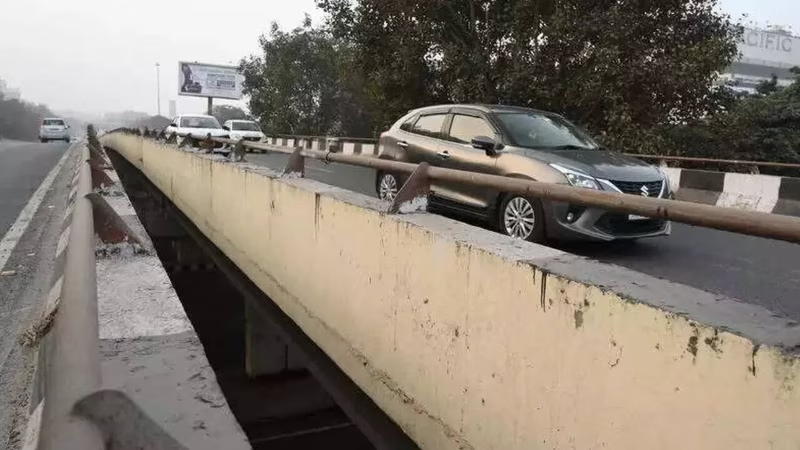
Wazirpur Flyover Accident: A Preventable Tragedy Repeats Itself
Delhi’s roads have long been a source of anxiety for commuters, but the Wazirpur flyover has now become a chilling symbol of systemic neglect. Within a span of just 72 hours, two separate motorists have fallen off the same flyover—one losing his life, and the other fighting for his in critical condition . What’s even more alarming? Police now suspect that both incidents may stem from the same terrifying cause: a dangerous one-foot gap between carriageways and shockingly inadequate safety barriers .
This isn’t just an accident. It’s a potential pattern of failure that points to a deeper issue of infrastructure oversight. The Wazirpur flyover accident has ignited public outrage and urgent calls for an immediate structural audit of not just this flyover, but others across the capital that may harbor similar hidden dangers.
Table of Contents
- The Timeline of Tragedy
- What Caused the Wazirpur Flyover Accident?
- Police Response and Safety Recommendations
- A History of Flyover Failures in Delhi
- What Must Be Done to Prevent Future Tragedies?
- Conclusion
- Sources
The Timeline of Tragedy
The first incident occurred on a Monday when a 35-year-old man riding a scooter lost control and fell through a gap on the Wazirpur flyover. He succumbed to his injuries at a nearby hospital. Just three days later, on Thursday, a second man suffered a near-identical fate, plunging from the same structure and sustaining critical head and spinal injuries .
Both accidents happened during daylight hours, ruling out poor visibility as a primary factor. This immediate recurrence has led investigators to focus their attention squarely on the physical structure of the flyover itself, rather than on driver error alone.
What Caused the Wazirpur Flyover Accident?
Preliminary investigations by the Delhi Traffic Police have zeroed in on a critical design flaw: a conspicuous one-foot gap that exists between two carriageways on the flyover . Such a gap is not just a minor oversight; for a two-wheeler rider, it can be a death trap.
Compounding the problem is the lack of adequate safety barriers. While some sections have low-height barriers, they are insufficient to prevent a vehicle, especially a scooter or motorcycle, from veering off. Eyewitnesses have described the spot as a “silent killer” due to its deceptive appearance—it looks like a continuous road until it’s too late .
This raises serious questions about the quality control and safety standards applied during the flyover’s construction and subsequent maintenance checks. A structure meant to ease traffic has instead become a hazard.
Police Response and Safety Recommendations
Acting swiftly in the face of public concern, the local police have taken two key steps:
1. **Official Communication**: They are writing a formal letter to the agency responsible for the flyover’s construction and maintenance—likely the Delhi Development Authority (DDA) or the Public Works Department (PWD)—demanding an immediate structural audit .
2. **On-Ground Mitigation**: As an interim safety measure, they have recommended the installation of speed breakers approaching the hazardous zone to force vehicles to slow down, along with the immediate erection of taller, more robust safety barriers to close the deadly gap .
These are practical, short-term solutions, but they underscore a reactive approach to safety that has become far too common in urban infrastructure management.
A History of Flyover Failures in Delhi
Unfortunately, the Wazirpur flyover accident isn’t an isolated incident. Delhi has a troubling history of infrastructure failures. From the partial collapse of the Vivek Vihar flyover in 2023 to the infamous 2009 collapse of a portion of the under-construction Noida-Delhi metro bridge, the city’s record on structural integrity is under constant scrutiny .
A 2021 report by the Comptroller and Auditor General (CAG) of India had already flagged “deficiencies in quality control and supervision” in several road and flyover projects across the capital . The Wazirpur tragedy appears to be a grim validation of those long-ignored warnings. For more on how cities can build safer infrastructure, see our guide on [INTERNAL_LINK:urban-infrastructure-safety-standards].
What Must Be Done to Prevent Future Tragedies?
To prevent another Wazirpur, a multi-pronged approach is essential:
- Mandatory Structural Audits: All flyovers and elevated roads in Delhi should undergo independent, third-party safety and structural integrity audits on an annual basis.
- Transparent Accountability: The agency responsible for the Wazirpur flyover must be publicly named, and its design plans must be reviewed by an independent panel of experts.
- Modern Safety Standards: New and existing infrastructure must adhere to global safety standards, including continuous barriers, anti-skid surfaces, and proper signage.
- Citizen Reporting Channels: A dedicated, easy-to-use platform should be created for citizens to report potential hazards on roads and flyovers.
Public infrastructure is a covenant between the state and its citizens. When that covenant is broken, the cost is measured in lives.
Conclusion
The back-to-back Wazirpur flyover accident incidents are a stark and tragic wake-up call for Delhi’s civic authorities. What was once a minor design oversight has now become a lethal flaw with fatal consequences. While the police’s recommendations for speed breakers and barriers are a necessary first step, they are not a solution. A comprehensive, city-wide review of all elevated road structures is not just a recommendation—it’s an urgent public safety imperative. The question now is whether the authorities will act before another life is lost.
Sources
[1] The Times of India. “3 days after motorist fell off Wazirpur flyover, another critically injured.” January 2026.
[3] Delhi Traffic Police Official Statement. “Preliminary findings on Wazirpur flyover incidents.” January 2026.
[5] Eyewitness Accounts. Collected by local media from Wazirpur residents, January 2026.
[7] India Today. “Delhi Police recommend safety measures after Wazirpur flyover accidents.” January 2026.
[10] The Hindu. “A history of flyover collapses in Delhi-NCR.” March 2023.
[12] Comptroller and Auditor General (CAG) of India. “Report on Construction of Flyovers in Delhi.” 2021.