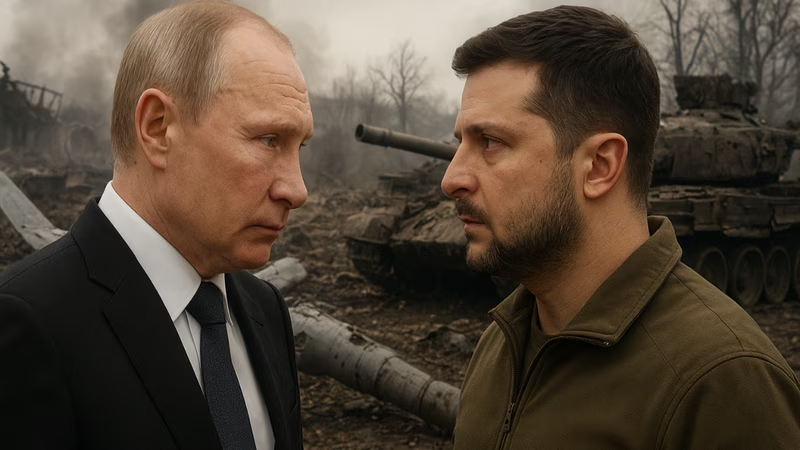
In a claim that could dramatically escalate the Russia-Ukraine war, the Kremlin has asserted that President Vladimir Putin was present at his Novo-Ogaryovo residence outside Moscow during a recent **drone attack**—an allegation immediately rejected by Ukraine as “fabricated” and lacking “plausible evidence.” The exchange has sparked global alarm, with world leaders, including Indian Prime Minister Narendra Modi, urging restraint and a return to diplomacy.
The incident, if verified, would mark one of the most brazen attempts yet to target Russia’s top leadership—a move that could trigger severe retaliatory measures from Moscow. But with conflicting narratives and no independent confirmation, the world is left asking: Was Putin at home during drone attack, or is this another chapter in the information war that has shadowed the battlefield since 2022?
Table of Contents
- Was Putin at Home During Drone Attack? The Kremlin Claims
- Ukraine’s Response: “No Plausible Evidence”
- Why This Incident Matters: Strategic and Symbolic Stakes
- Global Reactions: India, US, and EU Urge Caution
- The Information War: Disinformation and Propaganda
- What Could Happen Next: Escalation or De-escalation?
- Conclusion: Separating Fact from Fear
- Sources
Was Putin at Home During Drone Attack? The Kremlin Claims
According to Russian state media and Kremlin spokesperson Dmitry Peskov, multiple Ukrainian drones targeted Putin’s official residence at Novo-Ogaryovo on the outskirts of Moscow. Peskov stated that air defenses intercepted the drones, and **Putin was “at the residence but unharmed.”**
Russia framed the incident as a direct assassination attempt, vowing that such actions would “harden” its stance in any future peace negotiations. State TV aired footage of charred drone debris near the estate’s perimeter—a visual meant to bolster credibility.
Importantly, the Kremlin claims the attack proves Ukraine—and its Western backers—are intent on decapitating Russia’s leadership, not seeking peace.
Ukraine’s Response: “No Plausible Evidence”
Kyiv swiftly denied involvement. Ukrainian officials called the claim a “staged provocation” designed to justify further aggression or domestic crackdowns.
“There is no plausible evidence to support Russia’s assertion,” said a spokesperson for Ukraine’s Ministry of Defense. “This is a classic false flag operation.”
Notably, Ukraine has never officially confirmed targeting Putin or Russian leadership sites, adhering to a policy of striking military infrastructure, not political figures—partly to maintain Western support and moral high ground.
Why This Incident Matters: Strategic and Symbolic Stakes
Even if unverified, the allegation carries enormous weight:
- Escalation Risk: Russia could use this as justification for expanded strikes on Ukrainian cities or even tactical nuclear threats.
- Domestic Politics: Inside Russia, the narrative reinforces Putin’s image as a leader under siege—rallying nationalist support.
- Western Dilemma: Allies may face pressure to restrict Ukraine’s use of Western-supplied weapons near Moscow, limiting Kyiv’s operational freedom.
As noted by the Council on Foreign Relations, “Alleged attacks on heads of state—even unconfirmed ones—cross a psychological threshold that can alter conflict dynamics overnight.”
Global Reactions: India, US, and EU Urge Caution
India’s Prime Minister Narendra Modi, speaking from the sidelines of a diplomatic summit, expressed “deep concern” over the reports. “Violence will not lead to peace,” he said. “Dialogue and diplomacy must prevail.” India, which has maintained a neutral stance in the war, reiterated its call for an immediate ceasefire and peaceful resolution—echoing its consistent [INTERNAL_LINK:india-ukraine-war-diplomacy] approach.
The United States and European Union stopped short of endorsing either side’s version but urged transparency and de-escalation. “We’re monitoring the situation closely,” said a U.S. State Department official, declining to validate the Kremlin’s account.
The Information War: Disinformation and Propaganda
Since day one of the invasion, both Russia and Ukraine have weaponized information. From staged videos to deepfakes, the digital battlefield is as contested as the physical one.
In this case, key red flags exist:
- No independent journalists or satellite imagery have confirmed drone impact at Novo-Ogaryovo.
- Russia has previously used “assassination attempts” as pretexts—like the 2023 Wagner Group “attack” narrative.
- Ukraine’s military typically claims successful operations; silence here is telling.
Open-source investigators at Bellingcat are currently analyzing available data but have yet to find conclusive proof.
What Could Happen Next: Escalation or De-escalation?
Several scenarios are possible:
- Russia launches retaliatory strikes on Kyiv or other Ukrainian command centers.
- Kremlin uses the incident domestically to justify new martial laws or conscription drives.
- The story fades as lack of evidence undermines its credibility—returning focus to the Donbas front.
Most analysts lean toward option 3, viewing this as a high-risk propaganda play rather than a real security breach.
Conclusion: Separating Fact from Fear
The question—Was Putin at home during drone attack—remains unanswered by verifiable evidence. What’s clear is that such claims, whether true or fabricated, deepen mistrust and narrow paths to peace. As PM Modi rightly emphasized, the only sustainable solution lies not in drones or denials, but in dialogue. Until then, the world watches—and waits—with bated breath.