Table of Contents
- What Happened on Wall Street?
- Trump’s Greenland Comments: What Did He Actually Say?
- Why Did Markets React So Strongly?
- Global Impact: How India and Other Markets Were Affected
- Flight to Safety: Gold Rises, Bitcoin Wobbles
- What Should Investors Do Now?
- Conclusion: A Warning Shot for Global Trade Stability
- Sources
What Happened on Wall Street?
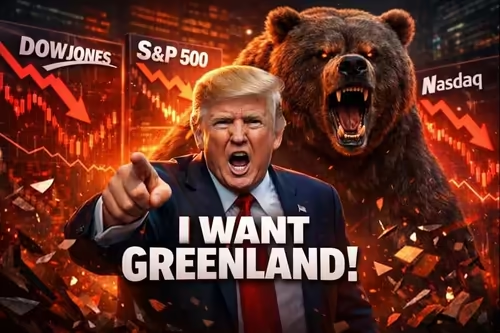
Tuesday was a brutal day for U.S. equities. In a sharp reversal from recent gains, Wall Street tumbles across the board, marking the worst single-day drop in nearly three months. The Dow Jones Industrial Average shed a staggering 850 points, while the broader S&P 500 index slid by 2%. The tech-heavy Nasdaq wasn’t spared either, falling in line with the broader risk-off sentiment .
This wasn’t just a minor correction—it was a full-blown panic triggered by geopolitical noise that reignited fears of a new trade war. And at the center of it all? A surprising comment from former President Donald Trump about Greenland.
Trump’s Greenland Comments: What Did He Actually Say?
While campaigning in New Hampshire, Trump floated a provocative idea: if Europe doesn’t cooperate on defense spending or trade, the U.S. should consider imposing tariffs on goods from countries like Denmark—which administers Greenland. Though he didn’t announce any formal policy, the mere suggestion of new tariffs against European allies sent shockwaves through financial markets .
Recall that during his first term, Trump’s unpredictable trade rhetoric often led to immediate market volatility. Investors still remember the 2018–2019 trade wars with China and the EU, which caused prolonged uncertainty and multiple market selloffs. This latest comment felt like a ghost from the past—and markets reacted accordingly.
Why Did Markets React So Strongly?
At first glance, a comment about Greenland might seem far-fetched. But investors aren’t just reacting to geography—they’re pricing in the risk of renewed protectionism. Here’s why the reaction was so intense:
- Trade sensitivity: Global supply chains are still fragile post-pandemic. Any hint of new tariffs threatens corporate profits and inflation outlooks.
- Election-year uncertainty: With the 2024 U.S. presidential election heating up, Trump’s statements carry more weight. Markets fear a return to aggressive trade policies if he wins.
- Liquidity conditions: Current interest rates are already high. Adding trade tensions increases the perceived risk premium, prompting institutional investors to reduce exposure quickly.
In short, the market isn’t just pricing in what Trump said—it’s pricing in what he might do if returned to power.
Global Impact: How India and Other Markets Were Affected
The sell-off wasn’t confined to the U.S. Financial contagion spread rapidly:
- European markets like the FTSE 100 and DAX dropped over 1.5%.
- Asian indices followed suit, with Japan’s Nikkei and South Korea’s KOSPI closing lower.
- In India, both the Sensex and Nifty fell more than 1%, reflecting investor anxiety over global headwinds and potential foreign fund outflows .
For Indian investors, this is a reminder of how interconnected global markets have become. Even domestic-focused companies can see their valuations pressured when international risk appetite dries up. [INTERNAL_LINK:how-global-markets-affect-indian-stocks] could be a useful resource for readers wanting to understand this linkage better.
Flight to Safety: Gold Rises, Bitcoin Wobbles
When Wall Street tumbles, investors instinctively seek safe havens. On Tuesday, that meant a surge in gold prices, which climbed above $2,350 per ounce—the highest level in weeks .
Cryptocurrencies, however, told a different story. Bitcoin, often touted as “digital gold,” actually declined slightly, showing it’s still viewed more as a risk asset than a true hedge during equity market stress. This divergence highlights an important truth: in times of real macro uncertainty, traditional safe havens still dominate.
What Should Investors Do Now?
Panic selling is rarely a winning strategy. Instead, consider these measured steps:
- Rebalance, don’t react: If your portfolio has drifted from its target allocation due to the drop, now may be a good time to rebalance—not flee.
- Focus on quality: Companies with strong balance sheets, consistent cash flows, and low debt tend to weather volatility better.
- Watch the Fed: The Federal Reserve’s next move on interest rates will be crucial. High rates plus trade tensions = a volatile cocktail.
Remember: one bad day doesn’t define a trend. But it does signal that geopolitical risks are back on the table.
Conclusion: A Warning Shot for Global Trade Stability
The Wall Street tumbles we saw on Tuesday weren’t just about numbers—they were a stark reminder of how fragile market confidence can be. A single political comment, amplified by social media and election-year dynamics, was enough to erase hundreds of billions in market value in hours.
As we move closer to November 2024, investors should brace for more volatility driven by policy uncertainty. Diversification, discipline, and a long-term perspective remain the best defenses against short-term noise. For now, the message is clear: the era of “policy calm” may be over.
Sources
- Times of India: Wall Street tumbles! Dow sheds 850 points, S&P 500 slips 2% after Trump’s Greenland bid
- World Gold Council: Gold Price Data & Market Insights
- U.S. Securities and Exchange Commission (SEC): Investor Education Resources