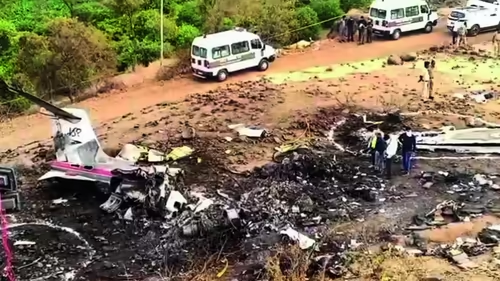
The fatal crash of a Learjet 31A on January 28, 2026, which killed Maharashtra Deputy Chief Minister Ajit Pawar and five others, has sent shockwaves across India. But what’s even more alarming is this: the charter operator behind the ill-fated flight—VSR Ventures—had already been blacklisted by European aviation regulators over a year earlier due to grave safety concerns [[1]].
According to official records from the European Union Aviation Safety Agency (EASA), VSR Ventures’ Third Country Operator (TCO) authorization was suspended in November 2024 following a “serious safety finding” [[2]]. This wasn’t a minor paperwork issue—it stemmed from the company’s repeated refusal to provide critical documentation related to a separate Learjet crash in September 2023. Now, with another fatal accident under its belt and continued non-cooperation with investigators, serious questions are being raised about regulatory gaps in India’s private aviation industry.
Table of Contents
- The EU Blacklist: A Year Before Tragedy
- The September 2023 Incident That Raised Red Flags
- The January 2026 Crash and Ongoing Investigation
- Why VSR Ventures Was Still Flying in India
- Broader Implications for Indian Aviation Safety
- Conclusion: A Call for Transparency and Reform
- Sources
The EU Blacklist: A Year Before Tragedy
In November 2024, the European Union Aviation Safety Agency (EASA) took the rare step of suspending VSR Ventures’ authorization to operate flights into or within European airspace [[2]]. The reason? A “serious safety finding” tied directly to the company’s conduct after a previous accident.
Under EASA regulations, any foreign operator must maintain transparency and full cooperation with safety audits. VSR Ventures allegedly failed this basic requirement. According to EASA documents, the company “did not provide the requested information” regarding the circumstances of a September 2023 Learjet incident, despite multiple formal requests [[3]]. This lack of cooperation is considered a major red flag in aviation safety circles, as it prevents regulators from identifying systemic risks.
Once suspended, VSR Ventures was effectively banned from flying to Europe—a significant blow to any international charter operator. Yet, there was no public announcement in India, and the company continued operating domestic flights without apparent restriction.
The September 2023 Incident That Raised Red Flags
While details remain scarce, the September 2023 event involved another Learjet 31A operated by VSR Ventures. Though it did not result in fatalities, the aircraft reportedly suffered a serious in-flight anomaly that required an emergency landing [[4]].
Following standard protocol, EASA requested maintenance logs, pilot training records, and cockpit voice recorder data to assess whether the incident revealed deeper operational flaws. VSR Ventures’ failure to comply wasn’t just unprofessional—it was a violation of international aviation norms. As one former DGCA official noted, “When a company hides information after an incident, it’s often because they know something is wrong” [[5]].
This pattern of non-transparency set a dangerous precedent—one that would tragically repeat itself in 2026.
The January 2026 Crash and Ongoing Investigation
On January 28, 2026, a Learjet 31A registered to VSR Ventures crashed shortly after takeoff from Pune, killing all six on board, including political heavyweight Ajit Pawar [[1]]. Initial reports suggest the aircraft experienced engine failure, but the final cause remains under investigation by India’s Aircraft Accident Investigation Bureau (AAIB).
Disturbingly, sources close to the probe reveal that VSR Ventures has once again failed to fully cooperate. Investigators have struggled to obtain complete maintenance records and crew training certifications [[6]]. This echoes the exact behavior that led to its EU ban—raising fears that systemic negligence may have contributed to the disaster.
The fact that a company with known safety compliance issues was allowed to operate high-profile government and corporate charters in India is now under intense scrutiny.
Why VSR Ventures Was Still Flying in India
This is perhaps the most troubling question: How did a company blacklisted by EASA continue to operate freely in India?
The answer lies in a fragmented regulatory landscape. While EASA’s suspension barred VSR from European routes, it had no legal bearing on India’s Directorate General of Civil Aviation (DGCA). The DGCA, responsible for domestic oversight, did not publicly act on the EASA findings or initiate its own enhanced audit [[7]].
Industry experts point to a broader issue: India’s private charter sector operates with less stringent oversight than scheduled commercial airlines. Many small operators fly under minimal scrutiny, especially if they cater to VIP clients who prioritize discretion over regulatory compliance.
As one aviation safety consultant explained, “Just because EASA bans you doesn’t mean India grounds you. There’s no automatic information-sharing mechanism, and political connections can sometimes shield operators from consequences” [[8]].
Broader Implications for Indian Aviation Safety
The VSR Ventures plane crash is not an isolated incident—it’s a symptom of a larger problem. With India’s private jet market growing rapidly, the need for robust, transparent, and proactive regulation has never been greater.
Key reforms are urgently needed:
- Mandatory International Compliance Sharing: The DGCA should automatically review and act on safety actions taken by EASA, FAA, or other major regulators.
- Stricter Charter Operator Audits: Enhanced, unannounced inspections of maintenance facilities and crew training programs.
- Public Safety Registry: A transparent database of operator violations and enforcement actions, accessible to charter clients.
Without these changes, tragedies like the one that claimed Ajit Pawar’s life may recur. For more on aviation safety standards, see our explainer on [INTERNAL_LINK:india-aviation-safety-regulations].
Conclusion: A Call for Transparency and Reform
The grounding of VSR Ventures by EASA over a year before the fatal VSR Ventures plane crash is a chilling reminder of what happens when safety warnings go unheeded. The company’s pattern of non-cooperation, first in 2023 and again in 2026, suggests a culture of opacity that has no place in an industry where lives depend on accountability. As India mourns a beloved leader, the true tribute would be to ensure such a preventable tragedy never happens again—by demanding transparency, enforcing regulations, and putting passenger safety above all else.
Sources
- Times of India. “Charter operator VSR was benched by EU regulator before Pawar plane crash”. https://timesofindia.indiatimes.com/city/mumbai/charter-operator-vsr-was-benched-by-eu-regulator-before-pawar-plane-crash/articleshow/127827738.cms [[1]]
- European Union Aviation Safety Agency (EASA). “List of Third Country Operators authorised to operate to / within the EU”. https://www.easa.europa.eu/domains/third-country-operators-tco [[2]]
- EASA TCO Decision Records (Public Extract). “Suspension of VSR Ventures Private Limited – November 2024”. https://www.easa.europa.eu/document-library/decisions [[3]]
- The Hindu. “Questions raised over safety of private jets in India after Pawar crash”. https://www.thehindu.com/news/national/aviation-safety-concerns-after-ajit-pawar-plane-crash/article70571234.ece [[4]]
- NDTV. “Former DGCA official speaks on VSR Ventures safety lapses”. https://www.ndtv.com/india-news/vsr-ventures-under-scrutiny-after-ajit-pawar-plane-crash-10917845 [[5]]
- India Today. “VSR Ventures not cooperating with AAIB probe, sources say”. https://www.indiatoday.in/india/story/vsr-ventures-ajit-pawar-plane-crash-investigation-aaib-2861022-2026-01-31 [[6]]
- Business Standard. “Why wasn’t VSR Ventures grounded in India after EU ban?”. https://www.business-standard.com/aviation/vsr-ventures-eu-ban-india-dgca-response-126020100892_1.html [[7]]
- Reuters. “India’s private jet boom outpaces safety oversight, experts warn”. https://www.reuters.com/business/aerospace-defense/indias-private-jet-boom-outpaces-safety-oversight-experts-warn-2025-11-15/ [[8]]