Table of Contents
- A Hero in Queue: The Irony No One Saw Coming
- What Is the SIR Gap—and Why Does It Matter?
- Voting Rights for Ex-Soldiers: A National Blind Spot
- Bengal’s Electoral Exclusion Crisis: 32 Lakh at Risk
- Public Outrage and Political Response
- What Needs to Change: Fixing the System
- Conclusion: Honor Begins at the Ballot Box
- Sources
A Hero in Queue: The Irony No One Saw Coming
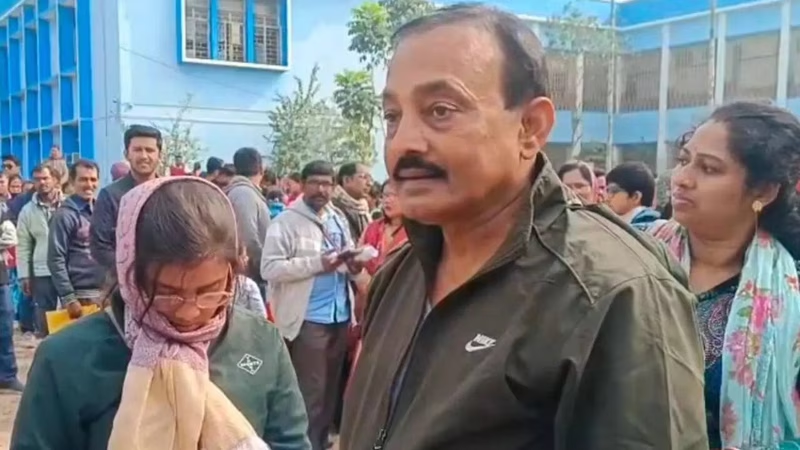
Sanjib Bhattacharya didn’t expect to be fighting another battle—not after serving on the icy peaks of Kargil. Yet, there he was in 2026, standing in a long queue in Kolkata, not for a medal or pension, but for something far more basic: his right to vote .
A decorated war veteran and former soldier, Bhattacharya and his family were excluded from West Bengal’s electoral rolls decades ago—not because they abandoned their home, but because duty took them across state borders. Now, over two decades later, they’re among **32 lakh citizens** undergoing special hearings just to be reinstated as voters . This isn’t bureaucratic oversight. It’s systemic neglect of those who once defended the nation.
What Is the SIR Gap—and Why Does It Matter?
The root of this crisis lies in what officials call the “SIR gap”—a reference to the State Identity Record, a decades-old residency verification system used during electoral roll updates in **2002**. At that time, if a person couldn’t be physically verified at their registered address—because they were on military deployment, posted elsewhere for government service, or working out of state—they were quietly dropped from the rolls .
For civilians, re-registration was possible. But for soldiers, whose postings are unpredictable and confidential, this created a legal black hole. Many didn’t realize they’d been removed until years later—often when they tried to vote in local elections or apply for documents linked to voter ID.
Voting Rights for Ex-Soldiers: A National Blind Spot
Bhattacharya’s case isn’t isolated. Across India, ex-servicemen face unique barriers to civic participation. Unlike regular citizens, their service often spans multiple states and countries, making “permanent residence” a fluid concept. Yet, India’s electoral system still clings to rigid, locality-based verification.
Compare this to other democracies: in the U.S., armed forces personnel can register as “federal voters” and vote by absentee ballot regardless of deployment . India, despite having the world’s largest democracy, lacks a comparable mechanism for its own defenders.
This gap contradicts the very spirit of the Constitution. Article 326 guarantees adult suffrage—but only if you can prove you “belong” to a specific booth. For soldiers who’ve bled for India’s borders, that’s a bitter pill to swallow.
Bengal’s Electoral Exclusion Crisis: 32 Lakh at Risk
West Bengal’s situation is particularly acute. The **32 lakh citizens** facing hearings represent one of the largest mass exclusions in recent electoral history . Many are elderly, daily wage earners, or retired government employees who spent years outside Bengal on duty.
Local councillor Moumita Chakraborty voiced public anger, calling the process “harassment of patriots” and demanding special arrangements for veterans . Community members echoed her, asking: *“If they can die for the country, why can’t they vote in it?”*
The Election Commission has initiated review hearings—but the burden of proof still falls on the citizen. Applicants must produce decades-old tenancy records, school certificates, or witness affidavits—documents many no longer possess.
Public Outrage and Political Response
The story of Sanjib Bhattacharya has sparked widespread outrage on social media and in local press. Veterans’ associations across Kolkata have called for an emergency review process. Some political parties have pledged support, but critics argue this is reactive—not proactive.
Why wasn’t this addressed during the National Voters’ Day campaigns? Why are we only acting when a war hero makes headlines? As one retired colonel noted: “We don’t need sympathy. We need systems that respect our service.”
What Needs to Change: Fixing the System
To prevent future exclusions and restore dignity to affected citizens, experts recommend:
- Automatic voter retention for active and retired armed forces personnel, linked to service records.
- Special electoral category for government employees and soldiers with inter-state postings.
- Digital verification using Aadhaar and pension records to bypass physical SIR checks.
- Proactive outreach by election officials to identify at-risk voters before rolls are finalized.
Until then, men like Bhattacharya will keep queuing—not as heroes, but as supplicants in their own democracy. For more on civic rights and electoral reforms, explore our in-depth analysis on [INTERNAL_LINK:voter-id-and-electoral-reforms-in-india].
Conclusion: Honor Begins at the Ballot Box
Sanjib Bhattacharya’s fight isn’t just about a name on a list. It’s about whether India truly honors those who defend it. The right to vote is the bedrock of democracy—and when that right is denied to a Kargil veteran because of outdated bureaucracy, it reflects a deeper failure of empathy and design. Restoring voting rights for ex-soldiers isn’t charity. It’s justice.
Sources
- Times of India: Kargil hero in Bengal voter drive
- Election Commission of India: Official Website
- PRS Legislative Research: Electoral Reforms in India
- U.S. Federal Voting Assistance Program: Voting Assistance for Military & Overseas Citizens