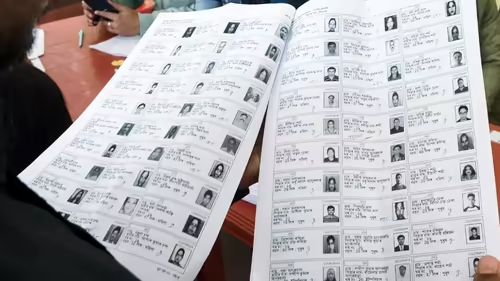
In a development that could reshape the discourse around electoral integrity and civil rights in India, the Supreme Court has issued a direct and pointed question to the Election Commission of India (ECI): How many voters have been deleted from electoral rolls specifically over doubts regarding their citizenship? This simple yet powerful query cuts to the heart of a growing national concern—balancing the need for clean voter lists against the fundamental right to vote, a cornerstone of Indian democracy.
Table of Contents
- The Supreme Court’s Directive: A Demand for Transparency
- Why This Question Matters: The Stakes of Voter Deletion
- The Link Between NRC and Electoral Rolls
- Concerns Over Process and Potential Mistakes
- What the ECI Response Could Reveal
- Conclusion: A Crucial Test for Indian Democracy
The Supreme Court’s Directive: A Demand for Transparency
The apex court’s intervention is not merely administrative; it’s a judicial call for accountability. During recent hearings, the bench expressed deep concern over the lack of publicly available data on voter deletions linked to citizenship verification. The court has now formally asked the ECI to provide a comprehensive, nationwide figure. This move follows petitions from civil society groups and opposition parties who allege that the process of removing names from voter lists has been opaque, inconsistent, and, in some cases, arbitrary . The focus keyword here is clear: voter deletion over citizenship is no longer just a bureaucratic footnote—it’s a matter of national legal scrutiny.
Why This Question Matters: The Stakes of Voter Deletion
The right to vote is enshrined in the Indian Constitution as a fundamental pillar of representative democracy. When a citizen’s name is removed from the electoral roll without proper notice or a fair hearing, it amounts to disenfranchisement—a severe curtailment of their civic rights. The implications are profound:
- Political Impact: Mass deletions can alter the demographic composition of constituencies, potentially influencing election outcomes.
- Social Impact: Marginalized communities, including minorities and the poor, are often disproportionately affected due to difficulties in producing legacy documents.
- Legal Impact: It raises questions about the separation of powers—should electoral officials be making quasi-judicial determinations on citizenship, a complex legal status?
The Link Between NRC and Electoral Rolls
While the National Register of Citizens (NRC) exercise in Assam was a state-specific initiative, its shadow looms large over this national debate. In Assam, individuals excluded from the NRC were also removed from the voter list, effectively stripping them of their voting rights pending legal appeals . The fear among activists is that a similar, albeit less formal, process might be creeping into other states through routine voter list revisions. The ECI maintains that deletions are based on Form 7 objections and follow due process, but critics argue that the burden of proof often falls unfairly on the voter, especially when the objection is based on vague “doubts” about nationality.
Concerns Over Process and Potential Mistakes
Several documented cases highlight the risks of error in this system. There have been reports of elderly citizens, war veterans, and even government employees being mistakenly flagged and removed from rolls because they couldn’t immediately produce decades-old birth certificates or land records. The process often lacks adequate mechanisms for appeal or re-inclusion before an election, leaving citizens voiceless at the ballot box. This is where the Supreme Court’s query becomes vital—it forces a systemic audit. As the Human Rights Watch and other international bodies have noted, any process that risks depriving citizens of their franchise must be transparent, fair, and subject to robust oversight.
What the ECI Response Could Reveal
The ECI’s forthcoming response will be closely watched. A high number of deletions could validate concerns about widespread disenfranchisement. A low number might suggest the issue is more localized. But beyond the raw figure, the court will likely demand details on:
- The states or districts where most deletions occurred.
- The procedural safeguards in place during the deletion process.
- The number of individuals who successfully appealed and were reinstated.
This data will be crucial for policymakers, researchers, and civil society to assess whether the current framework protects both electoral integrity and individual rights.
Conclusion: A Crucial Test for Indian Democracy
The Supreme Court’s question—“How many voters were deleted over citizenship?”—is far more than a request for statistics. It’s a litmus test for the health of India’s democratic institutions. The principle is simple: every eligible citizen must have the unimpeded right to vote. The process of maintaining clean electoral rolls must never become a tool for exclusion. The ECI’s answer, and the subsequent actions taken by the judiciary and legislature, will determine whether India’s world’s largest democracy can uphold its most sacred promise: that every voice counts. The nation is watching.
Sources
- Supreme Court asks EC: How many deleted over citizenship from rolls? Times of India.
- Petitions filed by civil society organizations on voter disenfranchisement. Supreme Court of India records.
- Assam NRC and its impact on voter lists. Ministry of Home Affairs, Government of India.
- International standards on electoral rights. Human Rights Watch. https://www.hrw.org/