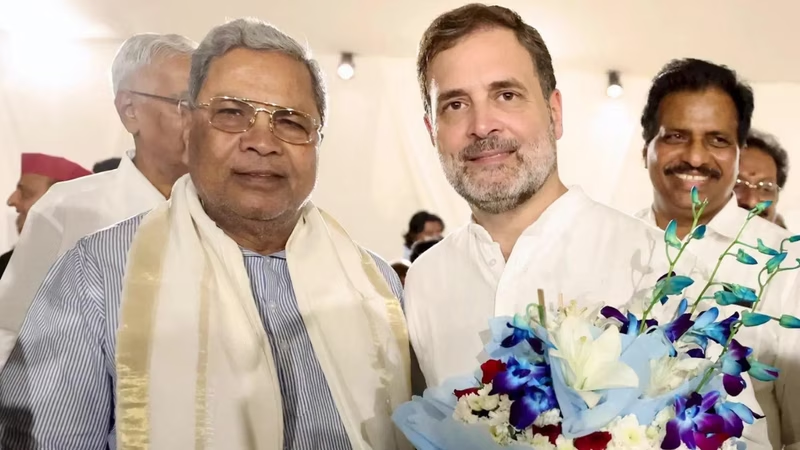
Karnataka CM Slams ‘Vote Chori’ Narrative: Siddaramaiah Defends Rahul Gandhi Against EC Survey Misuse
In the high-stakes arena of Indian electoral politics, few phrases ignite controversy faster than “Vote Chori.” Now, Karnataka Chief Minister Siddaramaiah has stepped into the fray, launching a sharp defense of Congress leader Rahul Gandhi while accusing the BJP and certain media outlets of weaponizing a routine administrative exercise to manufacture a scandal. His core argument? The much-cited survey supposedly backing the “Vote Chori” claims wasn’t about election rigging at all—and its methodology doesn’t hold water.
Speaking at a press conference in Bengaluru, Siddaramaiah didn’t mince words, calling the narrative a “deliberate misinformation campaign” designed to distract from real governance issues and undermine public trust in India’s electoral system .
Table of Contents
- What Is the ‘Vote Chori’ Claim?
- Siddaramaiah’s Defense: The EC Survey Explained
- Why the Survey Doesn’t Prove ‘Vote Chori’
- The Political Battlefield: Misinformation and Media
- Broader Implications for Indian Democracy
- Conclusion: A Call for Factual Integrity
- Sources
What Is the ‘Vote Chori’ Claim?
The phrase “Vote Chori” (Hindi for “vote theft”) was popularized by Rahul Gandhi during the 2023 Karnataka Assembly elections. He alleged that voter lists were being manipulated—specifically, that genuine voters were being removed and replaced with “ghost” or ineligible voters—to swing elections in favor of the BJP .
This claim quickly became a central talking point for the Congress party in the state. However, the BJP and its supporters seized on a government-conducted survey to refute Gandhi’s allegations, arguing that the data showed no such manipulation had occurred.
Siddaramaiah’s Defense: The EC Survey Explained
At the heart of the controversy is a survey conducted by a field agency under the aegis of the Election Commission of India (ECI). The BJP has been citing this survey as definitive proof that Rahul Gandhi’s Vote Chori allegations are baseless.
Siddaramaiah, however, insists this is a gross misrepresentation. He clarified that the survey in question was an administrative tool, not an audit of electoral integrity. Its primary objective was to assess voter awareness—specifically, whether people knew their polling booth locations, understood voter ID procedures, and were familiar with the electoral process .
“This was never a forensic exercise to cross-verify the authenticity of voter lists,” Siddaramaiah stated firmly. “To use its findings to discredit serious concerns about electoral rolls is not just misleading—it’s a misuse of public data for partisan ends.”
Why the Survey Doesn’t Prove ‘Vote Chori’
The CM’s rebuttal hinges on two key criticisms of the survey’s design and interpretation:
- Wrong Purpose, Wrong Conclusions: The survey’s mandate was educational, not investigative. It asked questions like, “Do you know where your polling booth is?” not “Is your name on the voter list?” Drawing conclusions about voter list manipulation from this data is like using a customer satisfaction survey to prove a bank isn’t committing fraud. The tools simply don’t match the claim.
- Statistically Insignificant Sample Size: Siddaramaiah pointed out that the survey covered a mere 3,000 respondents across Karnataka—a state with over 50 million registered voters . Statisticians widely agree that such a tiny sample cannot be extrapolated to make sweeping claims about the integrity of an entire electoral roll. It lacks the statistical power to be conclusive.
Experts from the Election Commission of India itself have historically emphasized that voter list verification is an ongoing, multi-layered process involving door-to-door surveys, public hearings, and digital verification—not a one-off, small-scale poll .
The Political Battlefield: Misinformation and Media
Siddaramaiah accused sections of the media of being complicit in the distortion, suggesting they ran with the BJP’s narrative without seeking context from the Election Commission or the state government. He framed this as part of a larger pattern where administrative data is twisted into political ammunition.
“They take a small, routine exercise and blow it out of proportion to create a false sense of certainty,” he said. “This is how misinformation becomes mainstream. It’s dangerous for our democracy.”
This incident highlights a growing trend in Indian politics: the strategic use of data—often decontextualized or misunderstood—to fuel polarizing narratives. The Karnataka voter list controversy is a textbook example of how technical, bureaucratic processes can be hijacked in the court of public opinion.
Broader Implications for Indian Democracy
The stakes in this debate go far beyond a single press conference. Public trust in the electoral system is the bedrock of any democracy. When data is misused to either fuel unfounded conspiracy theories or to prematurely shut down legitimate inquiries, that trust erodes.
The Congress has long argued for independent, transparent audits of voter lists—especially in states with high migration or reported discrepancies. By dismissing these concerns with a flawed interpretation of a completely different survey, the counter-narrative may be doing more harm than good to the very institution it claims to defend: the ECI.
For more on how data is shaping India’s political discourse, see our deep dive on [INTERNAL_LINK:indian-election-data-politics].
Conclusion: A Call for Factual Integrity
Siddaramaiah’s defense of Rahul Gandhi isn’t just about partisan loyalty; it’s a plea for factual rigor in political debate. The Vote Chori controversy, as it stands, is built on a house of cards—one that conflates a voter awareness survey with a forensic audit. Until a proper, large-scale, and transparent verification of electoral rolls is conducted and its findings made public, the debate will remain mired in speculation and spin.
In a democracy, allegations of electoral malpractice must be taken seriously and investigated with methodological integrity—not dismissed with a misleading headline or a misapplied statistic. As Siddaramaiah rightly notes, the truth matters more than the narrative.
Sources
- The Times of India: Siddaramaiah defends Rahul on ‘Vote Chori’ claims
- NDTV: Rahul Gandhi Raises ‘Vote Chori’ Issue in Karnataka Polls
- The Hindu: Siddaramaiah Slams BJP Over Misuse of EC Survey Data
- The Indian Express: Karnataka CM defends Rahul Gandhi on ‘Vote Chori’
- The Economic Times: Role of the Election Commission of India