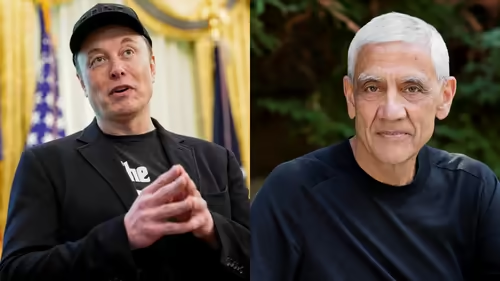
When Elon Musk tweets, the world listens. But this time, one of Silicon Valley’s founding fathers didn’t just listen—he clapped back hard.
Vinod Khosla, the Sun Microsystems co-founder and famed venture capitalist behind Khosla Ventures, has publicly called out Elon Musk for what he described as a “racist” social media post. The exchange, which unfolded on X (formerly Twitter), has reignited fierce debates about race, power, and accountability in the tech elite—and it all started with a single, inflammatory comment from Musk about “white people.”
Now, the Vinod Khosla vs Elon Musk showdown isn’t just gossip—it’s a flashpoint in the ongoing culture war over who gets to define truth, identity, and acceptable discourse in the digital age.
Table of Contents
- What Did Elon Musk Say?
- Vinod Khosla’s Blunt Response
- The History Between Khosla and Musk
- Why This Feud Matters Beyond Celebrity Drama
- Silicon Valley’s Unresolved Diversity Problem
- Conclusion
- Sources
What Did Elon Musk Say?
The controversy began when Elon Musk posted a comment on X that many interpreted as racially charged. While the exact wording has since been debated and partially deleted, multiple reports—including from The Times of India—state that Musk made a sweeping generalization about “white people” in a thread discussing global demographics or cultural trends [[1]].
Musk, who has increasingly leaned into culture-war rhetoric since acquiring Twitter in 2022, often frames such posts as “free speech” or “satire.” But critics argue that his massive platform—over 200 million followers—gives even offhand remarks outsized influence, especially when they echo long-standing racial stereotypes.
Vinod Khosla’s Blunt Response
Vinod Khosla didn’t mince words. In a direct reply to Musk, he wrote: “Maybe try not tweeting racist stuff.” Short. Sharp. And loaded with decades of Silicon Valley credibility.
For context, Khosla isn’t just any critic. He’s a pioneer of the tech industry, an early backer of AI and clean energy startups, and someone who has long advocated for meritocracy and inclusion—even if the industry has fallen short of those ideals. His rebuke carries weight because he’s part of the same inner circle that once celebrated Musk as a visionary.
Unlike anonymous online trolls, Khosla represents a faction of Silicon Valley that believes innovation and ethics must coexist. His message was clear: having power doesn’t exempt you from basic decency.
The History Between Khosla and Musk
This isn’t their first ideological clash. While there’s no record of personal animosity, their philosophies have diverged sharply in recent years:
- On Free Speech: Musk champions absolute free speech on X, even if it enables hate speech. Khosla supports open dialogue but emphasizes responsibility and harm reduction.
- On AI Ethics: Khosla has funded AI safety research and warned about unchecked automation. Musk, while once a vocal AI alarmist, now pushes rapid AI deployment via xAI and Grok.
- On Immigration: Khosla, an Indian immigrant himself, has consistently backed high-skilled immigration. Musk has made contradictory statements, sometimes supporting it, other times echoing nativist talking points.
This latest exchange may be the most public rupture yet between two titans whose visions for tech’s future are increasingly at odds.
Why This Feud Matters Beyond Celebrity Drama
At first glance, it’s just two billionaires arguing. But the Vinod Khosla vs Elon Musk conflict reflects deeper fractures in the tech world:
- Who sets the norms? As platforms like X become de facto public squares, the values of their owners shape global discourse.
- Accountability at the top: Even the most powerful figures should face consequences for harmful rhetoric—especially when they control information ecosystems.
- The myth of neutrality: Tech leaders often claim their platforms are neutral, but every design choice and policy decision reflects a worldview.
Khosla’s intervention is significant because it breaks the Silicon Valley code of silence. Too often, industry leaders avoid criticizing each other publicly. By speaking up, he’s modeling a form of ethical leadership that prioritizes societal impact over camaraderie.
Silicon Valley’s Unresolved Diversity Problem
Let’s not ignore the subtext: Khosla is one of the few non-white founders to reach the highest echelons of tech power. His perspective on race isn’t theoretical—it’s lived.
Despite decades of promises, Silicon Valley remains overwhelmingly white and male in its leadership ranks. A 2023 report by the Kapor Center found that less than 3% of venture capital partners are Black or Latino [[2]]. When someone like Musk—a white billionaire with near-unlimited reach—makes sweeping racial comments, it reinforces systemic imbalances.
Khosla’s pushback is a reminder that diversity isn’t just about hiring quotas; it’s about who gets to challenge harmful narratives without fear of backlash. You can learn more about inclusive innovation in our deep dive on [INTERNAL_LINK:silicon-valley-diversity-initiatives].
Conclusion
The Vinod Khosla vs Elon Musk clash is more than a viral moment—it’s a referendum on the soul of Silicon Valley. One man is asking for basic human decency; the other seems to believe rules don’t apply to him. As tech continues to shape every aspect of modern life, this tension between power and principle will only grow more urgent. And for once, a voice from within the system is saying: enough.