Village Defence Guards in J&K: A New Era of Community-Led Security?
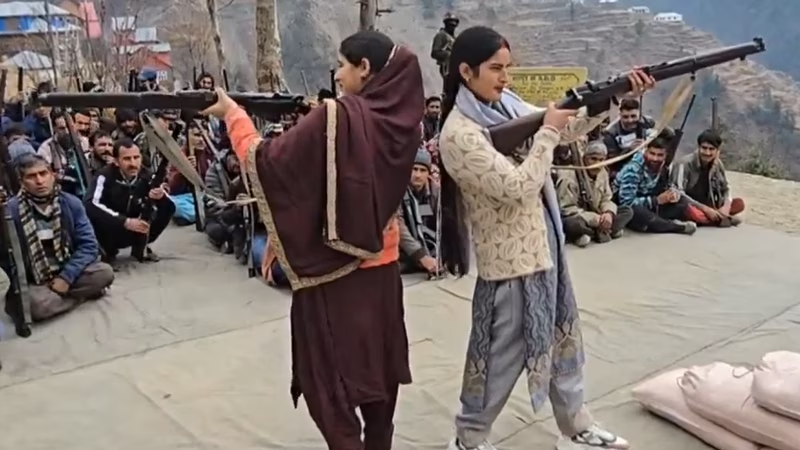
In a bold and strategic move to strengthen grassroots security, the Indian Army has launched an intensive training program for Village Defence Guards (VDGs) in the remote regions of Jammu and Kashmir. Focused on handling automatic rifles, mastering self-defence techniques, and enhancing situational awareness, this initiative aims to empower local communities to protect themselves amid ongoing anti-terror operations in the Chenab Valley .
The program, led by the Army’s Sabre Brigade, is currently training around 150 volunteers—including women—from 17 isolated villages in the Doda district . But is arming civilians the answer to long-term stability in J&K? Or does it open a Pandora’s box of risks? Let’s dive deep into what this program entails, its historical context, and its potential implications.
Table of Contents
- What Are Village Defence Guards?
- Village Defence Guards J&K: Training Breakdown
- Why Doda? The Strategic Significance
- Controversies and Concerns
- Historical Context of VDGs in J&K
- Expert Perspective: Is This the Right Move?
- Conclusion
- Sources
What Are Village Defence Guards?
Village Defence Guards (VDGs) are community-based volunteer security units formed in Jammu and Kashmir to act as a first line of defence in remote, vulnerable areas. These local residents—often farmers, teachers, or small business owners—are given basic military training and, in some cases, licensed firearms to respond to threats until official security forces arrive .
Unlike formal police or paramilitary units, VDGs operate on a part-time, localized basis. Their role is primarily defensive, focused on protecting their own villages from infiltration, terrorist attacks, or intimidation. The concept isn’t new—it dates back to the early 2000s—but recent escalations in rural violence have revived and expanded the program .
Village Defence Guards J&K: Training Breakdown
The current training program, conducted at Purmandal in Jammu by the Sabre Brigade, is among the most advanced VDG initiatives to date . It includes:
- Automatic Rifle Handling: Trainees learn to operate and maintain service-grade weapons like the INSAS rifle.
- Self-Defence & Combat Drills: Basic hand-to-hand combat and tactical movement in hostile environments.
- Surveillance & Intelligence Gathering: How to report suspicious activity without escalating risk.
- Emergency Response Protocols: Coordinating with police and army during active threats .
Notably, the inclusion of women in this cohort marks a significant shift toward inclusive local security—a move praised by civil society groups for empowering female voices in traditionally male-dominated security structures .
Why Doda? The Strategic Significance
Doda district, nestled in the Chenab Valley, has long been a hotspot for militant activity due to its rugged terrain and proximity to infiltration routes from Pakistan-occupied Kashmir. Remote villages here are often hours away from the nearest police outpost, making them easy targets for small, mobile terror cells .
By training VDGs in Doda, the Army is adopting a “defence by the people, for the people” model—a cost-effective and rapid-response strategy that complements larger counter-insurgency operations without overburdening military resources.
Controversies and Concerns
While the initiative has its supporters, critics raise serious questions:
- Weapon Proliferation Risk: Could licensed firearms fall into the wrong hands during chaos or corruption?
- Lack of Accountability: VDGs are not formally integrated into the legal justice system—what happens if they misuse force?
- Escalation of Violence: Arming civilians might embolden militants to retaliate more aggressively against villages.
Human rights organizations have previously warned that community defence militias, if unregulated, can blur the line between civilian and combatant—a concern under international humanitarian law.
Historical Context of VDGs in J&K
The VDG model was first piloted in the early 2000s during the peak of insurgency in J&K. Back then, it was known as the Village Defence Committee (VDC) scheme. It helped reduce targeted killings of minorities like Hindus and Sikhs in isolated hamlets. However, the program was scaled back after relative calm returned post-2010.
Now, with a resurgence of localized terror incidents—especially in the Jammu division—the government is reviving and modernizing the concept under the new “Guard” designation, with stricter oversight and better training .
Expert Perspective: Is This the Right Move?
Security analysts are divided. Some argue that in a complex terrain like J&K, local knowledge is an unmatched asset. “A villager knows every path, every house, every stranger,” says Dr. Ayesha Khan, a J&K conflict researcher at the Observer Research Foundation [[INTERNAL_LINK:jammu-kashmir-security-analysis]].
Others caution that sustainability depends on continuous training, weapon maintenance, and psychological support—elements often missing in short-term military-led programs.
For an authoritative view on counter-insurgency best practices, the Center for Strategic and International Studies (CSIS) offers global case studies on community-based security models.
Conclusion
The Indian Army’s decision to train Village Defence Guards in J&K is a high-stakes gamble with potentially transformative outcomes. If executed with discipline, transparency, and ongoing support, it could become a blueprint for community resilience in conflict zones worldwide. But without robust safeguards, it risks deepening cycles of violence.
As the 150 trainees in Doda return to their villages armed with new skills—and rifles—their success or failure will shape not just local safety, but national security policy for years to come.
Sources
- Kashmir Media Service. “Indian Army arms, trains Village Defence Guards in Jammu.”
- Times of India. “Army trains Village Defence Guards in Doda as anti-terror ops continue in Chenab valley.”
- News18. “Army trains village defence guards in J&K’s Doda with combat skills and weapons handling.”
- India Today. “Army trains Village Defence Guards in J&K’s Doda: 150 volunteers learning automatic rifle use.”
- Institute for Conflict Management. “Village Defence Guards (VDGs): Role, Structure, and Training in J&K.”
- The Hindu. “Army’s Sabre Brigade conducts intensive training for VDGs at Purmandal, Jammu.”
- Center for Strategic and International Studies (CSIS): https://www.csis.org/