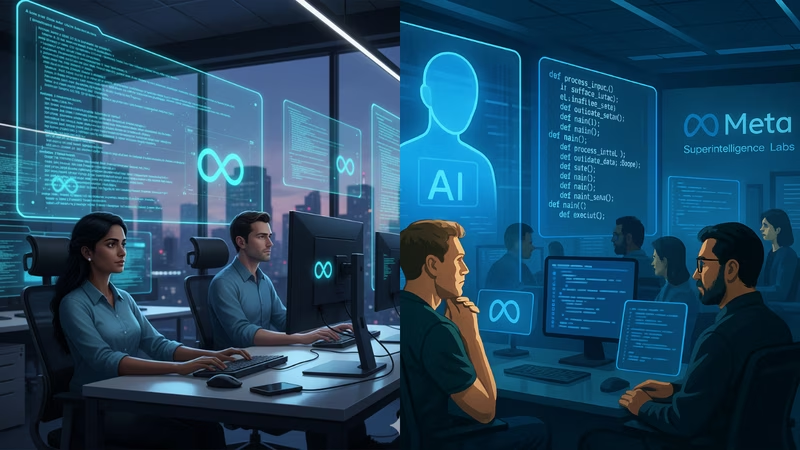
Remember when coding meant typing lines of precise syntax, debugging for hours, and mastering complex logic? That world is changing—fast. Enter Vibe Coding: a term so influential in 2025 that it was crowned Collins Dictionary’s Word of the Year . Coined by none other than Andrej Karpathy, Tesla’s former AI director, it describes a new paradigm where developers don’t just write code—they *describe* it in plain English, and AI fills in the rest.
But here’s the million-dollar question: Is Vibe Coding a superpower for engineers or the beginning of the end for hands-on programming? The tech world is split, and the stakes couldn’t be higher.
Table of Contents
- What Exactly Is Vibe Coding?
- How Andrej Karpathy Gave the Tech World Its New Mantra
- Vibe Coding in Action: From Idea to App in Minutes
- The Great Debate: Savior or Threat to Software Engineering?
- What This Means for Your Career as a Developer
- The Future of Coding: Human + AI, Not Human vs. AI
- Conclusion: Master the Vibe, Don’t Fear It
- Sources
What Exactly Is Vibe Coding?
At its core, Vibe Coding is the practice of using natural language prompts to generate, modify, or debug software through AI assistants like GitHub Copilot, Amazon CodeWhisperer, or custom large language models (LLMs). Instead of writing a for-loop, you might say: “Create a Python function that sorts a list of dictionaries by a given key.”
The AI interprets your *intent*—your “vibe”—and produces functional code. It’s not about replacing logic, but about abstracting the mechanical typing so engineers can focus on architecture, problem-solving, and innovation.
How Andrej Karpathy Gave the Tech World Its New Mantra
In a now-viral 2025 talk, Karpathy didn’t just predict this shift—he named it. Frustrated by the slow pace of traditional development, he described watching junior engineers ship features in hours that used to take days, simply by “vibing” with AI tools. “You’re not coding anymore,” he said. “You’re *vibe coding*.”
The phrase exploded. It captured the fluid, iterative, almost intuitive relationship developers were forming with AI. No more rigid syntax memorization—just a conversation with a very smart, if occasionally buggy, pair programmer.
By year’s end, Collins Dictionary officially anointed “Vibe Coding” as its 2025 Word of the Year, citing its profound impact on tech culture and workflow .
Vibe Coding in Action: From Idea to App in Minutes
Imagine you’re building a weather dashboard. In the old world, you’d spend hours setting up APIs, parsing JSON, and styling components. With Vibe Coding, your prompt might be:
“Build a responsive React app that fetches current weather from OpenWeather API and displays temperature, humidity, and a 5-day forecast with icons.”
Within seconds, your AI copilot generates 80% of the boilerplate. You tweak the UI, add error handling, and deploy. The result? A dramatic acceleration in prototyping and iteration.
Companies like Stripe and Airbnb have reported 30–50% faster feature delivery since adopting AI-assisted workflows at scale .
The Great Debate: Savior or Threat to Software Engineering?
Critics, however, are sounding alarm bells. Veteran engineers worry that Vibe Coding is eroding foundational skills. “If you don’t understand how a hash map works, how can you debug when the AI gets it wrong?” asks Dr. Lena Torres, a computer science professor at MIT .
Others fear job displacement. Why hire ten junior devs when one senior engineer with a powerful AI can do the same work? A 2025 Gartner report estimated that by 2027, 40% of routine coding tasks will be automated—freeing up talent for higher-value work, but also eliminating entry-level roles .
Proponents counter that this is no different than the shift from assembly language to high-level languages. “We didn’t lose programmers when C++ arrived,” Karpathy argued. “We just raised the abstraction level.”
What This Means for Your Career as a Developer
So, should you panic? No—but you should adapt. The skills that matter are evolving:
- Prompt engineering: The ability to clearly articulate your intent to an AI.
- System design: Big-picture thinking over line-by-line syntax.
- AI validation: Knowing when the AI’s output is secure, efficient, and correct.
- Domain expertise: Deep knowledge of your industry is now your biggest differentiator.
Bootcamps and universities are already updating curricula. MIT now requires a “Human-AI Collaboration” module in its intro CS course [INTERNAL_LINK:future-of-cs-education].
The Future of Coding: Human + AI, Not Human vs. AI
The truth is, Vibe Coding isn’t about replacing humans—it’s about amplifying them. The most successful engineers of 2026 and beyond won’t be those who resist AI, but those who master the dialogue between human intuition and machine speed.
As Karpathy himself put it: “The best coders won’t be the fastest typists. They’ll be the best storytellers—with code as their medium and AI as their brush.”
For more on thriving in the AI era, check out our deep dive on [INTERNAL_LINK:ai-skills-for-developers-2026].
Conclusion: Master the Vibe, Don’t Fear It
Vibe Coding is here to stay. It’s not a fad—it’s a fundamental shift in how we build software. The developers who thrive will be those who treat AI not as a crutch, but as a collaborator. The future of software engineering isn’t less human; it’s more human, with machines handling the mundane so we can focus on what truly matters: creating, connecting, and solving real problems.
Sources
[1] Collins Dictionary: Collins Word of the Year 2025 Announcement
[2] TechCrunch: How AI is Accelerating Software Development at Scale (2025)
[3] MIT CSAIL: Interview with Dr. Lena Torres on AI and Education
[4] Gartner: Forecast: AI in Software Development, 2025–2027
[5] Times of India: Rewind 2025: When Tesla’s ex-AI director gave ‘word’ that changed work of software engineers