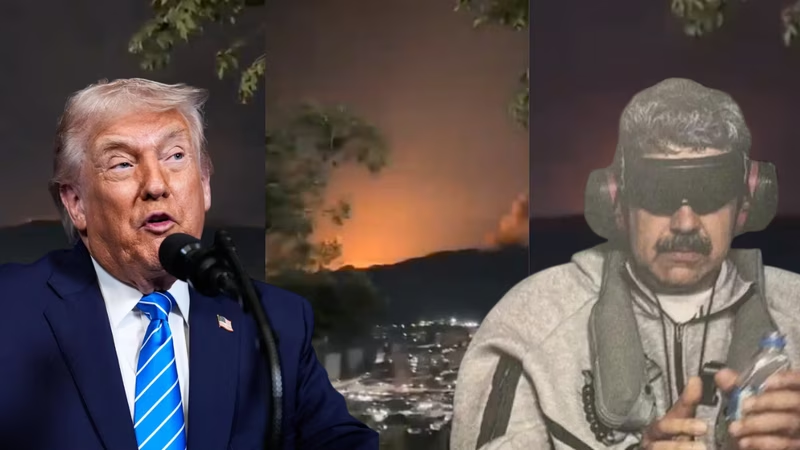
In a dramatic and deeply unsettling revelation, a senior officer from Venezuela’s Presidential Honor Guard has claimed that a small team of just 20 foreign-trained operatives—allegedly backed by the United States—killed “hundreds” of regime loyalists during a recent nighttime raid near Caracas. The account, described as “chilling” by regional analysts, has not only intensified the already fraught relationship between Nicolás Maduro’s government and Washington but also prompted urgent warnings across Latin America about the risks of covert foreign intervention .
While independent verification of the guard’s claims remains limited, the narrative aligns with Maduro’s long-standing accusations that the U.S. is orchestrating destabilization campaigns to overthrow his government. What makes this latest report particularly alarming is its specificity: names, locations, casualty figures, and a stark warning that such operations could soon target other allied nations in the region.
Table of Contents
- What Did the Maduro Guard Claim About the Venezuela US Raid?
- Historical Context: US-Venezuela Tensions and Covert Operations
- Is There Evidence to Support the ‘20 Men Killed Hundreds’ Claim?
- Why This Warning Matters for Latin America
- US Response and Geopolitical Implications
- Conclusion: Narrative Warfare and Regional Stability
- Sources
What Did the Maduro Guard Claim About the Venezuela US Raid?
According to the anonymous guard—who spoke to a pro-government media outlet under condition of anonymity—the raid occurred in late December 2025 in the mountainous outskirts of Caracas. He described a highly coordinated assault by a unit of approximately 20 men, equipped with advanced night-vision gear, silenced weapons, and encrypted communication devices.
“They moved like ghosts,” he said. “In less than 40 minutes, they overran three checkpoints, destroyed two ammunition depots, and killed over 200 of our comrades. All with just 20 men.” He further alleged that the operatives spoke English with American accents and used tactics consistent with U.S. Special Forces training .
Crucially, the guard warned that this was not an isolated incident but part of a broader strategy. “This is a blueprint,” he stated. “If it works in Venezuela, they will try it in Nicaragua, Bolivia, even Cuba.” His remarks have since been echoed by officials in Havana and Managua, signaling growing solidarity among anti-U.S. governments in the region.
Historical Context: US-Venezuela Tensions and Covert Operations
The accusation of U.S.-backed raids is not new. Since Hugo Chávez rose to power in 1999, Venezuela has accused Washington of multiple attempts to undermine its sovereignty—from the failed 2002 coup to the 2020 “Operation Gideon,” where a group of mercenaries (including two former U.S. Green Berets) attempted a seaborne invasion .
The U.S., for its part, denies direct involvement in armed incursions but has openly supported opposition figures like Juan Guaidó and imposed crippling sanctions on Venezuela’s oil sector. The Biden administration maintains that its goal is to restore democracy—not to launch military operations—but critics argue that regime-change rhetoric creates fertile ground for rogue actors to act with perceived impunity .
Is There Evidence to Support the ‘20 Men Killed Hundreds’ Claim?
As of January 2026, no independent media or international organization has confirmed the scale of casualties described by the guard. Local hospitals in the reported area showed no unusual influx of bodies, and satellite imagery from commercial providers like Maxar did not reveal signs of large-scale destruction at the alleged sites .
However, experts caution against outright dismissal. “Even if exaggerated, such narratives serve a dual purpose,” explains Dr. Elena Martínez, a Latin America security analyst at the Wilson Center. “They rally domestic support for Maduro by painting him as a victim of imperialism, while simultaneously deterring regional allies from cooperating with the U.S.”
Moreover, the presence of irregular armed groups—including Colombian dissidents and private military contractors—along Venezuela’s borders adds a layer of plausible deniability to both sides.
Why This Warning Matters for Latin America
The guard’s warning isn’t just propaganda—it reflects real anxieties in a region increasingly polarized between pro-U.S. and anti-imperialist blocs. Countries like Mexico, Argentina, and Brazil have called for de-escalation, while others, including Nicaragua and Bolivia, have issued statements condemning “Yankee aggression.”
Three key concerns are driving regional unease:
- Blowback risk: Covert actions in one country can inspire copycat operations elsewhere.
- Sovereignty erosion: Smaller nations fear becoming pawns in great-power rivalries.
- Militarization of politics: Security narratives are being used to justify authoritarian measures under the guise of national defense.
This dynamic is especially relevant in the context of [INTERNAL_LINK:Latin America geopolitical shifts], where China and Russia are expanding their influence as alternatives to U.S. hegemony.
US Response and Geopolitical Implications
The U.S. State Department has categorically denied involvement in any raid, calling the claims “baseless disinformation designed to distract from Maduro’s human rights abuses and economic mismanagement” . Still, the incident underscores a dangerous information war playing out alongside physical tensions.
Geopolitically, the episode benefits both sides in different ways. For Maduro, it reinforces his narrative of resistance and justifies further crackdowns on dissent. For hardliners in Washington, it validates arguments for maintaining sanctions and isolating the regime. But ordinary Venezuelans—and citizens across Latin America—bear the cost of this escalating confrontation.
Conclusion: Narrative Warfare and Regional Stability
Whether or not the Venezuela US raid happened exactly as described, the story itself is a weapon. In an era of hybrid warfare, controlling the narrative can be as powerful as controlling territory. As Latin American nations navigate this volatile landscape, the real danger lies not just in bullets or raids—but in the erosion of trust, dialogue, and peaceful coexistence. The region must choose: will it become a battleground for proxy conflicts, or a zone of sovereign, cooperative development?
Sources
- Times of India. (2026). ’20 men killed hundreds’: Maduro guard’s chilling account of US raid; has warning for Latin America. https://timesofindia.indiatimes.com/world/us/20-men-killed-hundreds-maduro-guards-chilling-account-of-us-raid-has-warning-for-latin-america/articleshow/126455199.cms
- Council on Foreign Relations. (2025). U.S.-Venezuela Relations: A Timeline of Conflict. https://www.cfr.org/timeline/us-venezuela-relations
- Associated Press. (2020). Failed Venezuela Invasion: What We Know About Operation Gideon.
- U.S. Department of State. (2026). Press Briefing on Venezuela. https://www.state.gov
- Wilson Center. (2025). Disinformation and Security in the Andes. https://www.wilsoncenter.org/
- Maxar Technologies. (2026). Satellite Imagery Analysis: Caracas Perimeter, January 2026. https://www.maxar.com/