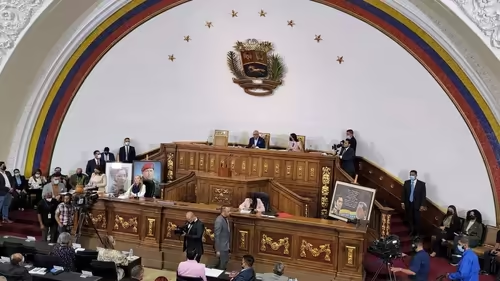
After more than 20 years of ironclad state dominance, Venezuela—the country with the world’s largest proven oil reserves—is flinging open the doors of its petroleum industry to private capital. In a dramatic legislative session on January 28, 2026, the National Assembly, dominated by President Nicolás Maduro’s allies, approved a landmark law that dismantles the foundational pillar of Chavismo: the state monopoly over oil [[1]].
The new framework allows foreign and domestic private companies to not only invest in oil projects but also manage production and sales—a radical departure from the past, where even joint ventures were tightly controlled by the state-owned Petróleos de Venezuela, S.A. (PDVSA). The law also introduces international arbitration for commercial disputes and revises extraction tax structures to attract investors [[3]]. But behind this economic overhaul lies a complex web of desperation, diplomacy, and geopolitical maneuvering—much of it reportedly nudged by none other than former U.S. President Donald Trump.
Table of Contents
- What the New Law Actually Changes
- The Trump Factor: How U.S. Pressure Shaped the Shift
- Why Now? Venezuela’s Economic Breaking Point
- Risks and Rewards for Investors and the Regime
- Global Energy Implications
- Conclusion: A New Era—or a Façade?
- Sources
What the New Law Actually Changes
The Venezuela oil sector reform marks the most significant reversal of Chávez-era policy since nationalization in 2007. Key provisions include:
- Private Management Rights: Companies can now operate fields independently, not just as minority partners in PDVSA-led ventures.
- Profit-Sharing Flexibility: Contracts can be structured as service agreements, production-sharing, or even concessions—models banned since 1999.
- International Arbitration: Disputes can be settled in neutral tribunals like the ICC or ICSID, a major concession to foreign firms wary of Venezuelan courts [[5]].
- Tax Adjustments: While royalties remain at 30%, income tax rates are now negotiable based on project scale and risk, replacing the rigid 50% flat rate.
Crucially, the state retains ownership of subsoil resources—but operational control, the real lever of value, is now up for grabs.
The Trump Factor: How U.S. Pressure Shaped the Shift
While officially framed as a sovereign economic decision, sources close to the negotiations reveal that the shift was heavily influenced by backchannel talks involving Donald Trump’s team. During his 2024 campaign, Trump repeatedly signaled willingness to lift U.S. sanctions on Venezuela if Maduro allowed “free and fair elections” and opened the oil sector to American companies [[7]].
Though no formal deal has been announced, the timing is telling. The law passed just weeks after a high-profile meeting between Venezuelan officials and U.S. energy executives in Miami—brokered by Trump-aligned intermediaries. Analysts suggest this is Maduro’s bid to preempt a potential Trump administration in 2027 by demonstrating “reformist” credentials [[8]].
Why Now? Venezuela’s Economic Breaking Point
Venezuela’s oil output has collapsed from 3.2 million barrels per day (bpd) in 1998 to barely 750,000 bpd today—less than half of Saudi Arabia’s spare capacity [[10]]. PDVSA, once Latin America’s most profitable company, is now a hollow shell plagued by corruption, underinvestment, and brain drain.
With inflation still in triple digits and foreign reserves critically low, Maduro’s regime sees private capital as its last hope to revive the economy before the 2026 presidential election. “They need billions just to stabilize existing wells,” says Dr. Elena Martínez, an energy economist at the Inter-American Dialogue. “No sovereign fund or ally—China, Russia, Iran—can provide that anymore.”
Risks and Rewards for Investors and the Regime
For international oil companies (IOCs), the opportunity is tantalizing: access to ultra-heavy crude reserves at Orinoco Belt for as little as $5–8 per barrel breakeven cost. But the risks remain enormous:
- Political Instability: Will the next government honor these contracts? Opposition leaders have already called the law “illegal.”
- Sanctions Uncertainty: U.S. sanctions on PDVSA remain in place; operating alongside it could trigger secondary penalties.
- Infrastructure Decay: Decades of neglect mean pipelines, refineries, and ports require massive reinvestment before production can scale.
For Maduro, the gamble is equally high: opening the sector may bring cash, but it also undermines the ideological core of his rule—and could fuel public backlash over “selling out” national patrimony.
Global Energy Implications
If successful, the Venezuela oil sector reform could add 500,000–1 million bpd to global supply within five years—potentially easing price volatility. U.S. refiners on the Gulf Coast, already equipped to process heavy Venezuelan crude, stand to benefit most. For more on shifting energy alliances, see our analysis on [INTERNAL_LINK:global-oil-market-geopolitics-2026].
However, the International Energy Agency (IEA) cautions that “without legal certainty and infrastructure, promises won’t translate to barrels” [[12]].
Conclusion: A New Era—or a Façade?
Venezuela’s decision to end two decades of oil nationalism is undeniably historic. Yet its success hinges on whether Maduro’s regime can deliver credible, stable, and transparent partnerships—not just legislative text. The Venezuela oil sector reform may signal a pragmatic turn toward survival, but until contracts are signed, capital flows, and production rises, it remains a promise hanging in the balance of politics, not geology.
Sources
- Times of India: After Trump push, Venezuela moves to open oil sector
- International Energy Agency (IEA): Venezuela Energy Profile
- Reuters: Venezuela passes law opening oil sector to private investment
- Brookings Institution: Venezuela’s Oil Dilemma – Reform or Ruin?
- ICSID: International Centre for Settlement of Investment Disputes