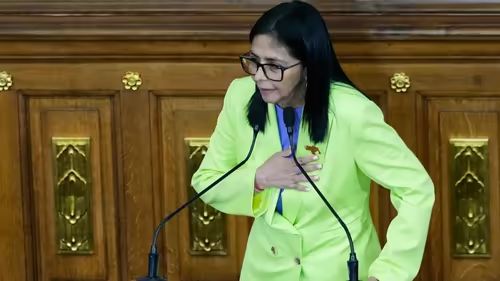
“They’re powerful—but we’re not afraid.” That’s the defiant message from Venezuela’s acting president, Delcy Rodríguez, as Caracas braces for what could be its most intense Venezuela diplomatic clash with US in years. Speaking to reporters this week, Rodríguez made it clear: Venezuela will not back down from a diplomatic fight if the United States continues to undermine its sovereignty or question the legitimacy of President Nicolás Maduro .
Her remarks come amid renewed friction between the two nations, even as both sides have cautiously engaged in talks over oil exports, migration, and electoral reforms. But beneath the surface, old wounds—sanctions, accusations of authoritarianism, and competing visions for Latin America—are flaring up again.
Table of Contents
- Delcy Rodríguez’s Defiant Stance on US Relations
- The Root of the Venezuela Diplomatic Clash with US
- Maduro’s Legitimacy and the 2024 Election Controversy
- Economic Pressure: Sanctions and Oil Diplomacy
- Geopolitical Stakes: Russia, China, and Latin American Alliances
- What Happens Next? Potential Scenarios
- Conclusion: Respect or Confrontation?
- Sources
Delcy Rodríguez’s Defiant Stance on US Relations
Acting President Delcy Rodríguez, who also serves as Venezuela’s Vice President, didn’t mince words. In her statement, she acknowledged U.S. global influence but stressed that Venezuela would not be intimidated. “We are not afraid of a diplomatic clash,” she said, adding that what Venezuela seeks is simple: “respect for our institutions and for President Maduro” .
This isn’t just rhetoric—it’s a calculated political signal. With Venezuela preparing for another presidential election cycle and facing internal economic pressures, the Maduro administration is reinforcing its anti-imperialist narrative to rally domestic support while positioning itself as a sovereign actor on the world stage.
The Root of the Venezuela Diplomatic Clash with US
The tension between Washington and Caracas dates back decades, but it intensified dramatically after 2019, when the U.S. recognized opposition leader Juan Guaidó as Venezuela’s legitimate president—a move Maduro called a “coup attempt.” Though the U.S. has since softened its stance (lifting some sanctions in 2023 to encourage democratic reforms), core disagreements remain:
- Legitimacy of Maduro’s government following disputed elections.
- Human rights concerns raised by international watchdogs.
- U.S. sanctions that have crippled Venezuela’s oil-dependent economy.
- Venezuela’s alliances with U.S. adversaries like Russia, China, and Iran.
Each side accuses the other of bad faith. The U.S. claims Maduro is delaying meaningful democratic change; Venezuela insists Washington is using democracy as a pretext for regime change.
Maduro’s Legitimacy and the 2024 Election Controversy
A major flashpoint is Venezuela’s upcoming presidential election. While the government claims the 2024 vote was free and fair, leading to Maduro’s re-election, the U.S., EU, and several Latin American countries have questioned its credibility due to the disqualification of key opposition candidates—including María Corina Machado .
Rodríguez’s demand for “respect” is directly tied to this issue. By insisting the U.S. recognize Maduro’s mandate, Venezuela is pushing back against what it sees as Western interference in its internal affairs—a theme that resonates across much of the Global South.
Economic Pressure: Sanctions and Oil Diplomacy
Economics lies at the heart of this standoff. Venezuela holds the world’s largest proven oil reserves, yet U.S. sanctions have slashed its production from 3 million barrels per day (bpd) in the early 2000s to under 800,000 bpd in recent years .
In a surprising shift, the Biden administration temporarily eased oil sanctions in 2023 to incentivize electoral concessions. But with those promises unfulfilled (in Washington’s view), there are growing calls in Congress to reinstate full sanctions—a move that would devastate Venezuela’s fragile recovery .
Rodríguez’s tough talk may be a preemptive strike: signaling that Caracas won’t buckle under renewed economic pressure.
Geopolitical Stakes: Russia, China, and Latin American Alliances
Venezuela isn’t isolated. It has deepened ties with Moscow and Beijing, securing loans, military cooperation, and diplomatic cover at the UN. Russia has sent military advisors; China remains a top creditor .
Regionally, Venezuela is finding allies in a shifting Latin America. Countries like Brazil, Colombia, and Mexico—while critical of Maduro—have opposed U.S.-led isolation, favoring dialogue instead. This bloc gives Caracas leverage, making a unilateral U.S. approach less effective.
What Happens Next? Potential Scenarios
Three outcomes seem plausible in the coming months:
- Escalation: If the U.S. reimposes harsh sanctions, Venezuela could expel diplomats or align more closely with Russia/China.
- Stalemate: Both sides maintain current positions—limited engagement without major breakthroughs.
- Negotiated Thaw: Behind-the-scenes talks lead to electoral guarantees in exchange for permanent sanctions relief.
For now, Rodríguez’s message is clear: Venezuela will defend its sovereignty, even if it means a Venezuela diplomatic clash with US becomes inevitable.
Conclusion: Respect or Confrontation?
Delcy Rodríguez’s warning isn’t just about pride—it’s about power, perception, and survival. In a multipolar world, nations like Venezuela are increasingly asserting their right to self-determination, even in the face of overwhelming U.S. influence. Whether this leads to a new era of respectful coexistence or a deeper rift depends on one thing: Washington’s willingness to engage with Caracas not as a pariah, but as a sovereign equal. For more on shifting dynamics in the region, see our analysis on [INTERNAL_LINK:latin-america-geopolitics-2026].
Sources
- Times of India: Venezuela leader ‘not afraid’ of ‘diplomatic’ US clash
- Council on Foreign Relations: Venezuela: The Crisis Explained
- U.S. Department of State: U.S. Relations With Venezuela
- Reuters: Venezuela Election 2024: Key Developments
- BBC News: Why Venezuela’s election is so controversial