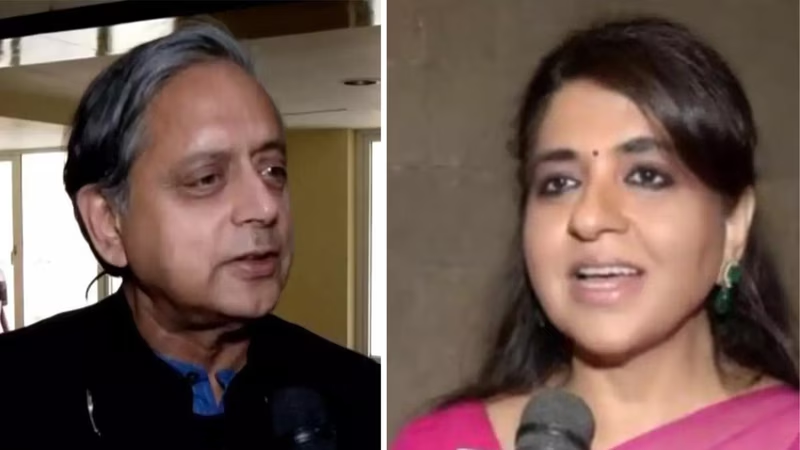
The world watched as US forces launched a dramatic operation in Venezuela—allegedly capturing President Nicolás Maduro—and India’s political class didn’t stay silent for long. The response was swift, passionate, and deeply polarized. Senior Congress leaders branded the move as “19th-century imperialism” and “law of the jungle,” while the AIMIM chief drew a provocative parallel to India’s own situation, triggering sharp backlash from the BJP and Shiv Sena. The government, meanwhile, struck a cautious diplomatic note. The Venezuela crisis India reaction has become more than a foreign policy discussion—it’s a mirror reflecting India’s own ideological fault lines on sovereignty, power, and global order.
Table of Contents
- The US Strike and India’s Official Stance
- Venezuela Crisis India Reaction: Congress Leaders Speak Out
- Owaisi’s India Parallel and the BJP-Shiv Sena Backlash
- Historical Context: India and Non-Alignment in a New Era
- What This Debate Reveals About Indian Politics
- Conclusion: Navigating a Multipolar World
- Sources
The US Strike and India’s Official Stance
While global media focused on the operational details of the alleged US military strike in Caracas, New Delhi chose the path of diplomatic restraint. India’s Ministry of External Affairs (MEA) issued a carefully worded statement expressing “deep concern” over the situation in Venezuela.
“India believes that all issues should be resolved through peaceful means and in accordance with international law,” the MEA said, stopping short of directly condemning the US but clearly signaling discomfort with unilateral military action .
This position aligns with India’s long-standing foreign policy principle of strategic autonomy—a legacy of its Non-Aligned Movement roots—while balancing its complex, evolving relationship with Washington.
Venezuela Crisis India Reaction: Congress Leaders Speak Out
If the government was measured, the opposition was scathing. Senior Congress leader and MP Shashi Tharoor minced no words, calling the US operation a textbook case of the “law of the jungle.”
“When a country invades another to arrest its leader, it’s not diplomacy—it’s 19th-century imperialism dressed in 21st-century tech,” Tharoor posted on X (formerly Twitter) . His comments were echoed by party spokesperson Abhishek Manu Singhvi, who warned that such actions “undermine the very foundation of the United Nations and international law.”
For Congress, this was a chance to reaffirm its commitment to multilateralism and position itself as the guardian of India’s traditional foreign policy values against what it perceives as the BJP’s inconsistent stance on Western powers.
Owaisi’s India Parallel and the BJP-Shiv Sena Backlash
AIMIM chief Asaduddin Owaisi took the debate in a more controversial direction. In a fiery speech, he asked, “If the US can go into Venezuela and arrest its president, what stops it from doing the same in India tomorrow?” .
He argued that strong institutions and national sovereignty are the only safeguards against foreign intervention—a veiled critique of what he described as the erosion of democratic norms in India.
The reaction from the ruling coalition was immediate and fierce. BJP leaders accused Owaisi of “fear-mongering” and “undermining India’s global standing.” Shiv Sena (Shinde faction) MP Rahul Shewale retorted, “India is not Venezuela. We have a Constitution, a strong military, and a people who won’t allow any foreign power to dictate terms.”
The exchange quickly escalated on social media, with hashtags like #IndiaIsNotVenezuela and #RespectSovereignty trending nationally.
Historical Context: India and Non-Alignment in a New Era
This controversy isn’t happening in a vacuum. India has historically championed the rights of smaller nations against great-power bullying. From its vocal support for decolonization to its leadership in the Non-Aligned Movement during the Cold War, non-interference has been a cornerstone of its foreign policy .
However, the 21st century has complicated this stance. As India deepens its strategic partnership with the US—through defense deals, tech collaboration, and the Quad alliance—it faces the challenge of balancing principle with pragmatism.
The Venezuela crisis India reaction exposes this tension. Can India condemn unilateralism while strengthening ties with its main practitioner? The opposition says no; the government insists it can walk that tightrope [INTERNAL_LINK:india-us-strategic-partnership].
What This Debate Reveals About Indian Politics
Beyond Venezuela, this episode reveals three key dynamics in Indian politics:
- Foreign Policy as Domestic Theater: International events are increasingly used as rhetorical tools in domestic political battles.
- The Sovereignty Card: Both opposition and ruling parties invoke national sovereignty—but to serve different narratives.
- Public Diplomacy in the Social Media Age: Foreign policy is no longer confined to Parliament or the MEA; it’s debated in real-time on digital platforms, amplifying polarization.
Conclusion: Navigating a Multipolar World
The Venezuela crisis India reaction is a microcosm of a larger global dilemma: how to uphold international law in an era where power often trumps principle. India’s internal debate—between Tharoor’s moral clarity, Owaisi’s cautionary analogy, and the BJP’s assertive nationalism—reflects the country’s struggle to define its role in a fracturing world order. As New Delhi continues to navigate this complexity, one thing is clear: the “law of the jungle” may be a global reality, but India’s response will shape its own destiny as much as it comments on others’.
Sources
- MEA expresses concern over Venezuela situation. Ministry of External Affairs, Government of India. https://www.mea.gov.in/
- ‘Law of Jungle’: Tharoor, Shaina NC & more speak on Venezuela crisis. Times of India. https://timesofindia.indiatimes.com/…
- Owaisi draws India-Venezuela parallel, BJP slams him. The Hindu.
- India’s Non-Aligned Foreign Policy: A Historical Overview. Carnegie Endowment for International Peace. https://carnegieendowment.org/