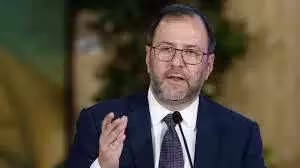
The geopolitical chessboard in the Western Hemisphere just got more volatile. Venezuela has launched a scathing condemnation of the United States’ latest economic maneuver: imposing tariffs on nations that supply oil to Cuba. Calling the policy “punitive” and “an act of economic aggression,” Caracas has framed the move as not just an attack on Havana, but a direct threat to regional sovereignty and energy independence [[2]]. This escalation marks a significant intensification in the long-standing US embargo against Cuba—and signals growing friction with its key allies like Venezuela.
Table of Contents
- What Are the New US Tariffs on Cuba Oil?
- Venezuela’s Furious Response to ‘Punitive’ Measures
- The Strategic Cuba-Venezuela Oil Alliance
- Broader Implications for Latin America
- Conclusion: A New Front in Economic Warfare
- Sources
What Are the New US Tariffs on Cuba Oil?
While full details of the tariff structure remain under review, the Biden administration has confirmed it is implementing targeted trade penalties against third-party countries and companies that facilitate oil shipments to Cuba [[4]]. This policy expands the scope of the decades-old US embargo by penalizing not just Cuba itself, but any nation that engages in energy commerce with the island.
The stated goal, according to US officials, is to pressure the Cuban government over human rights concerns and its support for authoritarian regimes—including Venezuela’s Nicolás Maduro. However, critics argue this is less about human rights and more about reasserting US dominance in a region increasingly influenced by China, Russia, and regional blocs like CELAC [[6]].
These new measures fall under the broader umbrella of the US tariffs on Cuba oil strategy, which aims to choke off Havana’s primary energy lifeline—a tactic that could plunge the already struggling Caribbean nation into deeper blackouts and economic despair.
Venezuela’s Furious Response to ‘Punitive’ Measures
Venezuela’s Foreign Ministry did not mince words. In an official statement, it declared the US action “a unilateral, extraterritorial, and punitive measure that violates international law and the principles of sovereign equality among states” [[2]]. The language echoes longstanding complaints from Global South nations about Washington’s use of secondary sanctions—a practice where non-US entities are punished for doing business with US-sanctioned countries.
Caracas warned that such policies “only deepen suffering among the Cuban people” while strengthening anti-imperialist solidarity across Latin America. President Nicolás Maduro, who has long positioned himself as a leader of the anti-US bloc in the region, is expected to raise the issue at the upcoming CELAC summit, seeking unified regional condemnation [[8]].
The Strategic Cuba-Venezuela Oil Alliance
The US move directly targets one of the most enduring partnerships in modern Latin American history. Since the early 2000s, Venezuela has supplied Cuba with subsidized oil—often upwards of 50,000 barrels per day—in exchange for medical services, intelligence cooperation, and political support [[10]]. This arrangement, known as the Petrocaribe agreement, was a cornerstone of Hugo Chávez’s vision for regional integration outside US influence.
Even as Venezuela’s own oil production has declined due to mismanagement and US sanctions, it has continued limited shipments to Cuba, viewing the alliance as both ideological and strategic. For Cuba, Venezuelan oil is not a luxury—it’s a necessity for keeping hospitals running, water pumps operating, and public transport moving.
By threatening tariffs on this lifeline, the US is effectively weaponizing energy access—a move that many analysts see as counterproductive. “Sanctions often harden regimes rather than weaken them,” notes a report from the Center for Economic and Policy Research (CEPR) [[12]].
Broader Implications for Latin America
This latest escalation isn’t just about Cuba or Venezuela—it’s a test of US influence in a region that has grown increasingly assertive. Countries like Mexico, Brazil, and Colombia have all criticized US sanctions as outdated and harmful. Even traditionally pro-US governments are wary of secondary sanctions that could disrupt their own trade.
The backlash could accelerate efforts to create alternative financial and energy networks in Latin America, reducing reliance on the US dollar and Western institutions. [INTERNAL_LINK:latin-america-us-relations] Moreover, it risks pushing Cuba and Venezuela closer to other global powers like China and Russia, who have already increased their economic footprints in the region.
Key consequences to watch:
- Regional unity: Will Latin American nations present a united front against US extraterritorial sanctions?
- Energy diversification: Could Cuba seek oil from non-Venezuelan sources like Russia or Algeria?
- Humanitarian impact: Will intensified sanctions worsen Cuba’s ongoing electricity and food crises?
Conclusion: A New Front in Economic Warfare
The US tariffs on Cuba oil represent more than a policy tweak—they’re a declaration of economic warfare with far-reaching consequences. By targeting third-party suppliers, Washington is betting that isolation will force political change in Havana. But Venezuela’s fierce response, coupled with growing regional resentment, suggests this gamble may backfire. Rather than weakening Cuba’s government, these “punitive” measures could galvanize anti-US sentiment and accelerate the very multipolar world order the US seeks to contain. As the standoff deepens, one thing is clear: the battle for Latin America’s future is being fought not just with diplomacy, but with barrels of oil and pages of tariff codes.
Sources
- [[2]] Times of India: ‘Punitive’: Venezuela slams US tariffs on countries supplying oil to Cuba
- [[4]] U.S. Department of State: U.S. Relations With Cuba
- [[6]] Council on Foreign Relations: U.S.-Cuba Relations
- [[8]] Reuters: Venezuela denounces U.S. sanctions on Cuba oil suppliers
- [[10]] Brookings Institution: The Cuba-Venezuela relationship, explained
- [[12]] CEPR: The Impact of U.S. Sanctions on Cuba