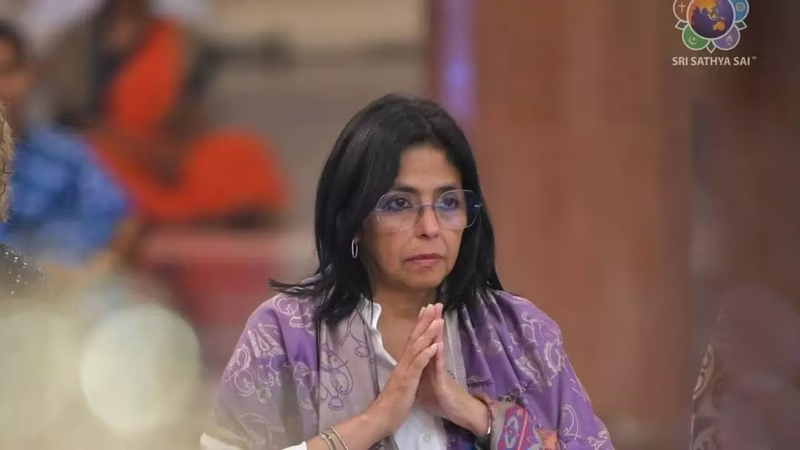
It’s a familiar script in geopolitics: accusations of humanitarian concern masking a scramble for strategic resources. But when Venezuela’s acting president Delcy Rodríguez recently called out the United States for “energy greed,” she wasn’t just venting—she was drawing a red line in one of the world’s most volatile oil battlegrounds.
As the U.S. announces plans to take direct control over future sales of Venezuela oil, Caracas is pushing back hard, framing the move not as a step toward democracy or human rights—but as a naked power grab over the world’s largest proven oil reserves . And in a clear geopolitical pivot, Rodríguez has left the door wide open for deeper energy cooperation with Russia and China.
Table of Contents
- The U.S. Move to Control Venezuelan Crude
- Delcy Rodríguez’s ‘Energy Greed’ Accusation
- Venezuela Oil and the Russia-China Option
- Sanctions: Democracy or Resource Control?
- Global Market Implications
- Conclusion: A New Energy Cold War?
- Sources
The U.S. Move to Control Venezuelan Crude
In a dramatic escalation, the U.S. government has declared it will now oversee all future sales of Venezuelan crude oil and manage the country’s global petroleum trade . This isn’t just regulatory oversight—it’s de facto control.
The justification? Alleged links between Venezuela’s oil sector and drug trafficking, corruption, and human rights abuses. But critics, including many Latin American analysts, argue this is a convenient cover story. After all, Venezuela sits atop an estimated 304 billion barrels of proven oil reserves—the largest in the world . In an era of energy insecurity and shifting supply chains, that’s a prize no global power can ignore.
[INTERNAL_LINK:us-sanctions-on-venezuela-explained] For years, U.S. sanctions have crippled Venezuela’s ability to export oil legally. Now, with this new directive, Washington appears to be transitioning from blockade to stewardship—a move that grants it unprecedented influence over Caracas’s economic lifeline.
Delcy Rodríguez’s ‘Energy Greed’ Accusation
“They use false pretexts about drugs and human rights,” Rodríguez stated bluntly, “but what they really want is our oil” . Her words cut through diplomatic niceties, directly accusing the U.S. of energy greed—a phrase that’s quickly gaining traction across Global South media.
She emphasized that Venezuela remains open to international energy partnerships—but only under “clearly defined commercial contracts” that respect national sovereignty. This is a not-so-subtle rejection of U.S.-imposed conditions and a signal that Caracas won’t accept charity disguised as cooperation.
Her stance reflects a broader shift in Latin American sentiment. Countries like Brazil, Argentina, and even traditionally U.S.-aligned Colombia have expressed discomfort with unilateral American control over another nation’s natural resources—even if that nation is politically isolated.
Venezuela Oil and the Russia-China Option
Faced with U.S. dominance, Venezuela is actively courting alternatives. Rodríguez explicitly stated the country is open to “mutually beneficial” deals with both Russia and China . This isn’t hypothetical—both nations already have deep stakes in Venezuela’s energy sector.
- China has loaned Venezuela over $60 billion since 2007, much of it secured against future oil shipments. While repayments have stalled, Beijing retains significant interest in reviving those flows .
- Russia’s Rosneft has operated Venezuelan oil fields for years and helped bypass U.S. sanctions through shadow tanker networks. Moscow sees Caracas as a strategic foothold in America’s backyard .
A formalized, large-scale energy alliance with either—or both—could reshape global oil logistics and challenge U.S. hegemony in the Western Hemisphere.
Sanctions: Democracy or Resource Control?
The U.S. insists its actions are aimed at restoring democracy and alleviating humanitarian suffering. Yet the timing raises eyebrows. Just as Venezuela showed signs of political negotiation and slight economic recovery, Washington tightened its grip on the oil spigot.
According to the U.S. State Department, the new oversight mechanism is meant to ensure oil revenues benefit the Venezuelan people, not the Maduro regime. But without transparent, multilateral oversight—say, through the UN or OAS—this claim rings hollow to many observers.
Historically, resource-rich nations under sanctions often see their wealth diverted—not to citizens, but to black markets or foreign custodians. The fear in Caracas is that Venezuela oil will become yet another asset managed by foreign powers with little accountability to its rightful owners.
Global Market Implications
This standoff isn’t just a regional squabble. It has ripple effects across global energy markets:
- If U.S.-managed Venezuelan oil floods the market, it could depress global crude prices, hurting producers like Saudi Arabia and Nigeria.
- Conversely, if Venezuela pivots fully to Russia and China, it could accelerate the de-dollarization of oil trades, using yuan or rubles instead of dollars.
- European refiners, who once relied on heavy Venezuelan crude, may face renewed supply uncertainty.
In short, the fate of Venezuela oil is now a proxy battle in a larger contest over who controls the future of global energy flows.
Conclusion: A New Energy Cold War?
Delcy Rodríguez’s accusation of “energy greed” may sound polemical, but it captures a growing global anxiety: that humanitarian rhetoric is increasingly used to justify resource appropriation. As the U.S. asserts control over Venezuelan crude, and Caracas flirts with Moscow and Beijing, we may be witnessing the opening salvo of a new energy cold war—one where oil isn’t just a commodity, but a weapon of geopolitical influence.
For investors, policymakers, and citizens alike, the message is clear: the battle for Venezuela oil is far from over—and its outcome will shape energy security for decades to come.
Sources
- Times of India: ‘Energy greed’: Venezuela acting prez calls out Trump; leaves door open for Russia, China
- U.S. Energy Information Administration (EIA) – Venezuela Oil Reserves
- Center for Strategic and International Studies (CSIS): China’s Loans to Venezuela
- Reuters: Rosneft’s Role in Venezuela’s Oil Sector