Table of Contents
- The Spark: A Menu That Ignited a Political Blaze
- TMC Attacks Centre: Accusations of ‘Cultural Imposition’
- What Is the Vande Bharat Sleeper Menu?
- Historical Context: How Has Railway Catering Evolved?
- Broader Implications: Food, Identity, and National Policy
- Conclusion: A Plate Full of Politics
- Sources
The Spark: A Menu That Ignited a Political Blaze
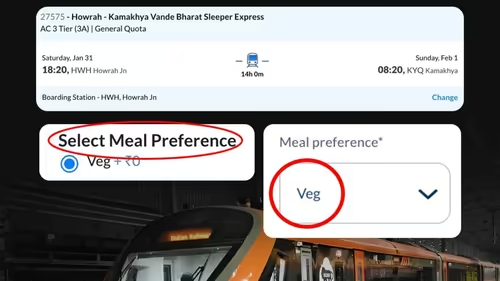
In a move that has sent shockwaves through India’s political and culinary landscape, the newly unveiled Vande Bharat sleeper menu has become the epicenter of a major controversy. The core issue? The menu is exclusively vegetarian. This seemingly simple catering decision has been seized upon by the Trinamool Congress (TMC) as a symbol of a much larger, more insidious agenda: the alleged cultural imposition by the central government on India’s diverse regional identities.
For a nation where food is not just sustenance but a deep-rooted part of cultural heritage—especially in regions like Bengal and Assam, which are directly connected by this new service—the absence of fish and meat is not just a dietary choice; it’s perceived as an erasure of identity. This controversy has quickly escalated from a discussion about train food to a national debate about federalism, cultural sensitivity, and who gets to decide what’s on our plates.
TMC Attacks Centre: Accusations of ‘Cultural Imposition’
The TMC has been at the forefront of this backlash, using strong language to condemn the Centre’s decision. Party leaders have framed the veg-only policy as a direct attack on the culinary traditions of Bengal, a state where fish is not just a staple but a cultural icon. They argue that this move reflects a “monolithic mindset” that fails to recognize or respect India’s rich tapestry of food cultures .
The party’s rhetoric centers on the idea of “policing our plates,” suggesting that the government is overstepping its bounds by dictating dietary choices under the guise of a national policy. This narrative taps into a broader sentiment of regional autonomy and resistance against perceived homogenization from the center. For the TMC, this is not just about a train menu; it’s a potent political symbol they can leverage to galvanize their base and position themselves as defenders of Bengali culture against a domineering central authority.
What Is the Vande Bharat Sleeper Menu?
So, what exactly does this controversial menu look like? The Vande Bharat sleeper train, which connects key regions like Bengal and Assam, features a specially curated menu designed for overnight journeys. The focus is on lighter, less spicy vegetarian fare that caters to a wide audience .
The menu proudly showcases regional specialties, drawing from the rich culinary traditions of its route. For instance, passengers can expect to find authentic Assamese dishes like joha rice, mati mohor, and masoor dali, alongside seasonal vegetable preparations . Similarly, the Bengali offerings include classics such as Suti Bhaja, Chaner Dalna, and the beloved sweet, Sandesh .
While the inclusion of these regional vegetarian dishes is a commendable effort to celebrate local cuisine, the complete omission of non-vegetarian options, particularly fish—a cornerstone of both Bengali and Assamese diets—has been the primary source of contention. The railway authorities have positioned this as a quality and safety measure for an overnight service, but critics see it as a deliberate exclusion.
Historical Context: How Has Railway Catering Evolved?
To fully understand the gravity of this situation, it’s crucial to look at the historical role of Indian Railways in catering. Traditionally, Indian Railways has offered a dual system, providing both vegetarian and non-vegetarian meal options on most long-distance and super-fast trains. Official policies, such as the 2005 Catering Policy, mandated the provision of both types of meals to cater to the diverse passenger base .
Over the years, there have been various debates and legal challenges surrounding railway catering, including issues related to halal meat and food safety standards . However, the fundamental principle of offering a choice between veg and non-veg has largely remained intact. The Vande Bharat sleeper’s veg-only policy, therefore, represents a significant and noticeable departure from this long-standing practice. This shift is what makes it appear, to many, not as a minor operational tweak but as a deliberate policy statement with wider cultural implications.
Broader Implications: Food, Identity, and National Policy
This controversy transcends the confines of a railway carriage. It touches on several critical themes in contemporary India:
- Cultural Federalism vs. National Uniformity: The debate highlights the constant tension between a centralized vision of national identity and the vibrant, often conflicting, realities of India’s regional cultures. Should a national service like the railways impose a uniform standard, or should it adapt to local customs?
- Food as a Political Symbol: In India, food choices are deeply intertwined with religion, caste, and regional identity. A policy that appears to favor one dietary practice over another can be easily interpreted as a political act, carrying symbolic weight far beyond its practical impact.
- The Role of Public Services: Public services like the railways are expected to be inclusive and representative of the population they serve. When they are perceived as promoting a particular cultural or ideological viewpoint, it can lead to a crisis of trust and legitimacy.
For many in Bengal and Assam, the missing fish on the Vande Bharat sleeper menu is a metaphor for a larger fear: the marginalization of their unique cultural practices in a rapidly homogenizing national narrative.
Conclusion: A Plate Full of Politics
The controversy over the Vande Bharat sleeper’s vegetarian-only menu is a stark reminder that in a country as diverse as India, even the most mundane decisions can carry profound political and cultural significance. What began as a catering policy has now become a flashpoint in a much larger debate about identity, autonomy, and the very definition of Indian culture. As the TMC continues its vocal opposition, the Centre will need to navigate this sensitive issue carefully, balancing operational logistics with the deep-seated cultural sentiments of millions of its citizens. One thing is certain: the conversation about what’s on our national plates is far from over. For more on how regional politics shape national discourse, see our analysis on [INTERNAL_LINK:regional-politics-in-india].
Sources
- Times of India: ‘Policing our plates’: TMC attacks Centre over Vande Bharat sleeper’s veg-only menu
- Various news reports on Vande Bharat sleeper train food menu [[1], [4], [13], [16], [19]]
- Indian Railways Catering Policy documents [[20], [21]]
- Reports on historical and current railway catering practices [[25], [27]]