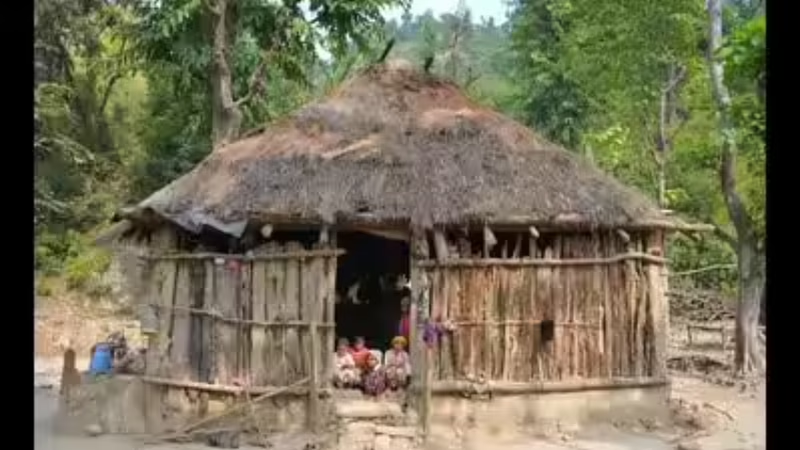
In a historic verdict that could reshape the relationship between indigenous communities and protected areas, the Uttarakhand High Court has delivered a nuanced and balanced judgment on the rights of the Van Gujjars. The court has permitted this traditional pastoralist community to engage in subsistence cultivation on land adjacent to reserve forests, while simultaneously drawing a hard line against any form of commercial exploitation.
This ruling is not just a legal footnote; it’s a lifeline for a community that has been caught in a decades-long struggle between conservation policies and their ancestral way of life. For the Van Gujjars, who have practiced seasonal migration and rotational grazing in the Himalayan foothills for generations, access to land is a matter of survival .
Table of Contents
- The Landmark Judgment: What the Court Actually Said
- Who Are the Van Gujjars? A Community at a Crossroads
- The Forest Rights Act 2006: A Promise Unfulfilled?
- Why This Ruling Matters for Conservation and Justice
- What Happens Next for the Van Gujjars?
- Conclusion: A Step Towards Coexistence
- Sources
The Landmark Judgment: What the Court Actually Said
The recent order from the Uttarakhand High Court is a masterclass in judicial balancing. On one hand, the court recognized the dire need of the Van Gujjars for a stable source of food and livelihood beyond their traditional pastoralism. It acknowledged that their practice of small-scale, subsistence farming on the fringes of forest land is not only a cultural necessity but also a practical adaptation to modern pressures .
On the other hand, the court was unequivocal in its stance on commercialization. The judgment explicitly bars the community from engaging in any commercial agricultural activity or establishing permanent commercial structures on these lands. This clear demarcation aims to protect the ecological integrity of the reserve forests while providing a humanitarian concession to the community.
Who Are the Van Gujjars? A Community at a Crossroads
The Van Gujjars are a semi-nomadic pastoralist community primarily found in the Shivalik hills of Uttarakhand, Uttar Pradesh, and Himachal Pradesh. Their lives are intrinsically tied to their herds of buffaloes, and they follow an ancient migratory pattern known as transhumance—moving to higher alpine meadows (bugyals) in the summer and descending to the lower Terai grasslands in the winter .
For decades, they have faced eviction drives, harassment by forest officials, and a systemic denial of their rights. They are often labeled as encroachers on forest land, despite having lived in harmony with these ecosystems for centuries. In fact, many conservationists argue that their traditional grazing practices actually help maintain the health of the grasslands and prevent wildfires .
A History of Eviction and Resistance
Their struggle is long and fraught with legal battles:
- In 2018, the same High Court had declared their settlements in Rajaji National Park illegal and ordered evictions without a proper rehabilitation plan .
- In 2021, the court had to intervene again after the state government stopped Van Gujjar families from reaching their summer pastures in Govind Pashu Vihar National Park .
- Repeated petitions have forced the state to form committees to look into their forest rights claims, though progress has been painfully slow .
The Forest Rights Act 2006: A Promise Unfulfilled?
The Scheduled Tribes and Other Traditional Forest Dwellers (Recognition of Forest Rights) Act, 2006, was supposed to be a game-changer. It legally recognizes the rights of forest-dwelling communities to their traditional lands and resources. Section 3 of the FRA specifically grants rights to pastoralist communities for grazing and access to common pastures .
However, for the Van Gujjars, the promise of the FRA has largely remained on paper. Their claims have been routinely rejected by local authorities, often due to a lack of documentary evidence—a nearly impossible standard for a nomadic community whose history is oral, not written . As of 2022, a staggering 16 years after the act was passed, only about 50% of all claims across India had been settled, leaving millions in limbo .
Why This Ruling Matters for Conservation and Justice
This latest judgment is significant because it moves beyond the binary of “people vs. wildlife.” It acknowledges a third path: coexistence. By allowing subsistence cultivation, the court is recognizing that the Van Gujjars’ needs are legitimate and that their exclusion is neither just nor sustainable.
Furthermore, this ruling could set a powerful precedent for other pastoralist communities across India, such as the Gaddis of Himachal Pradesh, who face similar challenges . It signals to state governments that blanket evictions are not the answer and that a more nuanced, rights-based approach is required.
What Happens Next for the Van Gujjars?
The immediate future for the Van Gujjars hinges on the implementation of this order. Key questions remain:
- How will the land for cultivation be identified and allocated? Will it be a formal process or left to local discretion?
- Who will monitor the ban on commercial activity? Clear guidelines and oversight mechanisms are essential to prevent future conflicts.
- Will this lead to a re-examination of their pending FRA claims? This judgment could provide the impetus needed for authorities to finally process their applications in good faith.
While this is a major victory, the community’s ultimate goal remains the full recognition of their forest rights under the FRA, which would grant them a more secure and permanent legal status .
Conclusion: A Step Towards Coexistence
The Uttarakhand High Court’s decision to allow the Van Gujjars to cultivate near reserve forests is a beacon of hope. It represents a shift from a purely protectionist model of conservation to one that integrates social justice and the rights of indigenous peoples. While the ban on commercial activity ensures ecological safeguards, the allowance for subsistence farming is a crucial acknowledgment of their humanity and their deep-rooted connection to the land. This ruling is not the end of their journey, but it is a vital step on the long road to dignity and recognition. For more on the intersection of indigenous rights and environmental policy, see our coverage on [INTERNAL_LINK:indigenous-conservation-efforts].
Sources
- Times of India: HC lets Van Gujjars cultivate near reserve forests, bars commercial activity
- Down To Earth: Van Gujjars help conserve forests, but are deprived of rights
- Land Conflict Watch: Van Gujjars in Uttarakhand Fight for Legal Recognition of Forest Rights [[13], [26]]
- Economic & Political Weekly: The making of pastoralisms
- The Hindu: Uttarakhand HC reprimands State for stopping Van Gujjars