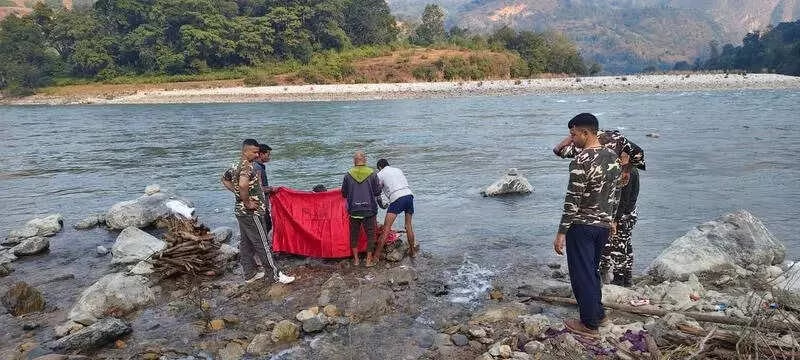
Picture this: a quiet Himalayan village at dawn. Smoke curls from a pyre. But the men carrying the body aren’t family or neighbors—they’re soldiers in uniform. In the remote border village of Dharchula’s Darma Valley in Uttarakhand, this heartbreaking scene recently became reality. An elderly woman passed away, and there was no one left strong enough to perform her last rites. The villagers were either too old, too young, or simply gone.
Enter the jawans of the Sashastra Seema Bal (SSB). They stepped in not as enforcers of border security, but as the last thread of humanity in a community on the brink of vanishing. This poignant moment is far more than a local tragedy—it’s a flashing red alert about the deepening Uttarakhand migration crisis that’s emptying entire valleys of life, culture, and future.
Table of Contents
- The Incident That Shook a Nation
- Uttarakhand Migration Crisis: A Silent Exodus
- Why Are People Leaving the Himalayas?
- The Human and Strategic Cost of Abandonment
- Government Efforts and Why They Fall Short
- A Future Without People: Can Uttarakhand Be Saved?
- Conclusion: When Soldiers Become Family
- Sources
The Incident That Shook a Nation
The story unfolded in a small settlement near the India-Nepal border, where the population has dwindled to a handful of elderly residents and children. When a woman in her 70s passed away, the grim reality hit home: there was literally no able-bodied person to perform the traditional cremation rituals .
Local officials, overwhelmed and with no other recourse, reached out to the nearest SSB outpost. Without hesitation, the jawans responded. They respectfully carried the body, prepared the pyre, and completed the last rites with dignity. Their act of compassion went viral, not for its heroism, but for what it revealed—a community so depleted it could no longer care for its own dead.
Uttarakhand Migration Crisis: A Silent Exodus
This incident is a powerful microcosm of a much larger crisis. Decades of out-migration have turned once-thriving Himalayan villages into ghost towns. According to a Census of India report, over 700 villages in Uttarakhand are now either completely deserted or on the verge of abandonment. In Pithoragarh district alone—where this event occurred—more than 40% of households are locked year-round .
The Uttarakhand migration crisis is driven by a perfect storm of economic hardship, lack of infrastructure, and environmental fragility. Young people leave for cities like Delhi, Dehradun, or even further afield in search of education, jobs, and a life less precarious than subsistence farming on steep, earthquake-prone slopes.
Why Are People Leaving the Himalayas?
It’s not that people don’t love their mountain homes. It’s that survival has become nearly impossible. Several interconnected factors are pushing residents out:
- Lack of Livelihoods: Agriculture is increasingly unviable due to fragmented landholdings, water scarcity, and climate-induced crop failures.
- Poor Infrastructure: Many villages lack reliable roads, electricity, healthcare, and internet—making daily life a struggle and deterring investment.
- Educational Gaps: Schools are often understaffed or closed, forcing families to migrate so their children can access quality education.
- Climate Vulnerability: The Himalayas are warming faster than the global average, leading to erratic rainfall, landslides, and glacial lake outburst floods that destroy homes and fields .
The Human and Strategic Cost of Abandonment
The consequences of this demographic collapse go far beyond social sorrow. They have a direct impact on national security. Uttarakhand shares a long and sensitive border with China and Nepal. A populated border is a secure border. When villages empty out, it creates a vacuum that can be exploited and undermines India’s territorial presence.
As one retired military official noted, “You can’t guard a border with just soldiers. You need eyes, ears, and hearts on the ground—local communities who know every trail and every season.” The SSB jawans performing last rites is a symbol of both compassion and a strategic red flag.
Government Efforts and Why They Fall Short
Successive governments have launched schemes to reverse the tide—like the ‘Smart Village’ initiative and subsidies for returning migrants. But these efforts often miss the mark. They focus on infrastructure without addressing the root cause: the absence of sustainable, year-round livelihoods.
Experts argue that a new model is needed—one that blends eco-tourism, high-value organic farming (like medicinal herbs), digital work hubs, and community forestry. Without economic dignity, no amount of road-building will bring people back .
A Future Without People: Can Uttarakhand Be Saved?
There is hope, but it requires urgent, innovative thinking. Some NGOs and local entrepreneurs are piloting community-led tourism and reviving traditional crafts. In villages like Munsiyari, homestays run by women’s collectives are creating income and pride.
Technology could also be a bridge. Satellite internet and mobile banking can connect remote hamlets to markets and services. But the real solution lies in policy that treats mountain communities not as welfare cases, but as custodians of a fragile ecosystem whose knowledge is invaluable.
Conclusion: When Soldiers Become Family
The image of SSB jawans performing last rites is a gut-wrenching emblem of the Uttarakhand migration crisis. It’s a moment that should jolt the nation into action. These mountains are not just scenic backdrops—they are the water towers of India, the guardians of biodiversity, and the home of resilient cultures. If we lose the people, we lose everything.
Reversing this trend isn’t just about nostalgia; it’s about national security, environmental sustainability, and human dignity. As one elderly villager reportedly whispered after the cremation, “Who will light my pyre when I go?” It’s a question India can no longer afford to ignore. Learn more about sustainable mountain development in our feature on [INTERNAL_LINK:ecotourism-in-indian-himalayas].