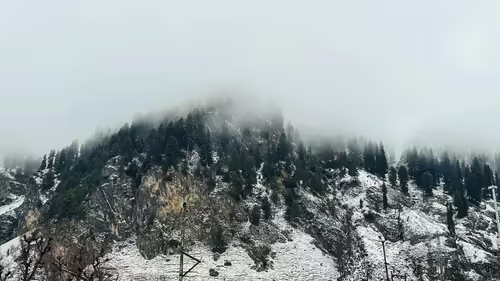
Uttarakhand Avalanche Alert: Mountains on High Alert as Danger Levels Spike
A fresh Uttarakhand avalanche alert has sent ripples of concern through the Himalayan state, with authorities issuing urgent warnings for all high-altitude areas. For the next 24 hours, districts like Chamoli, Rudraprayag, and Uttarkashi are under heightened surveillance as unstable snow conditions create a volatile environment. The State Disaster Response Force (SDRF) and National Disaster Response Force (NDRF) teams are on standby, ready to respond to any emergency .
Table of Contents
- What the Avalanche Danger Levels Mean
- Districts Under Uttarakhand Avalanche Alert
- Why Chamoli Is at Orange Level
- Travel Advisories for Tourists and Pilgrims
- How Uttarakhand Monitors Avalanche Risk
- Essential Safety Tips for Winter in the Himalayas
- Conclusion: Stay Informed, Stay Safe
- Sources
What the Avalanche Danger Levels Mean
Understanding avalanche risk isn’t just for mountaineers—it’s crucial for anyone venturing into mountainous terrain. India follows a standardized five-level scale, similar to international systems used by organizations like the American Avalanche Association:
- Level 1 (Green): Low risk. Natural avalanches unlikely.
- Level 2 (Yellow): Moderate risk. Triggered avalanches possible on specific slopes.
- Level 3 (Orange): Considerable risk. Avalanches likely on many slopes; dangerous conditions.
- Level 4 (Red): High risk. Frequent large avalanches expected.
- Level 5 (Black): Very high risk. Extremely dangerous; widespread large avalanches.
In the current Uttarakhand avalanche alert, most high-altitude zones above 2,800 meters are at **Level 2 (Yellow)**, while parts of Chamoli above 3,000 meters have escalated to **Level 3 (Orange)**—a significant jump in danger .
Districts Under Uttarakhand Avalanche Alert
The warning primarily affects the following districts, especially in areas exceeding 2,800 meters in elevation:
- Chamoli: Danger level **Orange (3)** above 3,000m—includes routes near Badrinath, Valley of Flowers, and Auli.
- Rudraprayag: Danger level **Yellow (2)** above 2,800m—covers Kedarnath trekking paths.
- Uttarkashi: Danger level **Yellow (2)**—affects Gangotri and Yamunotri approaches.
- Pithoragarh & Bageshwar: Also under observation due to recent snowfall.
Local authorities have activated emergency protocols, including restricted vehicle movement and enhanced monitoring of tourist inflow .
Why Chamoli Is at Orange Level
Chamoli stands out in this alert due to a combination of factors: recent heavy snowfall, steep terrain, and warming temperatures that destabilize snowpack layers. The region’s complex topography—home to some of India’s most iconic peaks and pilgrimage sites—makes it particularly vulnerable. Historical data from the National Institute of Mountaineering (NIM) shows Chamoli has experienced multiple avalanche events in past winters, reinforcing the need for caution .
Travel Advisories for Tourists and Pilgrims
If you’re planning a trip to Uttarakhand’s high mountains, heed these official recommendations:
- Avoid all non-essential travel above 2,800m for the next 24–48 hours.
- Check real-time updates via the Uttarakhand State Disaster Management Authority.
- Do not attempt treks to Kedarnath, Hemkund Sahib, or Valley of Flowers until the alert is lifted.
- Register your itinerary with local police or tourism offices if travel is unavoidable.
For those already in the region, [INTERNAL_LINK:winter-travel-uttarakhand] offers detailed packing and safety checklists.
How Uttarakhand Monitors Avalanche Risk
The state relies on a multi-agency network for early warning:
- Automatic Weather Stations (AWS): Deployed across high-altitude zones to track snow depth, temperature, and wind.
- Field Observations: SDRF and Indo-Tibetan Border Police (ITBP) conduct daily snow stability tests.
- Satellite Data: Integrated with IMD (India Meteorological Department) forecasts for snowfall prediction.
This system, though improving, still faces challenges in remote areas—making public vigilance equally important .
Essential Safety Tips for Winter in the Himalayas
Whether you’re a local resident or a visitor, these practices can save lives:
- Never travel alone in avalanche-prone zones.
- Carry an avalanche transceiver, probe, and shovel if venturing off-grid.
- Stay on marked trails and avoid convex slopes or cornices.
- Listen to local guides—they often know micro-terrain risks better than maps.
Conclusion: Stay Informed, Stay Safe
The current Uttarakhand avalanche alert is not a routine bulletin—it’s a critical safety directive born from real, measurable risk. With Chamoli already in the Orange zone, complacency could be fatal. Whether you’re a pilgrim, trekker, or resident, your best defense is awareness, preparation, and respect for the mountain’s power. Monitor official channels, delay non-essential journeys, and prioritize safety over schedule.