Table of Contents
- Hegseth’s Bold Claim: The Venezuela-Iraq Comparison
- What Is the US Venezuela Mission Really About?
- Maduro ‘Captured’: A New Era of Covert Ops?
- Trump’s Oil-Driven Vision for Venezuela
- Why the Iraq War Still Haunts US Foreign Policy
- Expert Reactions: Is This Really Different?
- Conclusion: Rhetoric vs. Reality in Venezuela
- Sources
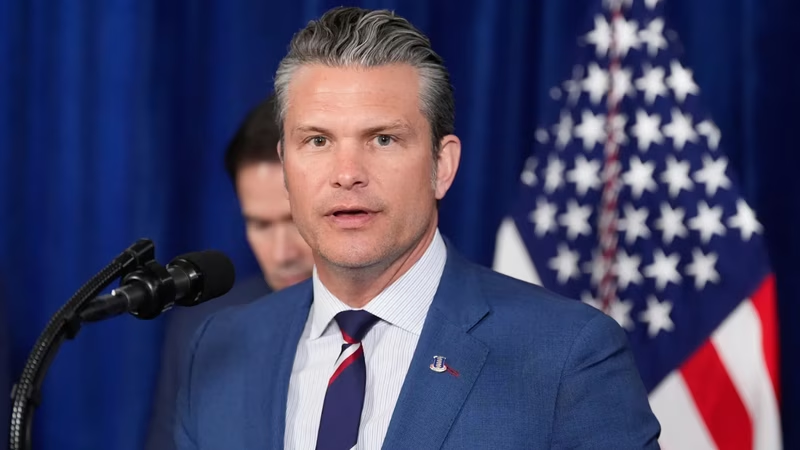
It was a statement designed to reassure—and to reframe. Pete Hegseth, the newly appointed US Secretary of War, declared that the recent American operation in Venezuela was the “exact opposite” of the 2003 Iraq invasion. Speaking with unmistakable confidence, Hegseth emphasized that this US Venezuela mission involved no prolonged occupation, zero American casualties, and a clear strategic outcome: securing access to the world’s largest oil reserves while removing a “hostile regime.”
Coming on the heels of President Donald Trump’s announcement that US oil companies will “rebuild Venezuela’s infrastructure” and bring “peace and prosperity,” the messaging is clear: this isn’t nation-building—it’s resource liberation. But beneath the confident rhetoric lies a complex geopolitical gamble that experts warn may not be as clean-cut as officials claim.
Hegseth’s Bold Claim: The Venezuela-Iraq Comparison
For Americans still scarred by the Iraq War’s 20-year fallout—4,500+ US deaths, trillions spent, and a destabilized Middle East—any new military intervention triggers alarm bells. Hegseth knows this. That’s why he’s drawing a sharp contrast.
“In Iraq, we sent hundreds of thousands of boots on the ground, got stuck in a quagmire, and paid a terrible price,” Hegseth stated. “In Venezuela? We executed a well-orchestrated, precision operation. No boots, no bases, no body bags. Just results.”
According to his account, the mission involved targeted intelligence, special forces coordination with internal dissidents, and the successful capture of President Nicolás Maduro. The goal wasn’t occupation—it was regime change and rapid economic reorientation toward US interests.
What Is the US Venezuela Mission Really About?
While Hegseth frames the operation as a clean break from past interventions, analysts see deeper motives tied to energy security and geopolitical dominance.
Venezuela holds over 300 billion barrels of proven oil reserves—the largest on Earth. Yet decades of mismanagement and sanctions have reduced its output to a fraction of capacity. Trump’s plan? Hand over reconstruction to American oil giants like ExxonMobil and Chevron, who would revive production in exchange for long-term extraction rights.
This isn’t just about oil—it’s about countering Chinese and Russian influence in Latin America. Both nations have deep economic ties with Caracas. By stepping in decisively, the US aims to reassert its Monroe Doctrine-era dominance in its own backyard.
Maduro ‘Captured’: A New Era of Covert Ops?
One of the most startling claims is that Nicolás Maduro has been “captured.” While neither the Venezuelan government nor independent sources have confirmed this, the assertion—if true—suggests a level of covert capability rarely seen.
Unlike Iraq, where Saddam Hussein was found in a spider hole years after the invasion, Maduro’s alleged capture appears immediate and surgical. If accurate, it points to either deep infiltration of his inner circle or sophisticated drone and signal intelligence—a hallmark of 21st-century asymmetric warfare.
However, skepticism remains high. As Dr. Lisa Marci, a Latin America analyst at the Brookings Institution, notes: “Unverified claims of Maduro’s capture sound more like psychological operations than confirmed facts. The risk of blowback is enormous if this turns out to be propaganda” .
Trump’s Oil-Driven Vision for Venezuela
President Trump’s announcement goes beyond military action. He’s pitching Venezuela as America’s next “energy frontier.” In his words: “We’re going to rebuild their oil fields, bring jobs, bring peace, and make sure that oil flows—not to China, but to us.”
The plan hinges on rapid privatization. US firms would lease oil infrastructure under 25–30-year contracts, injecting billions in exchange for production control. Proponents argue this could stabilize Venezuela’s economy overnight. Critics counter that it’s neo-colonialism dressed as humanitarianism—and could spark massive domestic resistance.
For India and other oil-importing nations, this shift matters—but not immediately. As noted in a recent analysis, Venezuela’s infrastructure is so degraded that meaningful output won’t return for 5–7 years . So while the US Venezuela mission may reshape long-term energy geopolitics, global markets won’t feel its impact tomorrow.
Why the Iraq War Still Haunts US Foreign Policy
Hegseth’s insistence on contrasting Venezuela with Iraq isn’t accidental. The Iraq War is now a byword for strategic overreach in Washington. By invoking it, he’s trying to reassure a war-weary public that this time, “we’ve learned our lesson.”
But history offers caution. Regime change—even when swift—often unleashes chaos. Libya in 2011 is a prime example: Qaddafi fell quickly, but the country collapsed into civil war. Venezuela, with its armed militias, economic collapse, and deep societal divisions, could follow a similar path.
Expert Reactions: Is This Really Different?
Reactions from the foreign policy community are mixed:
- Supporters argue this is a “minimal footprint” model—using intelligence, proxies, and economic leverage instead of mass deployment.
- Skeptics warn that without a legitimate political transition plan, removing Maduro could create a power vacuum filled by warlords or even more hostile actors.
- International law experts question the legality of a unilateral “capture” operation on sovereign soil, calling it a potential violation of the UN Charter [INTERNAL_LINK:international-law-and-us-interventions].
As the Council on Foreign Relations points out, “Short-term success doesn’t equal long-term stability” .
Conclusion: Rhetoric vs. Reality in Venezuela
The US Venezuela mission may indeed look nothing like the Iraq invasion on the surface. No tanks rolling into Caracas, no Green Zone. But the deeper challenge remains: can America install order without owning the aftermath?
Hegseth’s “exact opposite” framing is a powerful political narrative—but in the messy world of geopolitics, outcomes are rarely that binary. As Venezuela’s future hangs in the balance, the world watches to see if this operation delivers on its promises of peace, oil, and prosperity—or becomes another cautionary tale wrapped in bold rhetoric.