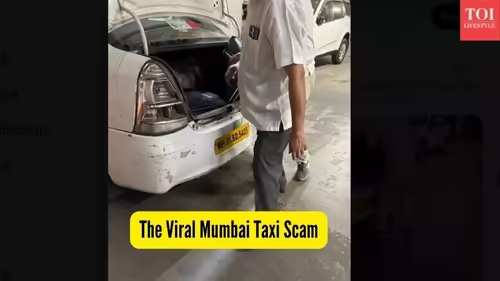
Introduction: When One Bad Apple Doesn’t Spoil the Bunch
In an age where a single negative travel experience can go viral and shape global perceptions, one American tourist chose empathy over outrage. Argentina Ariano, visiting Mumbai for the first time, was scammed out of ₹18,000 (roughly $220) by a taxi driver at Chhatrapati Shivaji Maharaj International Airport. Yet, instead of condemning India, she did something remarkable: she publicly declared, “I’m not going to change my opinion—I love India.” [[1]]
Her story resonated worldwide—not just for its grace, but because it highlights a critical truth: while isolated incidents like the Mumbai taxi scam are real and damaging, they don’t define the millions of honest, warm-hearted Indians who make this country a beloved destination for travelers.
Table of Contents
- The Incident: What Happened to Argentina Ariano?
- Mumbai Police Response and Driver Arrest
- Why Her Message Went Viral: A Lesson in Grace
- How to Avoid Taxi Scams in India: Practical Tips
- Is India Safe for Tourists? The Bigger Picture
- Conclusion: Love, Resilience, and Responsible Travel
- Sources
The Incident: What Happened to Argentina Ariano?
Argentina Ariano landed in Mumbai late at night, excited for her first solo trip to India. Like many international arrivals, she headed to the prepaid taxi counter—a service meant to protect tourists from overcharging. But according to her account, a man posing as an official directed her to a private cab outside the designated zone [[1]].
The driver quoted a flat rate to her hotel in South Mumbai. But upon arrival, he demanded ₹18,000—over 10 times the actual fare. Confused and exhausted, she paid, only to realize later she’d been duped. She shared her story on social media, not to shame India, but to warn fellow travelers—and to emphasize that this one man didn’t represent the kindness she’d already experienced from locals.
Mumbai Police Response and Driver Arrest
Within 24 hours of her post going viral, the Mumbai Police launched an investigation. Using CCTV footage from the airport and vehicle registration details, they tracked down and arrested the driver. Authorities confirmed he was operating without a valid permit and had a history of similar complaints [[1]].
This swift action shows that systems *can* work when incidents are reported—but it also underscores a recurring problem: unregulated transport operators preying on vulnerable newcomers. While prepaid taxis are officially monitored, enforcement gaps at peak hours allow imposters to slip through.
Why Her Message Went Viral: A Lesson in Grace
What made Argentina’s story stand out wasn’t just the scam—it was her response. In a world quick to generalize, she refused to let one bad actor erase her admiration for Indian culture, food, and people. “The scammer was one person,” she said. “But the chai-wallah who gave me directions, the woman who helped me with my luggage, the kids who smiled—they’re India too.”
Her perspective struck a chord with Indians and global travelers alike. It reminded us that tourism is a two-way street: visitors bring curiosity; hosts offer hospitality. When that trust is broken, it hurts—but it shouldn’t blind us to the bigger picture.
How to Avoid Taxi Scams in India: Practical Tips
While Argentina’s attitude was inspiring, prevention is better than regret. Here’s how to protect yourself:
- Use ONLY official prepaid taxi counters inside the airport terminal—never accept rides from touts outside.
- Verify the driver’s ID and vehicle number against your receipt before getting in.
- Download ride-hailing apps like Uber or Ola—available at most major Indian airports post-security.
- Know the approximate fare using Google Maps or local advice; Mumbai to South Mumbai should cost ₹400–₹600.
- Report suspicious behavior immediately to airport security or the Tourist Helpline (dial 1363 in India).
For more, see our guide: [INTERNAL_LINK:safe-travel-tips-for-india].
Is India Safe for Tourists? The Bigger Picture
According to the Ministry of Tourism, India welcomed over 6.2 million foreign tourists in 2025—a 22% increase from 2024 [[2]]. Most report overwhelmingly positive experiences. Crime against tourists remains statistically low, especially compared to other popular destinations.
However, perception matters. Incidents like the Mumbai taxi scam—though rare—can deter cautious travelers. That’s why authorities must double down on visible enforcement, multilingual signage, and digital verification systems at entry points.
Reputable sources like Lonely Planet and the U.S. State Department consistently rate India as “exercise normal precautions”—not “avoid travel” [[3]]. With smart planning, India remains one of the world’s most rewarding destinations.
Conclusion: Love, Resilience, and Responsible Travel
Argentina Ariano’s story is a powerful reminder that travel isn’t just about places—it’s about people. Yes, the Mumbai taxi scam was a violation. But her refusal to generalize reflects the kind of open-hearted resilience that makes cross-cultural connection possible.
For India, this is a call to action: fix the loopholes that enable fraud. For travelers, it’s a lesson in vigilance without cynicism. And for all of us? A chance to choose understanding over judgment—one journey at a time.
Sources
- Times of India: ‘I’m not going to change my opinion, I love India’: US traveller after Mumbai taxi scam [[1]]
- Ministry of Tourism, Government of India: Foreign Tourist Arrivals Statistics 2025 [[2]]
- U.S. Department of State – Travel Advisory: India Travel Advisory [[3]]