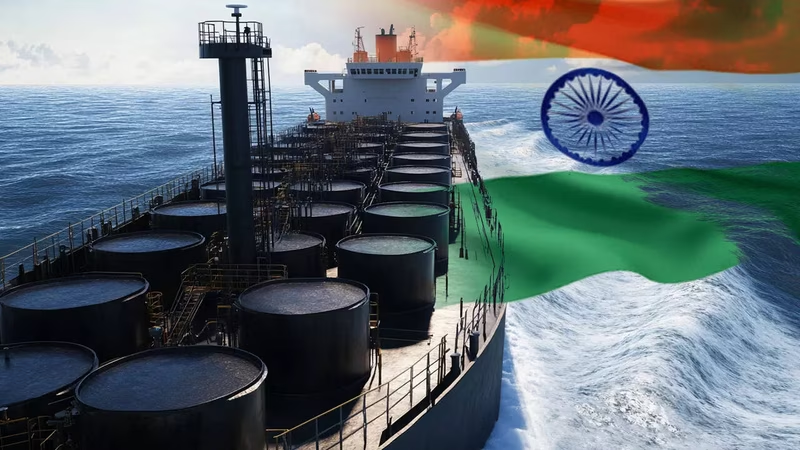
The geopolitical chessboard has shifted dramatically with the news that the United States has struck Venezuela. Headlines are buzzing with speculation about global oil markets, economic chaos, and a new Cold War. For an energy-hungry nation like India, which imports over 85% of its crude, the immediate question on everyone’s mind is: Should we be worried?
According to a recent analysis by the Global Trade Research Initiative (GTRI), the answer is a resounding no. India’s economy and its critical energy security are remarkably insulated from the unfolding crisis. This isn’t just a stroke of luck; it’s the result of a strategic pivot away from Venezuelan oil over the past five years.
Table of Contents
- Why India is Safe from US Strikes on Venezuela
- The Venezuela Oil Connection: A History
- Current Trade Ties: Minimal and Declining
- The Real Risk for India: Global Oil Prices
- GTRI Advises a Strategic Path Forward
- Conclusion: A Stable Outlook for India
- Sources
Why India is Safe from US Strikes on Venezuela
The core reason India remains unscathed is its near-total disengagement from the Venezuelan oil market. The GTRI has been clear: the ongoing crisis in Venezuela is “unlikely to have any material economic or energy impact for India” . This is a direct consequence of US sanctions, which have been in place since 2019 and severely restrict any trade with Venezuela’s state-owned oil company.
Indian refiners, who once saw Venezuela as a source of heavy, sour crude, were forced to find alternatives. This proactive shift has now become India’s shield. While the world frets over the potential disruption of Venezuela’s vast oil reserves, India simply isn’t at the table.
The Venezuela Oil Connection: A History
Just a decade ago, the story was very different. Venezuela, home to the world’s largest proven petroleum reserves, was a significant upstream crude supplier for India . Before the imposition of stringent US sanctions in 2019, Venezuela was a major player in the global oil market, exporting nearly 707 million barrels a year, with a combined 35% going to China and India .
Indian companies, including ONGC Videsh, had even secured stakes in Venezuelan oil fields, looking to secure a long-term, stable source of energy. However, the political and economic collapse of Venezuela, coupled with the US’s aggressive sanctions regime, made this partnership untenable. The relationship has been on life support ever since.
Current Trade Ties: Minimal and Declining
The numbers speak for themselves. Data from GTRI reveals that in the 2024-25 fiscal year, India’s total imports from Venezuela were a mere $364.5 million, of which crude oil accounted for only $255.3 million . To put this in perspective, this is a fraction of India’s daily oil import bill.
This minimal trade is a stark contrast to the pre-2019 era and is a clear indicator of India’s successful diversification strategy. The GTRI noted that India’s oil imports from Venezuela have “fallen steeply since 2019” as a direct result of the sanctions . This strategic retreat has effectively de-risked India’s energy portfolio from Venezuelan volatility.
The Real Risk for India: Global Oil Prices
While direct exposure is nil, India is not entirely immune to the ripple effects. The primary channel of concern is not Venezuelan barrels, but the price of crude on the global market . Any major geopolitical event in an oil-producing nation can spook markets and cause short-term price spikes.
However, experts believe the impact on global oil prices from the current situation will be limited. One analysis suggests that “the impact on oil prices won’t be severe” because the market has already priced in a large degree of instability from Venezuela, Russia, and other regions . Furthermore, the recent seizure of Venezuelan oil tankers by the US did not cause a significant spike in international oil prices, indicating a degree of market resilience .
GTRI Advises a Strategic Path Forward
Despite the current stability, the GTRI is not advising complacency. On the contrary, the think tank is using this moment as a stark reminder of the intense global competition for critical resources. Their core message is one of caution and proactive strategy.
- Diversify Aggressively: India must continue to secure its energy needs from a broad and stable coalition of suppliers, avoiding over-reliance on any single region.
- Explore New Partnerships: The crisis could potentially unlock opportunities. There are reports that the US move might pave the way for India to recover $1 billion in stuck dues and potentially restart its upstream projects with a more stable partner in the future .
- Build Strategic Reserves: This event underscores the importance of a robust strategic petroleum reserve to buffer against any future, unforeseen global shocks.
Conclusion: A Stable Outlook for India
In the grand scheme of the Venezuela crisis, India stands as a quiet observer, not a participant. The strategic decision to walk away from a sanctioned oil source years ago has paid off handsomely. While the world watches the drama unfold, India’s energy security and economic stability remain firmly intact. The key takeaway from the GTRI’s assessment is clear: the immediate threat is negligible, but the long-term lesson is to remain vigilant, diversified, and prepared for an increasingly competitive global landscape. For now, Indian consumers and businesses can breathe easy.
Sources
- Global Trade Research Initiative (GTRI) analysis on Venezuela-India trade, as reported by various news outlets [[9], [13], [14]].
- US Department of the Treasury sanctions information on Venezuela .
- International Energy Agency (IEA) data on global oil market dynamics [[20], [23]].
- [INTERNAL_LINK:global-oil-market-trends]
- [INTERNAL_LINK:india-energy-security-strategy]