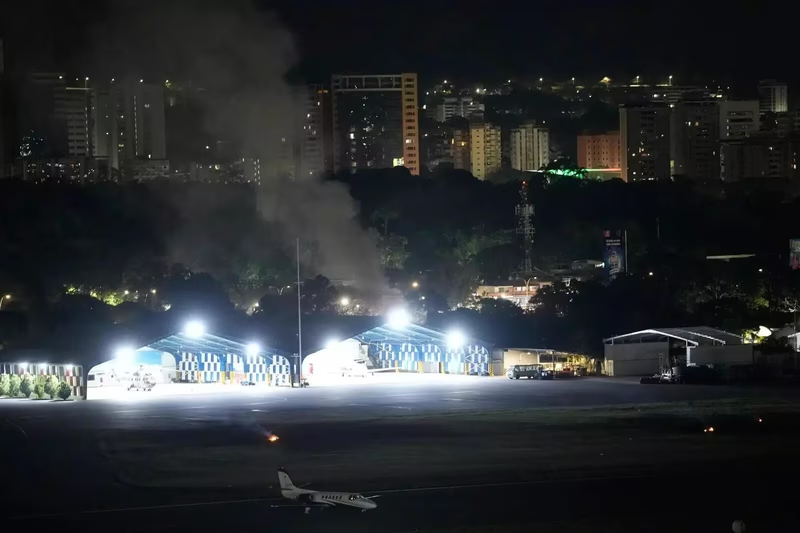
In a dramatic and dangerous escalation of long-simmering hostilities, the United States has launched direct military strikes against Venezuela—a move that has sent shockwaves across Latin America and the globe. Explosions were reported in multiple cities, including Caracas and Maracaibo, prompting scenes of panic and chaos. In response, Venezuelan President Nicolás Maduro has declared a nationwide state of emergency and called for mass civilian mobilization to defend the country . U.S. officials have confirmed that former President Donald Trump personally authorized the strikes on Venezuelan military facilities as part of a broader campaign to dismantle Maduro’s regime, citing recent seizures of U.S.-linked oil tankers and a regional military buildup as justification . This unprecedented turn of events marks one of the most significant direct confrontations between the U.S. and a Latin American nation in decades. The phrase ‘US strikes on Venezuela’ is no longer speculation—it’s a terrifying reality.
Table of Contents
- Confirmed: US Strikes on Venezuela – What Happened?
- Maduro’s Response: State of Emergency and Mass Mobilization
- Why Now? The Catalysts Behind the US Decision
- Regional and Global Reactions to the Escalation
- Historical Context: US-Venezuela Relations at a Breaking Point
- Potential Consequences: A Full-Blown War in the Americas?
- Conclusion: An Unstable New Chapter in Western Hemisphere Politics
- Sources
Confirmed: US Strikes on Venezuela – What Happened?
According to multiple U.S. defense sources, a series of precision airstrikes were conducted by U.S. aircraft early Saturday morning, targeting key Venezuelan military installations, radar stations, and suspected drone launch sites . While the Pentagon has not released a full list of targets, Venezuelan state media reported damage to both military and civilian infrastructure, including a power substation near Caracas that triggered localized blackouts .
The strikes appear to have been coordinated from U.S. naval assets in the Caribbean Sea and possibly from bases in nearby Colombia. The timing—just days after Venezuela impounded two oil tankers carrying U.S.-sanctioned crude—suggests a direct retaliatory motive. The use of military force represents a radical departure from years of economic sanctions and diplomatic isolation.
Maduro’s Response: State of Emergency and Mass Mobilization
Appearing on state television in military fatigues, President Maduro declared a nationwide state of emergency, activating Venezuela’s defense councils and calling on all citizens to prepare for “national resistance” . He labeled the attacks a “cowardly act of imperialist aggression” and vowed that Venezuela would “respond with all its might.”
Under the emergency decree, the government has imposed curfews in major cities, restricted internet access, and deployed the Bolivarian National Guard to strategic locations. Maduro also announced the immediate severing of all remaining diplomatic channels with the United States, effectively closing the door on any near-term de-escalation.
Why Now? The Catalysts Behind the US Decision
The sudden shift to direct military action didn’t happen in a vacuum. Several key developments created the perfect storm:
- Oil Tanker Seizures: Venezuela recently seized two tankers carrying crude oil from fields under U.S. sanctions, a direct challenge to American economic authority .
- Military Buildup: Intelligence reports indicated a significant influx of advanced Russian and Iranian military equipment into Venezuela, including drone systems and anti-aircraft batteries .
- Domestic Pressure: With the 2026 U.S. election cycle heating up, hardline foreign policy actions against adversaries like Maduro can serve as a political rallying point .
Together, these factors convinced U.S. leadership that diplomatic and economic tools had been exhausted, leaving military force as the only remaining option.
Regional and Global Reactions to the Escalation
The international response has been swift and deeply divided. Brazil and Colombia have called for an emergency meeting of the Organization of American States (OAS), urging restraint . Russia and Iran have issued strong condemnations, with Moscow warning of “unpredictable consequences” for U.S. actions. Meanwhile, the European Union has expressed “grave concern” but stopped short of taking sides.
Notably, China has maintained a cautious silence, reflecting its complex economic ties with both nations. The lack of a unified regional stance underscores the deep geopolitical fault lines that the crisis has exposed.
Historical Context: US-Venezuela Relations at a Breaking Point
Hostility between Washington and Caracas dates back to the Hugo Chávez era, but tensions have intensified under Maduro. The U.S. has recognized opposition leader Juan Guaidó as Venezuela’s legitimate president since 2019 and imposed crippling sanctions on the country’s oil sector—its economic lifeline .
Despite these measures, Maduro has clung to power with support from Russia, China, and Cuba. The US strikes on Venezuela represent the ultimate failure of the sanctions-only approach and a dangerous gamble that could either topple the regime or plunge the region into prolonged conflict.
Potential Consequences: A Full-Blown War in the Americas?
The immediate risk is of a spiraling military confrontation. Venezuela could retaliate by targeting U.S. interests in the region, disrupting oil shipments through the Caribbean, or activating its alliances with foreign powers. There’s also the very real danger of a humanitarian catastrophe, as Venezuela’s already fragile infrastructure buckles under attack.
For more on the humanitarian dimension, see our report on [INTERNAL_LINK:venezuela-humanitarian-crisis-2026].
Conclusion: An Unstable New Chapter in Western Hemisphere Politics
The US strikes on Venezuela have irrevocably altered the geopolitical landscape of the Americas. What began as a campaign of economic pressure has now crossed into open warfare. The world now watches anxiously to see whether this act of aggression will achieve its stated goal of regime change—or ignite a regional conflict with devastating human and strategic costs. One thing is certain: the era of indirect pressure on Venezuela is over. The age of direct confrontation has begun.
Sources
- Times of India: Explosions, aircraft, panic: Maduro declares emergency after US strikes…
- Reuters: US carried out airstrikes on Venezuela, officials say
- BBC News: Venezuela crisis: What you need to know
- Council on Foreign Relations: U.S.-Venezuela Relations Timeline
- Organization of American States (OAS) Official Site