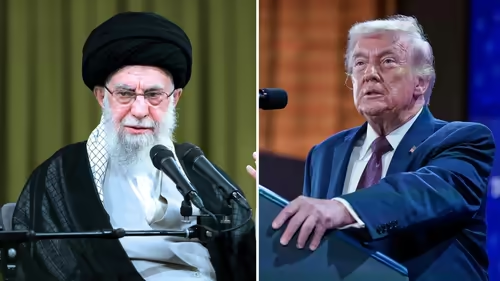
The geopolitical landscape is once again trembling on the edge of a precipice. Fresh reports confirm that the United States is actively considering a significant military escalation against Iran, a move that has prompted a stark and direct threat from Tehran to strike the ‘heart of Tel Aviv’ [[5]]. This dangerous game of brinkmanship, fueled by the collapse of nuclear negotiations and a brutal crackdown on domestic protests, is pushing the region closer to a full-scale conflict than it has been in years.
Table of Contents
- Escalating Tensions: The US Strike Iran Plan
- Tehran’s Chilling Retort: Threat to Hit Tel Aviv
- The Military Backdrop: US Navy Deployment
- The Stalled Diplomacy: Nuclear Talks and Protests
- Conclusion: A Region on the Brink
- Sources
Escalating Tensions: The US Strike Iran Plan
According to multiple sources, the Trump administration is finalizing options for a targeted military operation against Iran’s top brass. The primary objective appears to be twofold: to punish the Iranian regime for its violent suppression of recent nationwide protests and to strategically weaken the government’s hold on power by emboldening the demonstrators [[5]]. These proposed strikes are not aimed at the country’s nuclear infrastructure but rather at specific commanders and institutions directly responsible for the domestic crackdown. President Trump has publicly warned Iran of a “far worse” strike if a new nuclear deal is not reached, signaling a clear intent to use military force as a negotiating lever [[1]].
This potential US strike Iran scenario marks a significant departure from previous strategies, focusing on decapitation-style attacks against the security apparatus rather than broad economic sanctions or cyber warfare. The goal is to create internal chaos within the regime’s command structure, potentially fracturing its ability to respond cohesively.
Tehran’s Chilling Retort: Threat to Hit Tel Aviv
In a direct and unambiguous response, Iranian officials have issued a grave warning. They have stated that any American military action will be met with a devastating counter-strike aimed squarely at the “heart of Tel Aviv” [[7]]. This is not a vague threat against a general region; it is a specific, city-level target that underscores the high stakes involved. By naming Tel Aviv, Iran is deliberately drawing Israel into the conflict, knowing that an attack on the Israeli metropolis would almost certainly trigger a massive Israeli military response.
This strategy serves multiple purposes for Tehran:
- Deterring the US: By raising the specter of a wider regional war involving Israel, Iran hopes to make the cost of a US strike Iran too high for Washington to bear.
- Consolidating Domestic Support: Portraying the nation as under existential threat from foreign powers can rally domestic support behind the regime, even amidst internal unrest.
- Leveraging its Proxy Network: Iran’s extensive network of allies like Hezbollah in Lebanon provides it with the capability to launch such an attack, making the threat credible.
The Military Backdrop: US Navy Deployment
These threats are not occurring in a vacuum. The US has significantly bolstered its military presence in the region, moving the formidable USS Abraham Lincoln Carrier Strike Group into the Middle East as of January 26, 2026 [[18]]. This carrier strike group is a floating airbase, capable of launching a wide array of aircraft for both surveillance and offensive operations, providing the US with a powerful and flexible tool for any potential military action.
The deployment of this naval armada serves as a clear signal of American resolve and provides the necessary logistical backbone for any complex military operation against hardened Iranian targets. It transforms the theoretical threat of a US strike Iran into a tangible and immediate possibility.
The Stalled Diplomacy: Nuclear Talks and Protests
The current crisis is rooted in two interconnected failures of diplomacy. First, the long-running nuclear talks between the US and Iran have completely stalled. President Trump has repeatedly stated that time is running out for Iran to negotiate a new deal that permanently prevents it from developing nuclear weapons [[4]]. Second, the Iranian government’s harsh and violent response to widespread domestic protests in January 2026 has drawn international condemnation and provided the moral and political justification for the US to consider more aggressive action [[3]].
The combination of these factors—the nuclear impasse and the internal repression—has created a perfect storm. The US sees an opportunity to achieve its strategic goals of curbing Iran’s nuclear ambitions and supporting a popular uprising, while Iran feels cornered and is lashing out with its most potent deterrent: the threat of regional war.
Conclusion: A Region on the Brink
The situation is incredibly volatile. The prospect of a US strike Iran on its top military leadership is no longer just speculation but a serious plan under active consideration. Tehran’s retaliatory threat to hit Tel Aviv has raised the stakes to an alarming level, potentially dragging Israel into a direct conflict. With a US carrier strike group positioned in the region and diplomatic channels seemingly closed, the risk of a miscalculation or an unintended escalation leading to a major war is higher than it has been in over a decade. The world watches with bated breath as these two adversaries navigate this perilous standoff. For more on the broader implications of this conflict, see our analysis on [INTERNAL_LINK:middle-east-geopolitics].
Sources
- Times of India: US set to strike Iran’s top brass? Tehran threatens to hit ‘heart of Tel Aviv’ [[5]]
- Bloomberg: Trump Warns Iran to Negotiate as US Warships Enter Region [[4]]
- UK Parliament Library: Iran protests 2026: UK and international response [[3]]
- Times of Israel: Iran threatens to hit ‘heart of Tel Aviv’ in response to any US attack [[7]]
- Xinhua News: USS Abraham Lincoln carrier strike group currently deployed to the Middle East [[18]]
- Iran International: Trump warns of ‘far worse’ strike as US armada heads to Middle East [[1]]