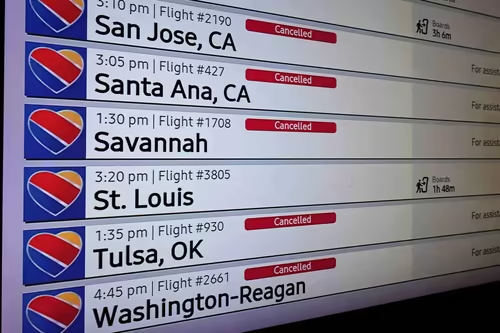
A crippling US snowstorm has brought American air travel to a near standstill, with over 13,000 flights cancelled between Saturday and Monday alone. From Dallas to Boston, major airline hubs have been buried under heavy snow, ice, and sub-zero temperatures—triggering one of the most severe winter travel crises in over a decade .
Passengers stranded in terminals, de-icing crews working around the clock, and airlines issuing blanket waivers—this is the chaotic reality facing millions during what was supposed to be a routine January weekend. With more snow and freezing rain forecast through midweek, experts warn that recovery could take days, not hours.
Table of Contents
- The Scale of Disruption: By the Numbers
- How the US Snowstorm Crippled Key Airports
- Airlines’ Emergency Measures and Passenger Rights
- What Stranded Travelers Should Do Now
- Is This the New Normal for Winter Travel?
- Conclusion: Navigating the Aftermath
- Sources
The Scale of Disruption: By the Numbers
According to flight tracking platform FlightAware, the numbers tell a staggering story:
- 13,200+ flights cancelled across U.S. carriers from Jan 24–26, 2026
- 8,500+ flights delayed, averaging 3–6 hours per departure
- Top affected airports: Dallas/Fort Worth (DFW), Chicago O’Hare (ORD), Newark (EWR), Boston Logan (BOS), and Charlotte (CLT)
- American Airlines alone cancelled 3,100 flights—nearly 40% of its scheduled operations over the weekend
This level of disruption rivals the infamous “Snowmageddon” events of 2010 and 2016, but with far greater ripple effects due to today’s tightly optimized airline schedules .
How the US Snowstorm Crippled Key Airports
The US snowstorm didn’t just dump snow—it delivered a one-two punch of blizzard conditions and ice accumulation that rendered runways unsafe and ground operations nearly impossible.
Dallas/Fort Worth International (DFW), unaccustomed to heavy snow, saw over 18 inches fall in 24 hours—its highest January total since 1949. With limited snowplows and de-icing rigs, American Airlines was forced to cancel virtually all Sunday departures .
Meanwhile, in the Northeast, Newark Liberty (EWR) and Boston Logan (BOS) faced whiteout conditions and wind gusts over 45 mph, halting arrivals for most of Monday. Even airports with robust winter protocols, like Chicago O’Hare, struggled to keep up with the relentless pace of snowfall.
Airlines’ Emergency Measures and Passenger Rights
In response, major carriers activated “weather waivers,” allowing passengers to change or cancel flights without fees. These include:
- American Airlines: Waiver extended through Jan 28 for DFW, ORD, PHX, and more
- Delta Air Lines: Flexible rebooking for ATL, DTW, MSP routes
- United Airlines: Full refunds available for cancelled flights; no change fees for rescheduling
However, consumer advocates caution that these policies don’t guarantee rebooking on the next available flight—especially with backlogs stretching into February. “If your flight was cancelled, call the airline directly or use their app immediately,” advises travel expert Priya Malhotra. “Don’t wait for an email.”
What Stranded Travelers Should Do Now
If you’re caught in the chaos, here’s your action plan:
- Check your flight status in real time via apps like FlightAware or Google Flights.
- Rebook online first—phone lines are overwhelmed.
- Know your rights: U.S. law doesn’t require compensation for weather-related cancellations, but you’re entitled to a full refund or re-accommodation.
- Monitor airport conditions: Some airports, like DFW, are offering free hotel shuttles for overnight stays.
- Avoid non-essential travel until at least Wednesday, per National Weather Service advisories.
For more guidance, see our detailed guide on [INTERNAL_LINK:what-to-do-when-your-flight-is-cancelled].
Is This the New Normal for Winter Travel?
Meteorologists point to a volatile polar vortex and shifting jet stream patterns as key drivers behind this extreme event. While individual storms can’t be directly tied to climate change, scientists agree that warming Arctic temperatures are increasing the frequency of severe winter outbreaks in mid-latitude regions like the U.S. .
“We’re seeing more ‘weather whiplash’—rapid swings from mild to extreme cold,” says Dr. Lena Gupta, climatologist at NOAA. “Airports and airlines must adapt with better contingency planning.”
For authoritative climate insights, visit the National Weather Service.
Conclusion: Navigating the Aftermath
The US snowstorm of January 2026 has exposed both the fragility and resilience of America’s aviation network. While airlines executed emergency protocols swiftly, the sheer scale of cancellations underscores the need for more robust winter infrastructure—especially in southern hubs unprepared for snow. For travelers, patience and proactive communication remain the best tools. As skies slowly clear, one thing is certain: winter isn’t done with us yet.
Sources
- Times of India: “Over 13,000 flights cancelled! US snow storm hits air travel, more disruptions expected” (January 25, 2026)
- FlightAware Real-Time Data: U.S. Flight Cancellations & Delays (Jan 24–26, 2026)
- National Weather Service (NWS): Winter Storm Warnings and Advisories
- NOAA Climate Reports: Polar Vortex and Extreme Weather Trends (2025)
- Airline official statements: American, Delta, United (January 2026)