Table of Contents
- The Great Grounding of January 2026
- Your US Snow Storm Flight Cancellation Rights: The Harsh Truth
- How to Get Rebooked Fast: Airline Waivers Explained
- What About Hotels and Meals? Your Financial Responsibility
- Pro Tips for Navigating the Chaos
- Conclusion: Don’t Wait for a Check, Get Moving
- Sources
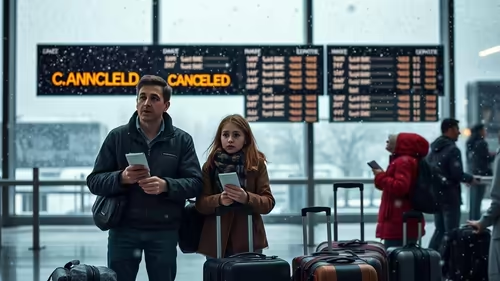
If you’re reading this from a crowded airport terminal, nursing lukewarm coffee and watching your flight status turn from “Delayed” to “Canceled” for the third time, you’re not alone. A monster winter storm—dubbed by some as one of the most disruptive in recent memory—has brought US air travel to its knees. We’re talking over 13,000 canceled flights in just a few days, with major hubs like Chicago O’Hare, New York’s JFK, and Washington Dulles looking more like ghost towns than transportation centers .
This chaos leaves one burning question on every stranded traveler’s mind: “Will my airline pay me for this?” The answer, unfortunately, is a resounding no. Let’s break down exactly what’s happening, what you’re entitled to, and how to get back on your way with minimal pain.
The Great Grounding of January 2026
The numbers are staggering. Data from flight tracking services shows that cancellations exploded from around 4,000 on Friday to a peak of nearly 9,000 on Sunday, January 25th, 2026—the very day this storm is at its most ferocious across the Mid-Atlantic and Northeast [[1], [5]]. This isn’t just an inconvenience; it’s a systemic shutdown affecting hundreds of thousands of passengers.
Airlines, to their credit, saw this coming. They’ve been proactive in issuing travel waivers for weeks, allowing passengers to change their plans without the usual hefty fees. This is a standard industry practice for “acts of God” like hurricanes, blizzards, and volcanic ash clouds. But a waiver is not a refund, and it’s certainly not compensation. It’s simply a lifeline to get you on a different plane when the skies clear.
Your US Snow Storm Flight Cancellation Rights: The Harsh Truth
Let’s be brutally clear: under current US Department of Transportation (DOT) regulations, airlines are not required to provide any compensation for meals, hotel stays, or other incidental expenses when a flight is canceled or delayed due to weather . This is a critical distinction that many travelers misunderstand.
Unlike in the European Union, which has strict EC 261 rules that can sometimes lead to compensation even for weather events (though they are often contested), the US operates under a much more airline-friendly framework . The DOT’s position is straightforward: if the cancellation is outside the airline’s control—which a massive snowstorm definitely is—they owe you a seat on their next available flight or a full refund of your ticket, nothing more .
It’s worth noting that in late 2025, the DOT actually rolled back a proposed rule that would have mandated more automatic compensation for certain delays and cancellations, further cementing the current reality for passengers [[19], [21]]. So, while you might feel entitled to a free hotel night after being stranded, legally, that burden falls squarely on you—or your travel insurance.
How to Get Rebooked Fast: Airline Waivers Explained
While you won’t get cash, you can get a new flight. Every major US carrier—from American and Delta to United and JetBlue—has issued specific travel waivers for this event. These waivers typically cover a window of dates (for this storm, generally January 23-25, 2026) and allow you to rebook your trip for a later date, often within the next week or two, without paying a change fee [[7], [11]].
Here’s your action plan:
- Don’t wait in line. The airline counter will be swamped. Use the airline’s mobile app or website. Go to the “Manage My Trip” section. This is by far the fastest way to secure a new seat .
- Check the waiver details. Each airline has a list of impacted airports and specific rules for the new travel dates. Make sure your itinerary qualifies before you start the process .
- Be flexible. The first flight out is likely full. Look for options on less popular routes or at nearby airports. For example, if you’re stuck in Newark, check flights out of Philadelphia or even Boston.
What About Hotels and Meals? Your Financial Responsibility
This is where things get expensive. If your flight is canceled and you’re left stranded overnight, the cost of a hotel room, dinner, and a cab is yours to bear. Airlines will not reimburse you for these costs during a weather event.
Your best defense here is travel insurance. A comprehensive policy that includes “trip delay” or “interruption” coverage can reimburse you for these unforeseen expenses, often up to a daily limit. If you booked your trip with a premium travel credit card, it’s also worth checking its benefits guide, as many offer trip delay protection as a cardholder perk.
Without insurance, you’re on your own. In this case, your best bet is to be proactive. Call a hotel near the airport yourself before you even leave the terminal. Don’t rely on the airline’s customer service agents to find you a room—they can’t, and they won’t.
Pro Tips for Navigating the Chaos
Beyond the official channels, a little savvy can go a long way:
- Follow airline staff on social media. Sometimes, ground agents or customer service managers will post real-time updates or tips on X (formerly Twitter) that aren’t on the main corporate feed.
- Know your elite status (or lack thereof). If you have frequent flyer status, call the dedicated elite line. They often have more power and flexibility to help you than the general customer service queue.
- Consider alternate transportation. For shorter distances, Amtrak or even a rental car might be a viable, if slower, option to get you to your destination .
Conclusion: Don’t Wait for a Check, Get Moving
A US snow storm flight cancellation is a logistical nightmare, not a financial windfall. The system is designed to get you to your destination eventually, not to compensate you for the hassle. Your energy is best spent not on demanding a hotel voucher that won’t come, but on using the airline’s waiver to secure your next flight and managing your own expenses wisely. In the world of air travel, knowledge is your most valuable piece of carry-on luggage.
Sources
- Flight cancellation statistics from FlightAware and news reports [[1], [5]].
- Airline rebooking waiver policies from official airline websites and news summaries [[7], [11], [14]].
- US Department of Transportation (DOT) rules on passenger compensation [[19], [21], [22]].
- Information on Amtrak service disruptions .