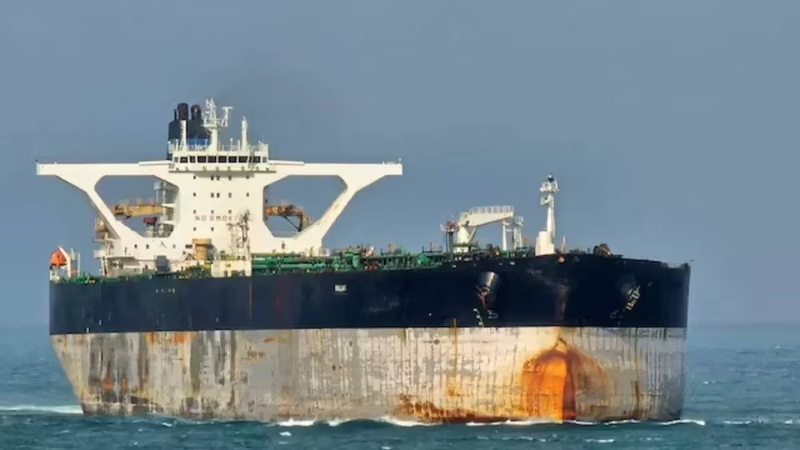
In a scene that could have been ripped from a Cold War thriller, the United States has executed a high-risk, high-stakes seizure of a Russian-flagged oil tanker in international waters. The vessel, allegedly involved in illicit oil shipments from Venezuela, became the target of a coordinated US Coast Guard and military operation that unfolded under the watchful eyes of nearby Russian warships. This event is not just a maritime incident; it’s a potent symbol of the intensifying geopolitical struggle over energy, sanctions, and global influence.
The operation, coming on the heels of a controversial US raid in Caracas, sends a clear and unambiguous message to both Moscow and Caracas: Washington is willing to use its full military and legal might to enforce its sanctions regime, even in the face of direct Russian military presence.
Table of Contents
- The Seizure: A High-Seas Chase and Confrontation
- The Venezuela-Russia Energy Nexus
- The Russian Naval Presence: A Deliberate Show of Force?
- Legal and Diplomatic Implications: Navigating Murky Waters
- A New Front in Geopolitical Tensions
- Final Thoughts: A Precarious Precedent
- Sources
The Seizure: A High-Seas Chase and Confrontation
The US operation was the culmination of a lengthy pursuit of the Russian-flagged oil tanker, which had reportedly evaded previous US boarding attempts. According to official reports, US Coast Guard personnel, backed by Department of Defense assets, finally managed to intercept and board the vessel .
The seizure was executed to enforce long-standing US sanctions against Venezuela’s state-owned oil company, PDVSA, which the US accuses of propping up the Nicolás Maduro regime through illicit oil sales . The fact that this ship was flying a Russian flag adds a significant layer of complexity, as it directly involves a major nuclear power in what the US frames as a law enforcement action.
The Venezuela-Russia Energy Nexus
This incident is just the latest chapter in a deepening strategic partnership between Venezuela and Russia, forged in the crucible of US sanctions. With its own oil industry crippled by decades of mismanagement and US-led economic isolation, Venezuela has become increasingly reliant on Moscow for political backing and technical expertise to maintain its oil exports.
Russia, in turn, sees Venezuela as a crucial foothold in the Western Hemisphere and a way to challenge US dominance in its traditional ‘backyard.’ By providing tankers, shipping services, and even diluents needed to process Venezuela’s heavy crude, Russia has effectively become the lifeline of the Maduro government’s primary source of foreign currency. This Russian-flagged oil tanker was likely a key piece in that logistical puzzle .
The Russian Naval Presence: A Deliberate Show of Force?
The most unnerving aspect of this operation was the confirmed presence of Russian naval vessels, including a submarine and warships, in the vicinity of the seizure . This proximity is highly unlikely to be coincidental. It strongly suggests a deliberate Russian strategy to shadow and protect its commercial and strategic assets in the Caribbean.
For the US, conducting a boarding operation with hostile naval forces watching is an enormous gamble. It risks a direct, unintended military confrontation at sea, a scenario that could spiral out of control with terrifying speed. The presence of the Russian fleet serves as a stark reminder that this is not a simple case of maritime law enforcement but a dangerous game of geopolitical brinkmanship.
Legal and Diplomatic Implications: Navigating Murky Waters
The legality of seizing a foreign-flagged vessel is a complex area of international law. The US justifies its actions under its domestic laws, particularly its authority to enforce sanctions against entities supporting the Maduro regime. However, Russia and its allies will almost certainly condemn the move as an illegal act of piracy and a violation of freedom of navigation.
This seizure will undoubtedly trigger a fierce diplomatic row. Moscow is expected to lodge strong formal protests and may retaliate with its own actions against US interests. The situation highlights the growing tension between the principle of national sovereignty (represented by the ship’s Russian flag) and the US’s assertion of its right to enforce its sanctions globally—a concept known as “extraterritoriality” that is deeply controversial in international relations.
A New Front in Geopolitical Tensions
This incident should be viewed as part of a broader pattern of US-Russia confrontation that extends far beyond the war in Ukraine. The Caribbean, once a primary Cold War battleground, is again becoming a zone of strategic competition. The US raid in Caracas, just days before this seizure, was another aggressive signal of Washington’s intent to destabilize the Maduro government .
By targeting a Russian-flagged asset, the US has effectively drawn Moscow directly into this regional conflict. It’s a calculated risk designed to disrupt the Venezuela-Russia energy pipeline, but it also significantly raises the stakes for both superpowers. The world is now watching to see if this high-seas drama will remain a contained incident or become the spark for a much wider crisis.
For more on the history of US sanctions and their global impact, see our analysis on [INTERNAL_LINK:impact-of-us-sanctions-on-global-trade].
Final Thoughts: A Precarious Precedent
The US seizure of this Russian-flagged oil tanker is a bold and dangerous move that underscores the high-stakes nature of modern geopolitical conflict. It demonstrates Washington’s unwavering commitment to its Venezuela policy but also reveals the immense risks involved when great-power competition spills into the maritime domain. With Russian warships as silent witnesses, this operation has set a precarious precedent that could have far-reaching consequences for international law, freedom of navigation, and the already fragile state of US-Russia relations.
Sources
The US Coast Guard and military attempted to seize a Russian-flagged oil tanker after a lengthy pursuit.
Russian submarine and warships were reported to be in the vicinity of the operation.
The operation targeted a vessel linked to Venezuela’s state oil company, PDVSA, to enforce US sanctions.
Russia has been a key partner for Venezuela in circumventing US oil sanctions.
The oil tanker seizure occurred shortly after a US raid in Caracas, escalating tensions in the region.
Original Reporting: US seizes Russia-flagged ship: Oil tanker linked to Venezuela; Moscow warship nearby.